







Question: 6. An object with mass m is released from rest on a ramp of negligible friction with an angle of inclination 61 from a height
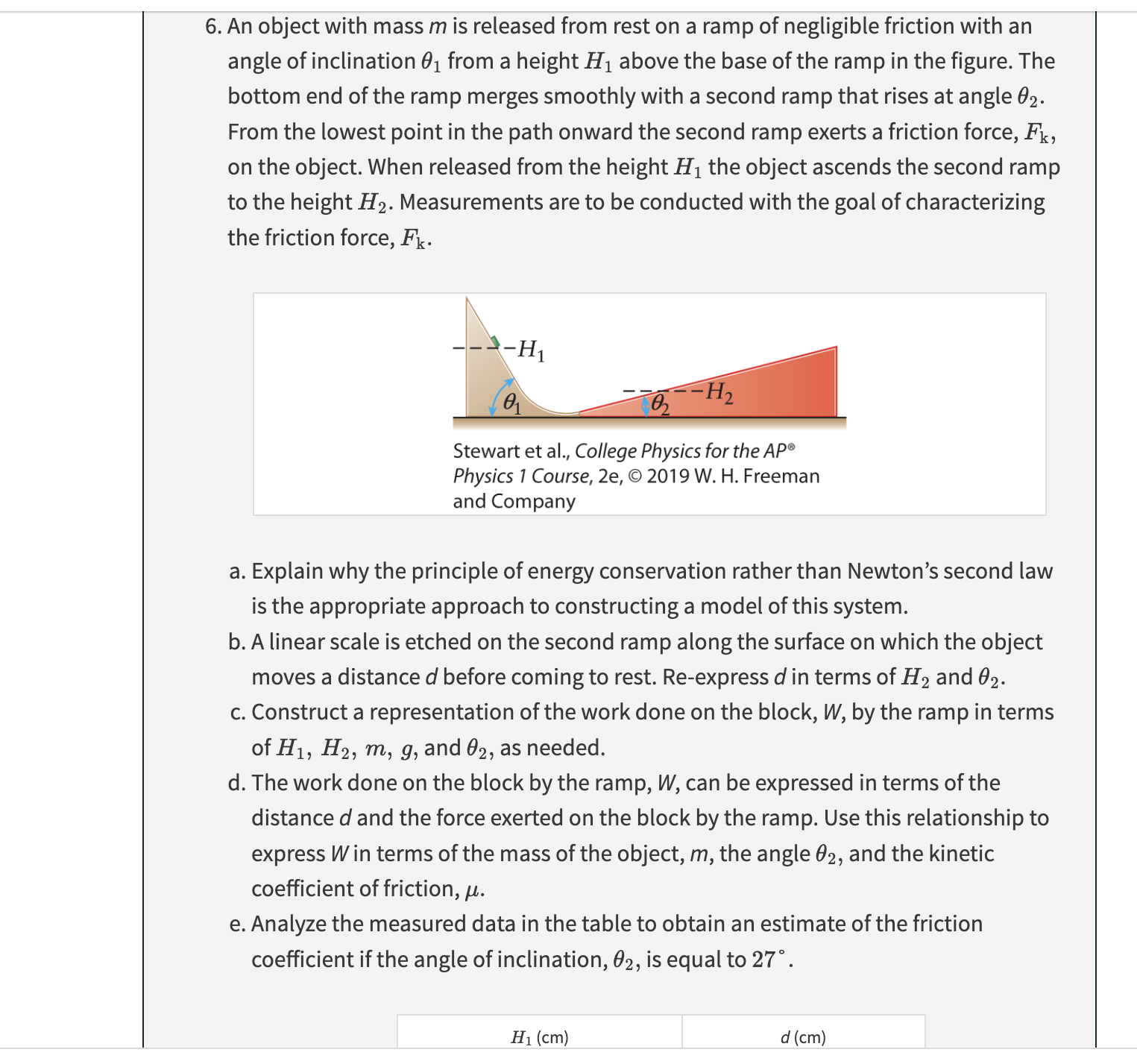
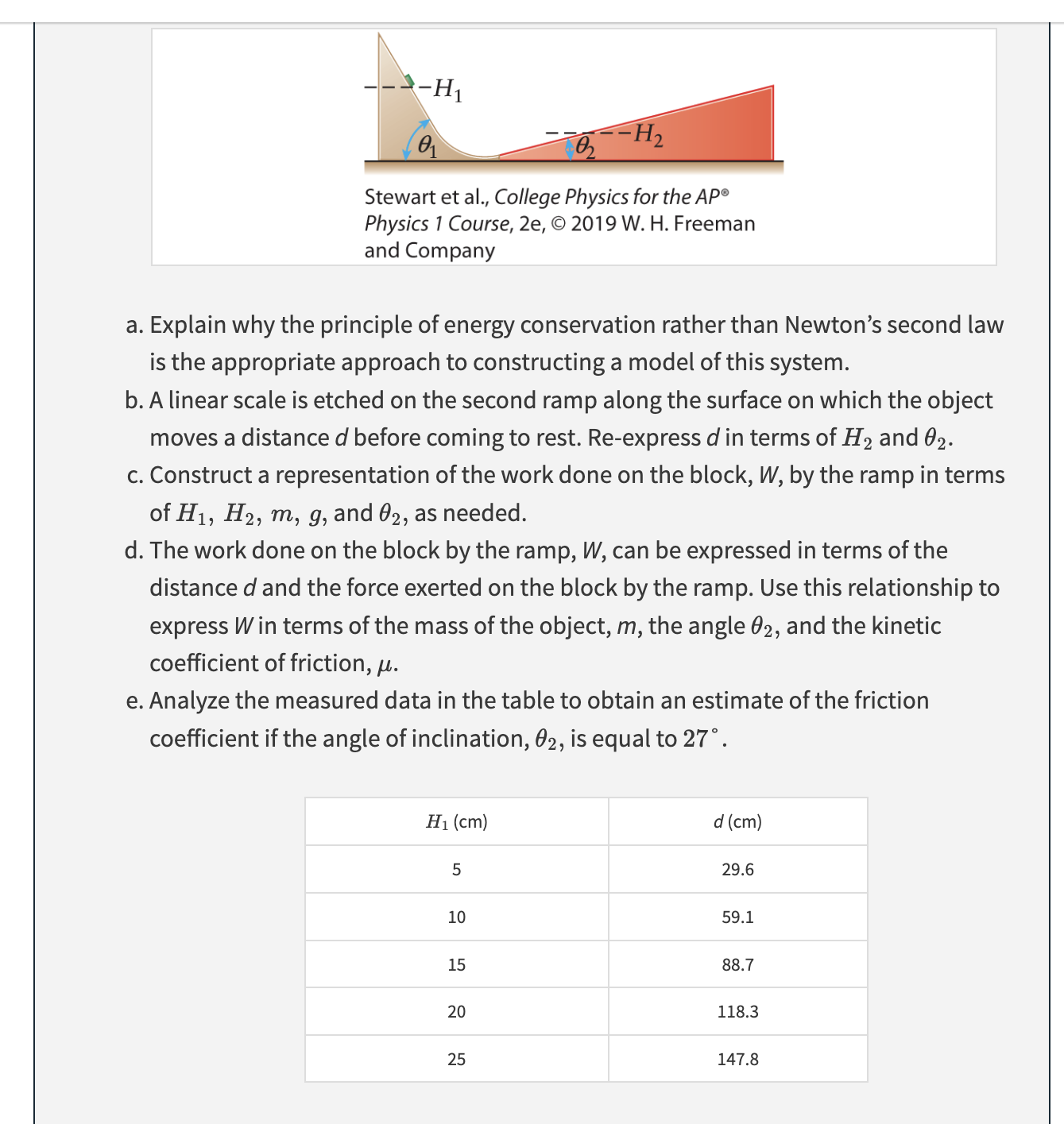
6. An object with mass m is released from rest on a ramp of negligible friction with an angle of inclination 61 from a height H1 above the base of the ramp in the figure. The bottom end of the ramp merges smoothly with a second ramp that rises at angle 62. From the lowest point in the path onward the second ramp exerts a friction force, Fk, on the object. When released from the height H1 the object ascends the second ramp to the height H2. Measurements are to be conducted with the goal of characterizing the friction force, Fk. Stewart et al., College Physics for the APE Physics 1 Course, 2e, 2019 W. H. Freeman and Company a. Explain why the principle of energy conservation rather than Newton's second law is the appropriate approach to constructing a model of this system. b. A linear scale is etched on the second ramp along the surface on which the object moves a distance d before coming to rest. Reexpress din terms of H2 and 62. c. Construct a representation of the work done on the block, W, by the ramp in terms of H1, H2, m, g, and 92, as needed. d. The work done on the block by the ramp, W, can be expressed in terms of the distance d and the force exerted on the block by the ramp. Use this relationship to express Win terms of the mass ofthe object, m, the angle 92, and the kinetic coefcient of friction, ,u. e. Analyze the measured data in the table to obtain an estimate of the friction coefcient ifthe angle of inclination, 92, is equal to 27. H1 (cm) 0' (cm) - H1 - -H2 Stewart et al., College Physics for the Ape Physics 1 Course, 2e, @ 2019 W. H. Freeman and Company a. Explain why the principle of energy conservation rather than Newton's second law is the appropriate approach to constructing a model of this system. b. A linear scale is etched on the second ramp along the surface on which the object moves a distance d before coming to rest. Re-express d in terms of H2 and 02. c. Construct a representation of the work done on the block, W, by the ramp in terms of H1, H2, m, g, and 02, as needed. d. The work done on the block by the ramp, W, can be expressed in terms of the distance d and the force exerted on the block by the ramp. Use this relationship to express W in terms of the mass of the object, m, the angle 02, and the kinetic coefficient of friction, M. e. Analyze the measured data in the table to obtain an estimate of the friction coefficient if the angle of inclination, 02, is equal to 27 . H1 (cm) d (cm) 5 29.6 10 59.1 15 88.7 20 118.3 25 147.8
Step by Step Solution
There are 3 Steps involved in it

Get step-by-step solutions from verified subject matter experts
 Study Help