







Question: 6. Calculating a beta coefficient for a single stock Suppose that the standard deviation of returns for a single stock A is = 30%, and
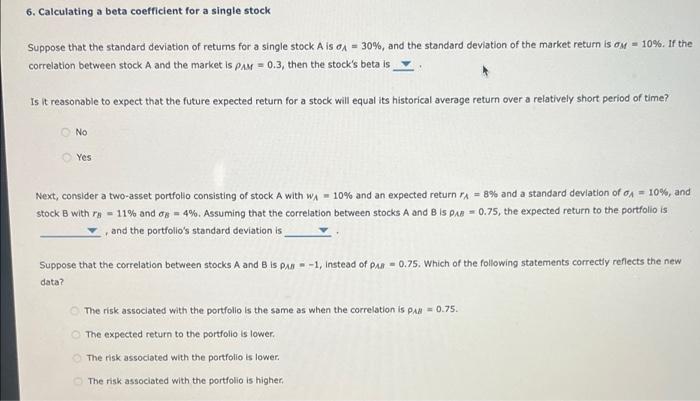
6. Calculating a beta coefficient for a single stock Suppose that the standard deviation of returns for a single stock A is = 30%, and the standard deviation of the market return is M = 10%. If the correlation between stock A and the market is PAM = 0.3, then the stock's beta is Is it reasonable to expect that the future expected return for a stock will equal its historical average return over a relatively short period of time? No Yes Next, consider a two-asset portfolio consisting of stock A with WA = 10 % and an expected return A = 8% and a standard deviation of A= 10%, and stock B with r 11% and og = 4%. Assuming that the correlation between stocks A and B is PAB 0.75, the expected return to the portfolio is , and the portfolio's standard deviation is Suppose that the correlation between stocks A and B is PAB -1, instead of PAR 0.75. Which of the following statements correctly reflects the new data? The risk associated with the portfolio is the same as when the correlation is PAR = 0.75. The expected return to the portfolio is lower. The risk associated with the portfolio is lower. The risk associated with the portfolio is higher
Step by Step Solution
There are 3 Steps involved in it

Get step-by-step solutions from verified subject matter experts
 Study Help