







Question: 6. Consider two Nash Bargaining Problems, each with two decision makers denoted by subscripts 1 and 2. In both, the status quo point is (1,1).
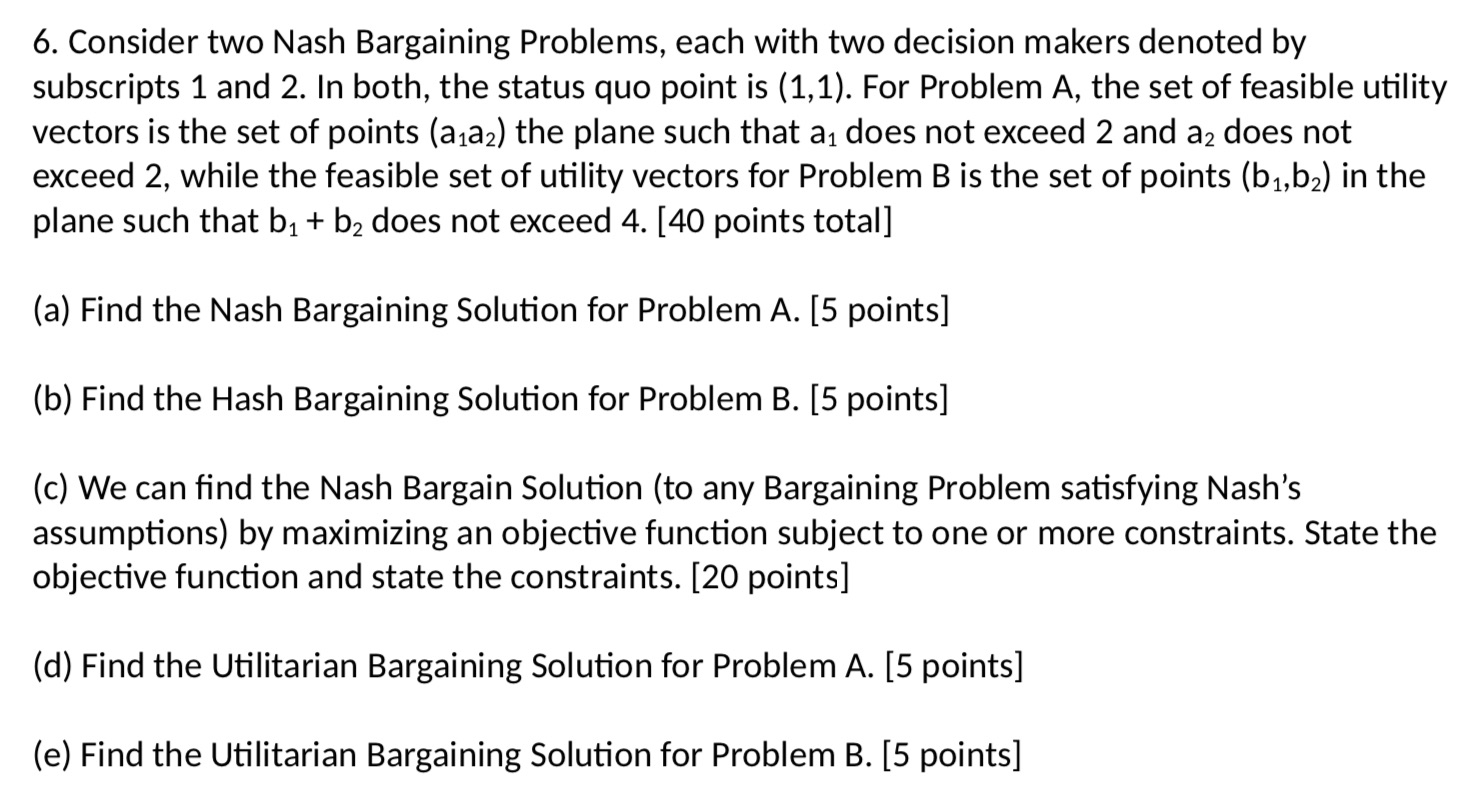
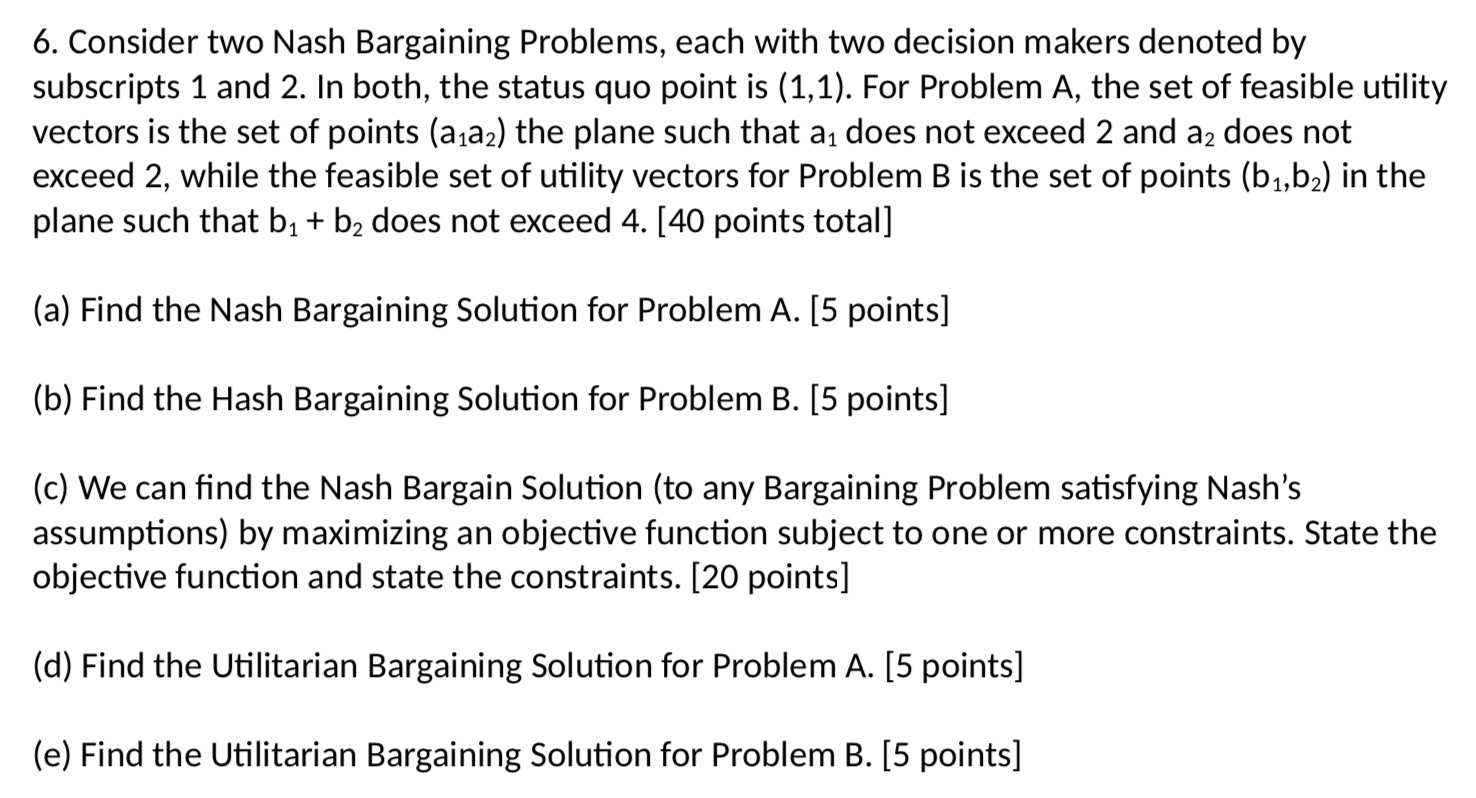
6. Consider two Nash Bargaining Problems, each with two decision makers denoted by subscripts 1 and 2. In both, the status quo point is (1,1). For Problem A, the set of feasible utility vectors is the set of points (a1a2) the plane such that al does not exceed 2 and a: does not exceed 2, while the feasible set of utility vectors for Problem B is the set of points (b1,b2) in the plane such that b1 + b; does not exceed 4. [40 points total] (a) Find the Nash Bargaining Solution for Problem A. [5 points] (b) Find the Hash Bargaining Solution for Problem B. [5 points] (c) We can find the Nash Bargain Solution (to any Bargaining Problem satisfying Nash's assumptions) by maximizing an objective function subject to one or more constraints. State the objective function and state the constraints. [20 points] (d) Find the Utilitarian Bargaining Solution for Problem A. [5 points] (e) Find the Utilitarian Bargaining Solution for Problem B. [5 points]
Step by Step Solution
There are 3 Steps involved in it

Get step-by-step solutions from verified subject matter experts
 Study Help