







Question: The first page is the reading section that I need to answer from the questions of What is your advice that comes after. All the
The first page is the reading section that I need to answer from the questions of What is your advice that comes after. All the pages are in orders first the reading then the questions. 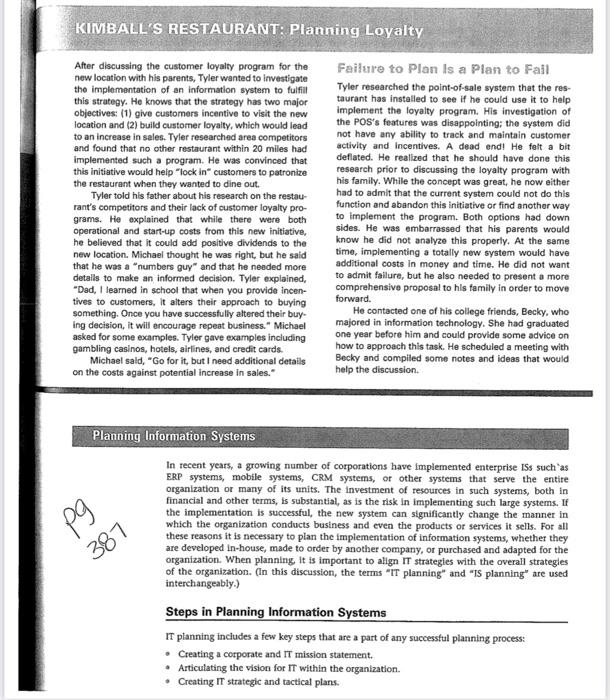
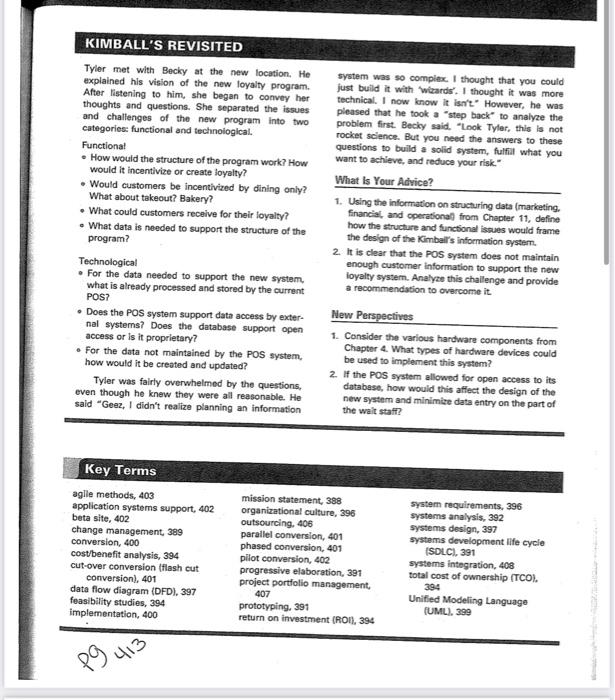
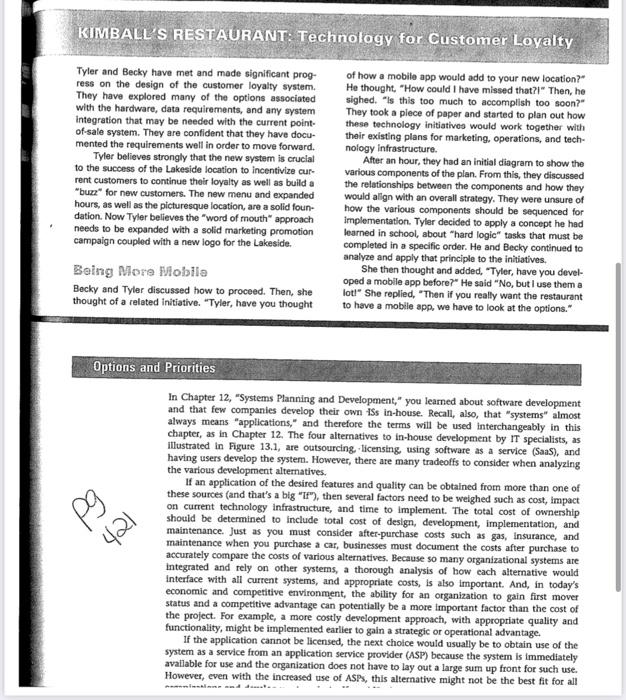
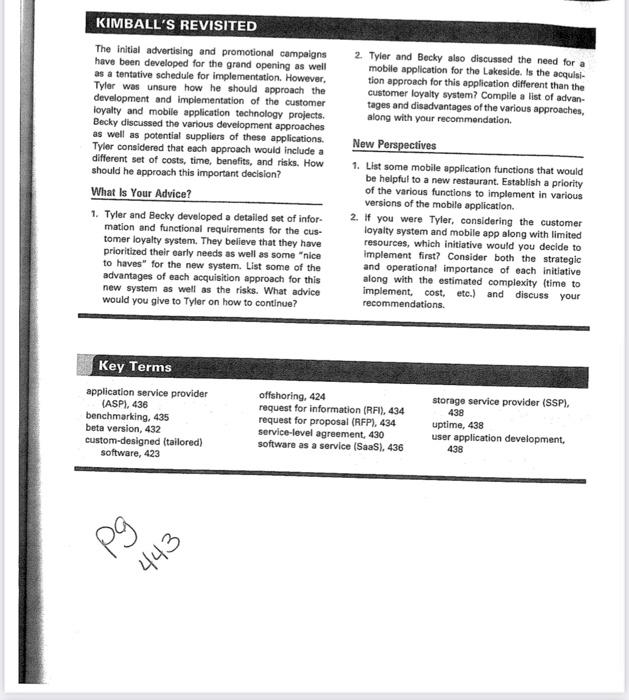
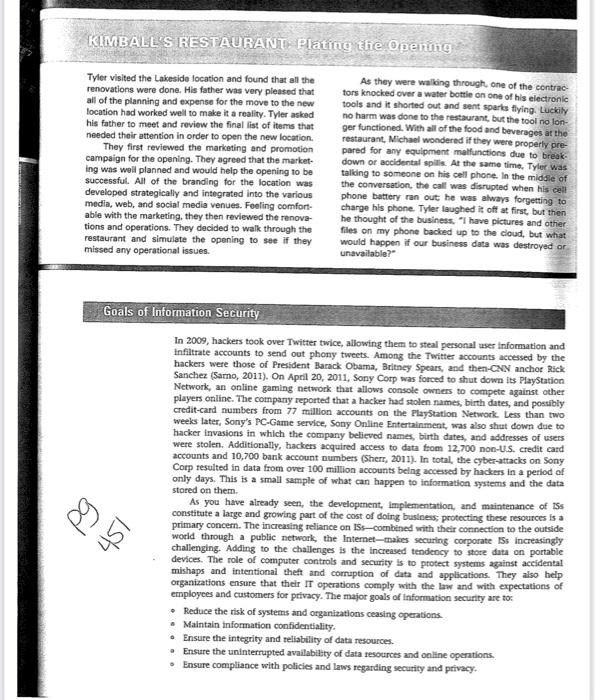
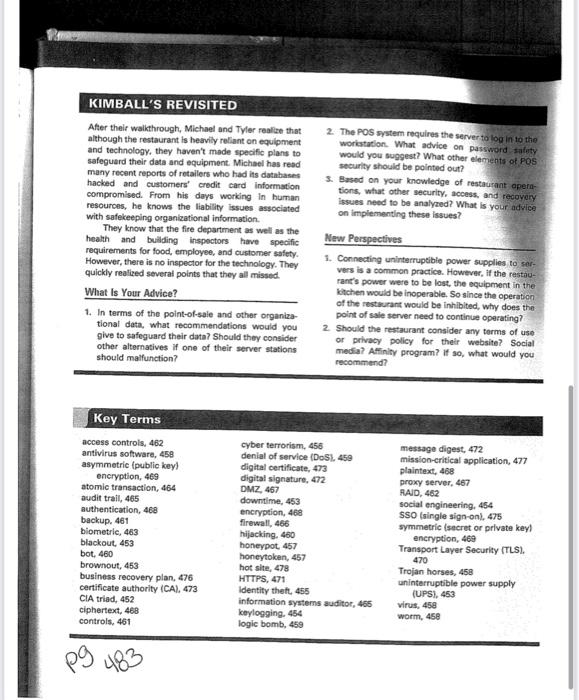
KIMBALL'S RESTAURANT: Planning Loyalty After discussing the customer loyalty program for the new location with his parents, Tyler wanted to investigate the implementation of an information system to fulfill this strategy. He knows that the strategy has two major objectives: (1) give customers incentive to visit the new location and (2) build customer loyalty, which would lead to an increase in sales. Tyler researched area competitors and found that no other restaurant within 20 miles had implemented such a program. He was convinced that this initiative would help "lock in" customers to patronize the restaurant when they wanted to dine out. Tyler told his father about his research on the restau- rant's competitors and their lack of customer loyalty pro- grams. He explained that while there were both operational and start-up costs from this new initiative, he believed that it could add positive dividends to the new location. Michael thought he was right, but he said that he was a "numbers guy" and that he needed more detalls to make an informed decision. Tyler explained, "Dad, I learned in school that when you provide incen- tives to customers, it alters their approach to buying something. Once you have successfully altered their buy- ing decision, it will encourage repeat business." Michael asked for some examples. Tyler gave examples including gambling casinos, hotels, airlines, and credit cards. Michael said, "Go for it, but I need additional details on the costs against potential increase in sales." Planning Information Systems pg 387 Failure to Plan Is a Plan to Fail Tyler researched the point-of-sale system that the res- taurant has installed to see if he could use it to help implement the loyalty program. His investigation of the POS's features was disappointing; the system did not have any ability to track and maintain customer activity and Incentives. A dead end! He felt a bit deflated. He realized that he should have done this research prior to discussing the loyalty program with his family. While the concept was great, he now either had to admit that the current system could not do this function and abandon this initiative or find another way to implement the program. Both options had down sides. He was embarrassed that his parents would know he did not analyze this properly. At the same time, implementing a totally new system would have additional costs in money and time. He did not want to admit failure, but he also needed to present a more comprehensive proposal to his family in order to move forward. He contacted one of his college friends, Becky, who majored in information technology. She had graduated one year before him and could provide some advice on how to approach this task. He scheduled a meeting with Becky and compiled some notes and ideas that would help the discussion. In recent years, a growing number of corporations have implemented enterprise ISs such as ERP systems, mobile systems, CRM systems, or other systems that serve the entire. organization or many of its units. The investment of resources in such systems, both in financial and other terms, is substantial, as is the risk in implementing such large systems. If the implementation is successful, the new system can significantly change the manner in which the organization conducts business and even the products or services it sells. For all these reasons it is necessary to plan the implementation of information systems, whether they are developed in-house, made to order by another company, or purchased and adapted for the organization. When planning, it is important to align IT strategles with the overall strategies of the organization. (In this discussion, the terms "IT planning" and "IS planning" are used interchangeably.) Steps in Planning Information Systems IT planning includes a few key steps that are a part of any successful planning process: Creating a corporate and IT mission statement. Articulating the vision for IT within the organization. Creating IT strategic and tactical plans. KIMBALL'S REVISITED Tyler met with Becky at the new location. He explained his vision of the new loyalty program. After listening to him, she began to convey her thoughts and questions. She separated the issues and challenges of the new program into two categories: functional and technological. Functional How would the structure of the program work? How would it incentivize or create loyalty? . Would customers be incentivized by dining only? What about takeout? Bakery? What could customers receive for their loyalty? What data is needed to support the structure of the program? Technological For the data needed to support the new system, what is already processed and stored by the current POS? . Does the POS system support data access by exter- Inal systems? Does the database support open access or is it proprietary? For the data not maintained by the POS system, how would it be created and updated? Tyler was fairly overwhelmed by the questions, even though he knew they were all reasonable. He said "Geez, I didn't realize planning an information Key Terms agile methods, 403 application systems support, 402 beta site, 402 change management, 389 conversion, 400 cost/benefit analysis, 394 cut-over conversion (flash cut conversion), 401 data flow diagram (DFD), 397 feasibility studies, 394 implementation, 400 413 . system was so complex. I thought that you could just build it with wizards. I thought it was more technical. I now know it isn't" However, he was pleased that he took a "step back to analyze the problem first. Becky said. "Look Tyler, this is not rocket science. But you need the answers to these questions to build a solid system, fulfill what you want to achieve, and reduce your risk." What Is Your Advice? 1. Using the information on structuring data (marketing. financial, and operational from Chapter 11, define how the structure and functional issues would frame the design of the Kimball's information system. 2. It is clear that the POS system does not maintain enough customer information to support the new loyalty system. Analyze this challenge and provide a recommendation to overcome it. New Perspectives 1. Consider the various hardware components from Chapter 4. What types of hardware devices could be used to implement this system? 2. If the POS system allowed for open access to its database, how would this affect the design of the new system and minimize data entry on the part of the wait staff? mission statement, 388 organizational culture, 396 outsourcing, 406 parallel conversion, 401 phased conversion, 401 pilot conversion, 402 progressive elaboration, 391 project portfolio management, 407 prototyping, 391 return on investment (ROI), 394 system requirements, 396 systems analysis, 392 systems design, 397 systems development life cycle (SDLC), 391 systems integration, 408 total cost of ownership (TCO), 394 Unified Modeling Language (UML), 399 KIMBALL'S RESTAURANT: Technology for Customer Loyalty Tyler and Becky have met and made significant prog- ress on the design of the customer loyalty system. They have explored many of the options associated with the hardware, data requirements, and any system integration that may be needed with the current point- of-sale system. They are confident that they have docu- mented the requirements well in order to move forward. of how a mobile app would add to your new location?" He thought, "How could I have missed that?!" Then, he sighed. "Is this too much to accomplish too soon?" They took a piece of paper and started to plan out how these technology initiatives would work together with their existing plans for marketing, operations, and tech- nology infrastructure. Tyler believes strongly that the new system is crucial to the success of the Lakeside location to Incentivize cur- rent customers to continue their loyalty as well as build a "buzz" for new customers. The new menu and expanded hours, as well as the picturesque location, are a solid foun- dation. Now Tyler believes the "word of mouth" approach needs to be expanded with a solid marketing promotion campaign coupled with a new logo for the Lakeside. Being More Mobila Becky and Tyler discussed how to proceed. Then, she thought of a related initiative. "Tyler, have you thought Options and Priorities pg reh After an hour, they had an initial diagram to show the various components of the plan. From this, they discussed the relationships between the components and how they would align with an overall strategy. They were unsure of how the various components should be sequenced for Implementation. Tyler decided to apply a concept he had learned in school, about "hard logic" tasks that must be completed in a specific order. He and Becky continued to analyze and apply that principle to the initiatives. She then thought and added, "Tyler, have you devel- oped a mobile app before?" He said "No, but I use them a lot! She replied, "Then if you really want the restaurant to have a mobile app, we have to look at the options." In Chapter 12, "Systems Planning and Development," you learned about software development and that few companies develop their own ISs in-house. Recall, also, that "systems" almost always means "applications," and therefore the terms will be used interchangeably in this chapter, as in Chapter 12. The four alternatives to in-house development by IT specialists, as illustrated in Figure 13.1, are outsourcing, licensing, using software as a service (SaaS), and having users develop the system. However, there are many tradeoffs to consider when analyzing the various development alternatives. If an application of the desired features and quality can be obtained from more than one of these sources (and that's a big "If"), then several factors need to be weighed such as cost, impact on current technology infrastructure, and time to implement. The total cost of ownership should be determined to include total cost of design, development, implementation, and maintenance. Just as you must consider after-purchase costs such as gas, insurance, and maintenance when you purchase a car, businesses must document the costs after purchase to accurately compare the costs of various alternatives. Because so many organizational systems are integrated and rely on other systems, a thorough analysis of how each alternative would interface with all current systems, and appropriate costs, is also important. And, in today's economic and competitive environment, the ability for an organization to gain first mover status and a competitive advantage can potentially be a more important factor than the cost of the project. For example, a more costly development approach, with appropriate quality and functionality, might be implemented earlier to gain a strategic or operational advantage. If the application cannot be licensed, the next choice would usually be to obtain use of the system as a service from an application service provider (ASP) because the system is immediately available for use and the organization does not have to lay out a large sum up front for such use. However, even with the increased use of ASPS, this alternative might not be the best fit for all KIMBALL'S REVISITED The initial advertising and promotional campaigns have been developed for the grand opening as well as a tentative schedule for implementation. However, Tyler was unsure how he should approach the development and implementation of the customer loyalty and mobile application technology projects. Becky discussed the various development approaches as well as potential suppliers of these applications. Tyler considered that each approach would include a different set of costs, time, benefits, and risks. How should he approach this important decision? What Is Your Advice? 1. Tyler and Becky developed a detailed set of infor- mation and functional requirements for the cus- tomer loyalty system. They believe that they have prioritized their early needs as well as some "nice to haves" for the new system. List some of the advantages of each acquisition approach for this new system as well as the risks. What advice would you give to Tyler on how to continue? Key Terms application service provider (ASP), 436 benchmarking, 435 beta version, 432 custom-designed (tailored) software, 423 Pg 443 2. Tyler and Becky also discussed the need for a mobile application for the Lakeside. Is the acquisi- tion approach for this application different than the customer loyalty system? Compile a list of advan- tages and disadvantages of the various approaches, along with your recommendation. New Perspectives 1. List some mobile application functions that would be helpful to a new restaurant. Establish a priority of the various functions to implement in various versions of the mobile application. 2. If you were Tyler, considering the customer loyalty system and mobile app along with limited resources, which initiative would you decide to implement first? Consider both the strategic and operational importance of each initiative along with the estimated complexity (time to implement, cost, etc.) and discuss your recommendations. offshoring, 424 request for information (RFI), 434 request for proposal (RFP), 434 service-level agreement, 430 software as a service (SaaS), 436 storage service provider (SSP), 438 uptime, 438 user application development, 438 KIMBALL'S RESTAURANT Plating the Opening Tyler visited the Lakeside location and found that all the renovations were done. His father was very pleased that all of the planning and expense for the move to the new location had worked well to make it a reality. Tyler asked his father to meet and review the final list of items that needed their attention in order to open the new location. They first reviewed the marketing and promotion campaign for the opening. They agreed that the market- ing was well planned and would help the opening to be successful. All of the branding for the location was developed strategically and integrated into the various media, web, and social media venues. Feeling comfort- able with the marketing, they then reviewed the renova- tions and operations. They decided to walk through the restaurant and simulate the opening to see if they missed any operational issues. Goals of Information Security 6d Ish As they were walking through, one of the contrac tors knocked over a water bottle on one of his electronic tools and it shorted out and sent sparks flying. Luckily no harm was done to the restaurant, but the tool no lon- ger functioned. With all of the food and beverages at the restaurant, Michael wondered if they were properly pre- pared for any equipment malfunctions due to break- down or accidental spills. At the same time, Tyler was talking to someone on his cell phone. In the middle of the conversation, the call was disrupted when his cell phone battery ran out he was always forgetting to charge his phone. Tyler laughed it off at first, but then he thought of the business, "I have pictures and other files on my phone backed up to the cloud, but what would happen if our business data was destroyed or unavailable?" In 2009, hackers took over Twitter twice, allowing them to steal personal user information and infiltrate accounts to send out phony tweets. Among the Twitter accounts accessed by the hackers were those of President Barack Obama, Britney Spears, and then-CNN anchor Rick Sanchez (Sarno, 2011). On April 20, 2011, Sony Corp was forced to shut down its PlayStation Network, an online gaming network that allows console owners to compete against other players online. The company reported that a hacker had stolen names, birth dates, and possibly credit card numbers from 77 million accounts on the PlayStation Network. Less than two weeks later, Sony's PC-Game service, Sony Online Entertainment, was also shut down due to hacker Invasions in which the company believed names, birth addresses of users were stolen. Additionally, hackers acquired access to data from 12,700 non-U.S. credit card accounts and 10,700 bank account numbers (Sherr, 2011). In total, the cyber-attacks on Sony Corp resulted in data from over 100 million accounts being accessed by hackers in a period of only days. This is a small sample of what can happen to information systems and the data stored on them. As you have already seen, the development, implementation, and maintenance of 15 constitute a large and growing part of the cost of doing business; protecting these resources is a primary concern. The increasing reliance on ISs-combined with their connection to the outside world through a public network, the Internet-makes securing corporate ISs increasingly challenging. Adding to the challenges is the increased tendency to store data on portable devices. The role of computer controls and security is to protect systems against accidental mishaps and intentional theft and corruption of data and applications. They also help organizations ensure that their IT operations comply with the law and with expectations of employees and customers for privacy. The major goals of Information security are to: Reduce the risk of systems and organizations ceasing operations. Maintain information confidentiality. Ensure the integrity and reliability of data resources. Ensure the uninterrupted availability of data resources and online operations. Ensure compliance with policies and laws regarding security and privacy. KIMBALL'S REVISITED After their walkthrough, Michael and Tyler realize that although the restaurant is heavily reliant on equipment and technology, they haven't made specific plans to safeguard their data and equipment. Michael has read many recent reports of retailers who had its databases hacked and customers' credit card information compromised. From his days working In human resources, he knows the liability issues associated with safekeeping organizational information. They know that the fire department as well as the health and building inspectors have specific requirements for food, employee, and customer safety. However, there is no inspector for the technology. They quickly realized several points that they all missed. What Is Your Advice? 1. In terms of the point-of-sale and other organiza- tional data, what recommendations would you give to safeguard their data? Should they consider other alternatives if one of their server stations should malfunction? Key Terms access controls, 462 antivirus software, 458 asymmetric (public key) encryption, 469 atomic transaction, 464 audit trail, 465 authentication, 468 backup, 461 biometric, 463 blackout, 453 bot, 460 brownout, 453 business recovery plan, 476 certificate authority (CA), 473 CIA triad, 452 ciphertext, 468 controls, 461 pg 483 downtime, 453 encryption, 468 2. The POS system requires the server to log in to the workstation. What advice on password, safety would you suggest? What other elements of POS security should be pointed out? firewall, 466 hijacking, 460 honeypot, 457 honeytoken, 457 hot site, 478 HTTPS, 471 identity theft, 455 3. Based on your knowledge of restaurant opers- tions, what other security, access, and recovery issues need to be analyzed? What is your advice on implementing these issues? New Perspectives 1. Connecting uninterruptible power supplies to ser- vers is a common practice. However, if the restau- rant's power were to be lost, the equipment in the kitchen would be inoperable. So since the operation of the restaurant would be inhibited, why does the point of sale server need to continue operating? cyber terrorism, 456 denial of service (DoS), 459 digital certificate, 473 digital signature, 472 DMZ, 467 2. Should the restaurant consider any terms of use or privacy policy for their website? Social media? Affinity program? If so, what would you recommend? information systems auditor, 465 keylogging, 454 logic bomb, 459 message digest, 472 mission-critical application, 477 plaintext, 468 proxy server, 467 RAID, 462 social engineering, 454 SSO (single sign-on), 475 symmetric (secret or private key) encryption, 469 Transport Layer Security (TLS), 470 Trojan horses, 458 uninterruptible power supply (UPS), 453 virus, 458 worm, 458 Step by Step Solution
There are 3 Steps involved in it
1 Expert Approved Answer
Step: 1 Unlock

Question Has Been Solved by an Expert!
Get step-by-step solutions from verified subject matter experts
Step: 2 Unlock
Step: 3 Unlock
 Study Help