







Question: 6. Let L1 and L2 be two languages. (a) Define the exclusive-or (XOR) operation as Li2 = {xl either z E L1 or x La
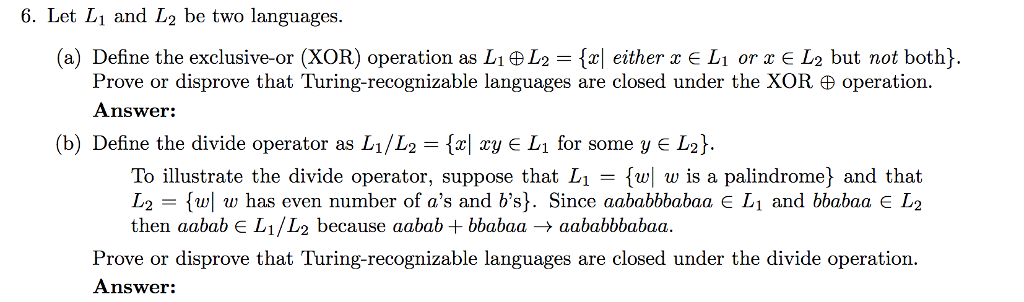
6. Let L1 and L2 be two languages. (a) Define the exclusive-or (XOR) operation as Li2 = {xl either z E L1 or x La but not both} Prove or disprove that Turing-recognizable languages are closed under the XOR operation. Answer: (b) Define the divide operator as Li/L2 (x zy E L1 for some y E L2). To illustrate the divide operator, suppose that Lw w is a palindrome and that L2ww has even number of a's and b's). Since aababbbabaa E L1 and bbabaa E L2 then aabab E L1/L2 because aabab + bbabaa - aababbbabaa Prove or disprove that Turing-recognizable languages are closed under the divide operation. Answer: 6. Let L1 and L2 be two languages. (a) Define the exclusive-or (XOR) operation as Li2 = {xl either z E L1 or x La but not both} Prove or disprove that Turing-recognizable languages are closed under the XOR operation. Answer: (b) Define the divide operator as Li/L2 (x zy E L1 for some y E L2). To illustrate the divide operator, suppose that Lw w is a palindrome and that L2ww has even number of a's and b's). Since aababbbabaa E L1 and bbabaa E L2 then aabab E L1/L2 because aabab + bbabaa - aababbbabaa Prove or disprove that Turing-recognizable languages are closed under the divide operation
Step by Step Solution
There are 3 Steps involved in it

Get step-by-step solutions from verified subject matter experts
 Study Help