







Question: 6. Let's think about optimization Optimization itself is a really powerful tool, but the underlying ideas are not always easy to understand! Pretend like you're
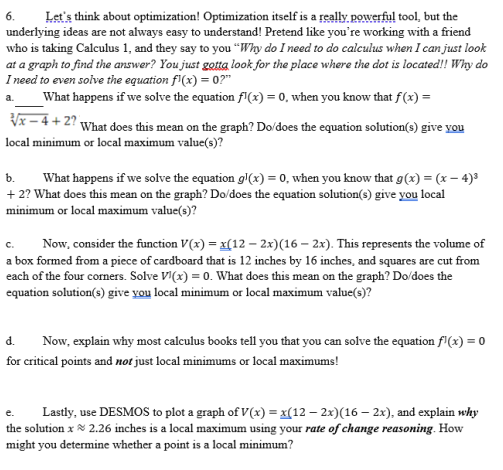
6. Let's think about optimization Optimization itself is a really powerful tool, but the underlying ideas are not always easy to understand! Pretend like you're working with a friend who is taking Calculus 1, and they say to you Why do I need to do calculus when I can just look at a graph to find the answer? You just gotta look for the place where the dot is located!! Why do I need to even solve the equation f(x) = 0.2" What happens if we solve the equation f'(x) = 0, when you know that f(x) = Vx 4 + 2? What does this mean on the graph? Do does the equation solution(s) give you local minimum or local maximum value(s)? b. What happens if we solve the equation g'(x) = 0, when you know that g(x) = (x - 4) + 2? What does this mean on the graph? Do does the equation solution(s) give you local minimum or local maximum value(s)? c. Now, consider the function V(x) = x[12 - 2x)(16 - 2x). This represents the volume of a box formed from a piece of cardboard that is 12 inches by 16 inches, and squares are cut from each of the four corners. Solve Vl(x) = 0. What does this mean on the graph? Do/does the equation solution(s) give you local minimum or local maximum value(s)? d. Now, explain why most calculus books tell you that you can solve the equation f(x) = 0 for critical points and not just local minimums or local maximums! e. Lastly, use DESMOS to plot a graph of V(x) = x(12 2x)(16 2x), and explain why the solution x * 2.26 inches is a local maximum using your rate of change reasoning. How might you determine whether a point is a local minimum? 6. Let's think about optimization Optimization itself is a really powerful tool, but the underlying ideas are not always easy to understand! Pretend like you're working with a friend who is taking Calculus 1, and they say to you Why do I need to do calculus when I can just look at a graph to find the answer? You just gotta look for the place where the dot is located!! Why do I need to even solve the equation f(x) = 0.2" What happens if we solve the equation f'(x) = 0, when you know that f(x) = Vx 4 + 2? What does this mean on the graph? Do does the equation solution(s) give you local minimum or local maximum value(s)? b. What happens if we solve the equation g'(x) = 0, when you know that g(x) = (x - 4) + 2? What does this mean on the graph? Do does the equation solution(s) give you local minimum or local maximum value(s)? c. Now, consider the function V(x) = x[12 - 2x)(16 - 2x). This represents the volume of a box formed from a piece of cardboard that is 12 inches by 16 inches, and squares are cut from each of the four corners. Solve Vl(x) = 0. What does this mean on the graph? Do/does the equation solution(s) give you local minimum or local maximum value(s)? d. Now, explain why most calculus books tell you that you can solve the equation f(x) = 0 for critical points and not just local minimums or local maximums! e. Lastly, use DESMOS to plot a graph of V(x) = x(12 2x)(16 2x), and explain why the solution x * 2.26 inches is a local maximum using your rate of change reasoning. How might you determine whether a point is a local minimum
Step by Step Solution
There are 3 Steps involved in it

Get step-by-step solutions from verified subject matter experts
 Study Help