Question: Please read and First, choose Five terms or concepts from the chapter that you are going to Identify 1. Define the term (using your own
Please read and First, choose Five terms or concepts from the chapter that you are going to "Identify"
1. Define the term (using your own words or the book's
definition).
2. Provide and example or explanation of the term (probably of your own).
3. Tell me why the term is interesting or important to you, the chapter, or understanding communication.
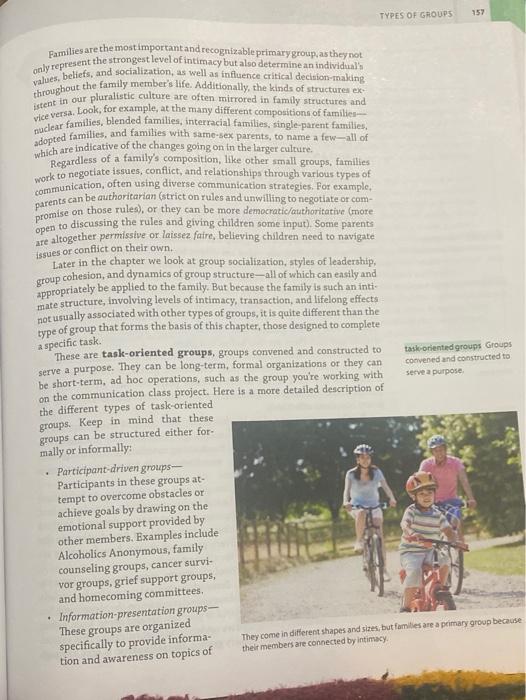
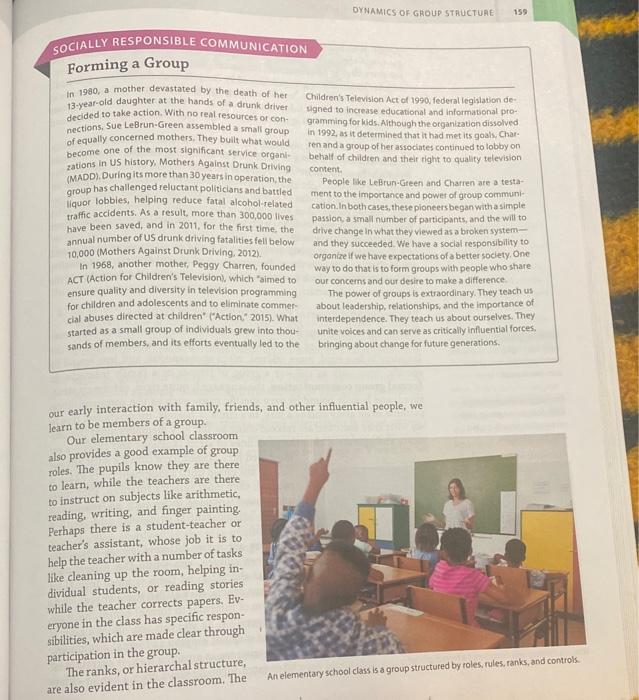
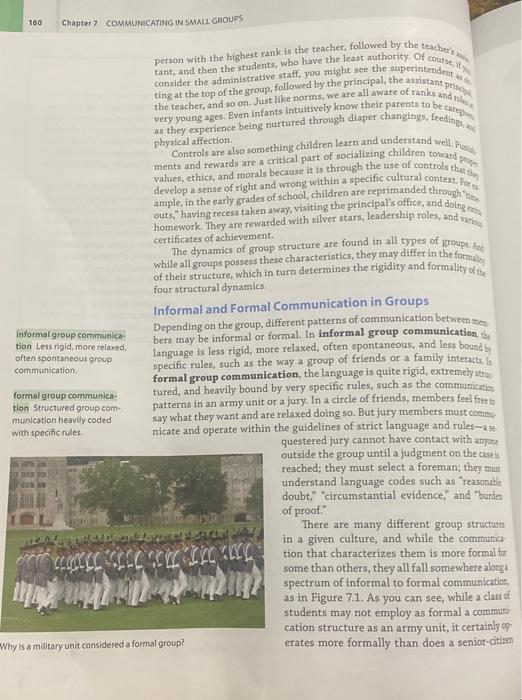
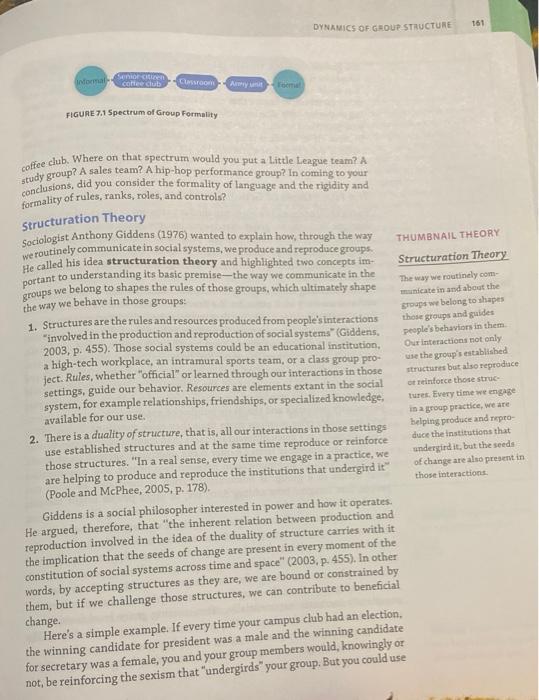
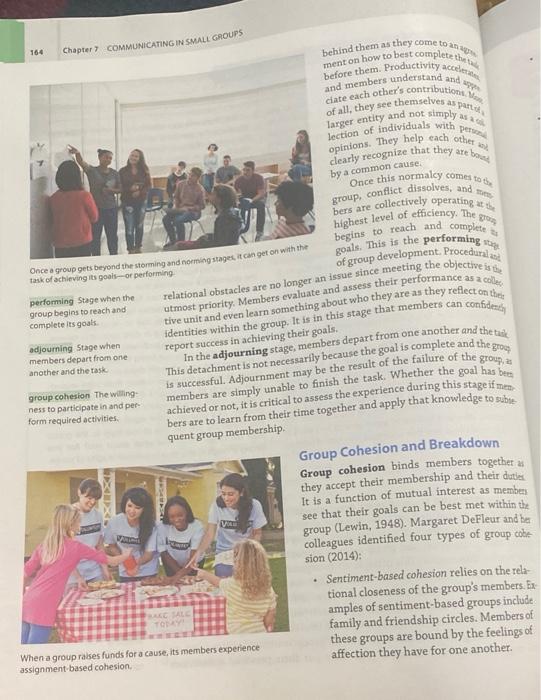
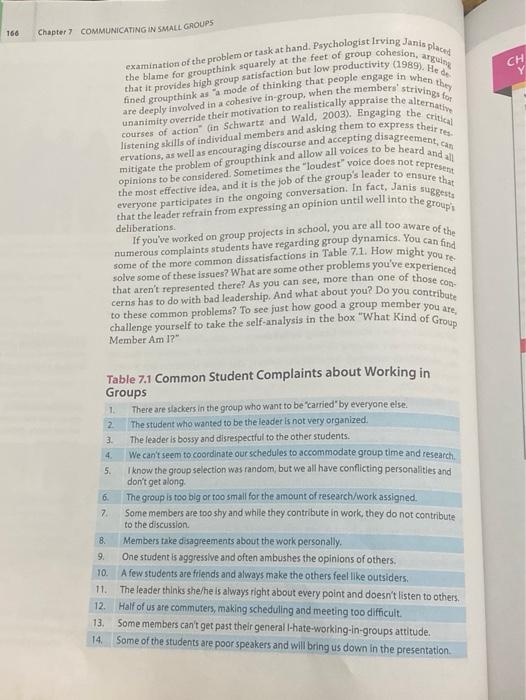
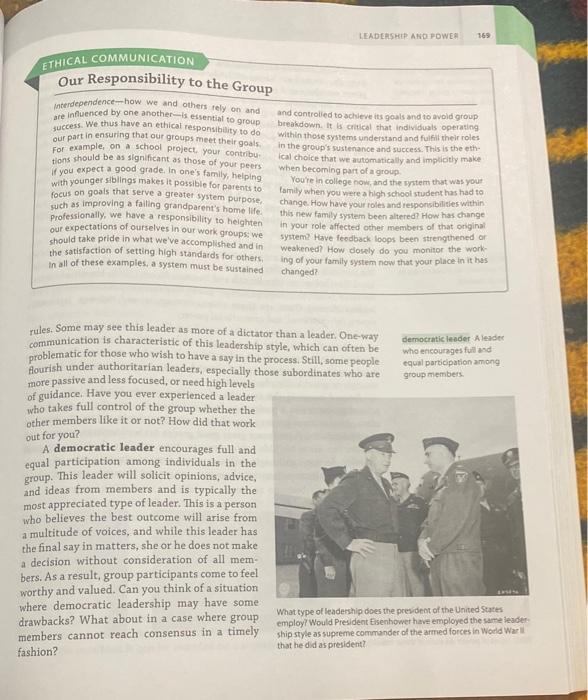
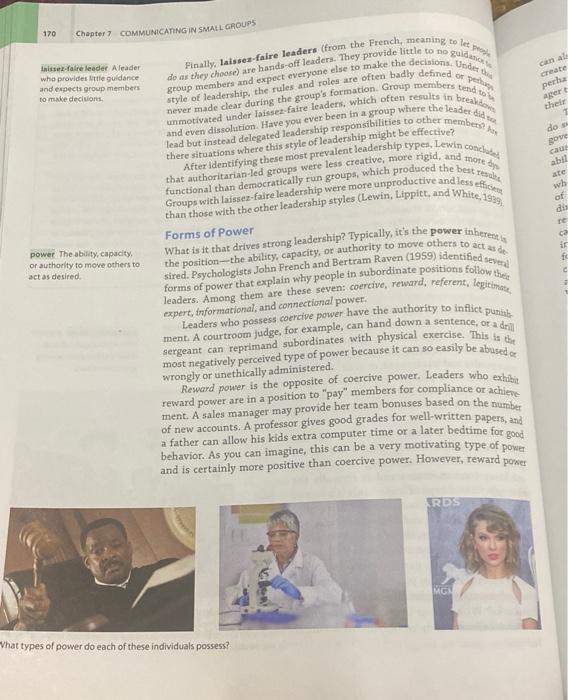
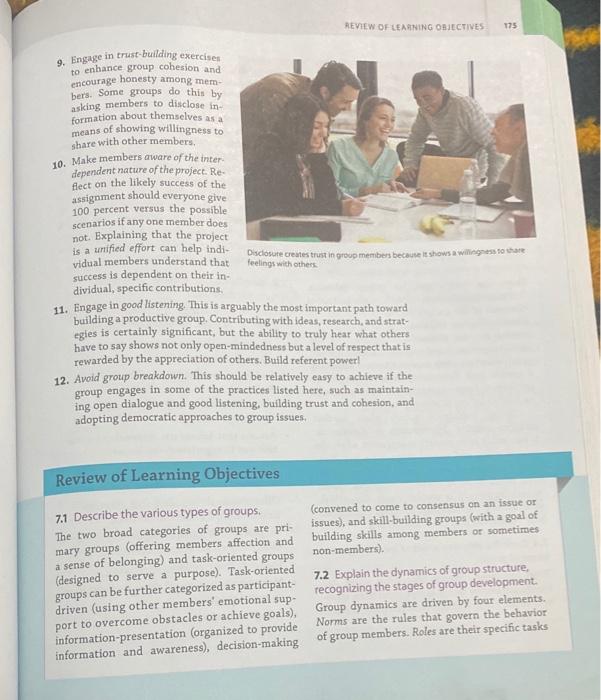
7 Communicating in Small Groups Chapter Outline Types of Groups 156 Dynamics of Group Structure 158 Leadership and Power 168 Improving Your Group Communication Skills 173 The semester is coming to a quick close, and your big group pres- entation, which counts as much as the final exam, is scheduled for next week. You're not really sure how it's going to go. You dislike working in groups for many reasons, and all of your concerns have come to fruition with this particular project. Two of the members are students you barely know, and the other two are people you don't like and with whom you have little in common. Because the class is Introduction to Communication, you feel especially pres- sured to perform well; throughout the semester you've studied topics like interpersonal communication and, especially perti- nent, group dynamics. Not delivering a good presentation might be indicative of your inability to grasp the course's concepts. And sad to say, all the issues you studied regarding group conflict and breakdown are exemplified in your experience working with this assigned team In the first few weeks of meetings, two students failed to show up on a number of occasions, claiming their classes conflicted with the meeting times (even though they said nothing when the five of you together constructed the schedule). One student insisted on being the group's "leader" despite the others' desire to have equal input in how things got done. Another member did absolutely no research and relied on everyone else to meet required deadlines, And each participant had different ideas about how to approach the project and what to include as part of the presentation. It was a di- saster waiting to happen, and you found yourself constantly think- ing, "Why couldn't the professor simply have assigned independent projects?" 156 Chapter 7 COMMUNICATING IN SMALL GROUPS va th is v Working in groupe demands specific communication skills. Without the skills, it can be extremely difficult to effectively negotiate schedules, lines, problem solving, rules, responsibilities, and outcomes. According communication theorists Stephen Littlejohn and Karen Foss, we often ask, it better to do things yourself or to work with a group?" The answer, they Us, depends on how well the group works together, how focused it is, and how much creative and critical thinking the group allows. How well does the group weigh information, how effectively does the group create options, and how critically does it evaluate ideas?" (2011, p. 264). We will examine the may characteristics of group communication in this chapter, hoping to least some of these questions Learning Objectives 7.1 7.2 7.3 7.4 7.5 Describe the various types of groups Explain the dynamics of group structure, recognizing the stages of group development Discuss types of group cohesion and the factors that cause group breakdown. Describe different styles of leadership and forms of power Identify ways to improve your group communication skills small gro Collection of 3 to 15 people with a common purpose Types of Groups You may dislike working on group projects, but keep in mind these import ant points. First, working in small groups, collections of 3 to 15 people with a common purpose, is a fact of life. You were born into a group, and as you began to make friends, you willingly became a member of many more. Second, groups not only are essential to helping you make your way in the world, but can be fun and rewarding. It's pretty difficult to cover all 10 positions on your softball team without some assistance, and more than likely you'd lose every tug-of-war at every picnic you ever attended if you had to pull the rope by yourself. In fact, you might never even get to a picnic without the benefit of some organizational structure, or group work. You can read about two very successful and important groups in the box "Forming a Group." Groups are classified depending on both their structure and their purpose. Two broad categories are primary groups and task-oriented groups. Primary groups offer their members affection and a sense of belonging. Members transact To tines, traditions, and personal communication with full knowledge that these will affect future interactions. Members of primary groups are bound by close, intimate communication and are connected through history and emotion. These groups are "primary" because they are central to our basic needs, and they are the first groups to which we belong. Examples include families and groups of friends, primary group Group offer ing members affection and belonging TYPES OF GROUPS 157 a specific task. Families are the most important and recognizable primary group, as they not only represent the strongest level of intimacy but also determine an individual's values, beliefs, and socialization, as well as influence critical decision-making throughout the family member's life. Additionally, the kinds of structures e istent in our pluralistic culture are often mirrored in family structures and nuclear families, blended families, interracial families, single-parent families, vice versa. Look, for example, at the many different compositions of families adopted families, and families with same-sex parents, to name a few-all of which are indicative of the changes going on in the larger culture, work to negotiate issues, conflict, and relationships through various types of communication, often using diverse communication strategies. For example, parents can be authoritarian (strict on rules and unwilling to negotiate or com- promise on those rules), or they can be more democratic/authoritative more open to discussing the rules and giving children some Input). Some parents are altogether permissive or laissez faire, believing children need to navigate issues or conflict on their own Later in the chapter we look at group socialization, styles of leadership, group cohesion, and dynamics of group structure-all of which can easily and appropriately be applied to the family. But because the family is such an inti- mate structure, involving levels of intimacy, transaction, and lifelong effects not usually associated with other types of groups, it is quite different than the type of group that forms the basis of this chapter, those designed to complete These are task-oriented groups, groups convened and constructed to task oriented groups Groups serve a purpose. They can be long-term, formal organizations or they can convened and constructed to be short-term, ad hoc operations, such as the group you're working with serve a purpose on the communication class project. Here is a more detailed description of the different types of task-oriented groups. Keep in mind that these groups can be structured either for- mally or informally: Participant-driven groups Participants in these groups at- tempt to overcome obstacles or achieve goals by drawing on the emotional support provided by other members. Examples include Alcoholics Anonymous, family counseling groups, cancer survi- vor groups, grief support groups, and homecoming committees Information presentation groups These groups are organized specifically to provide informa- They come in different shapes and sizes, but families are a primary group because their members are connected by intimacy. tion and awareness on topics of . 158 Chapter 7 COMMUNICATING IN SMALL GROUPS Cers, and Chamber of Commerce groups. interest to people. Examples include health awareness groups. Yo ten Decision-making groups. The ultimate goal of these groups is to come to consensus on a given issue or number of issues. The decisions often result in documents outlining procedural changes. Examples include boards of directors, evaluation committees, judicial and military review Ski-building groups-Building skills among members or sometimes clude public speaking workshops, leadership-building groups, writing among non-members is the primary goal of these groups. Examples in boards, Juries, judging panels, and school committees workshops, choral groups, and youth and intramural sports teame Dynamics of Group Structure dynamics How a group structures itself to achieve its goal norms Rules that governa group roles Specific tasks or responsibilities of group members ranks Hierarchal structure of the group Regardless of its type, every group has dynamics- how the group structures itself to achieve its goals--that are driven by four common elements or roles, ranks, and controls (DeFleur, D'Antonio, and DeFleur, 1984). Norms are the rules that govern the behavior of group members. They can be unspoken and understood, or they can be formal and written down. For example, ers on a basketball team understand that missing practice means a game the bench and that an untucked shirt at practice means laps. They also know that the rule book stipulates that the ball must be advanced only by parse dribble and that there are two halves to a game. Roles are the specific tasks and responsibilities of each member. In a rock band, for example, one member plays the electric guitar, another the druma a third the keyboard, and a fourth member plays the bass guitar, and one person is the lead singer. If all members perform their roles as expected, the group functions effectively. Ranks are represented by the hierarchal structure of the group; for in- stance, a typical community group consists of a president, vice president, sec. retary, treasurer, membership chair, fundraising coordinator, and the general membership. In other words, some members simply have more important roles, and more authority, than others. Finally, controls speak to the rewards and punishments, or behavioral consequences, that group members face. A violinist might be moved up to first chair in a chamber ensemble for superior performance or demoted to third chair for careless playing, and a hockey player could get sent to the penalty box for high-sticking or roughing. Every group, no matter how formal or in formal, operates according to these four dynamics. Let's consider an elementary school classroom, since most of us have ex- perienced membership in this group. Some of the typical norms (rules) include raise your hand before speaking, don't shove your classmates on the playground, line up in an orderly fashion, and be respectful to your teacher and peers. Even before we got to school, at a very young age, we understood that rules like this existed because of our socialization in primary groups. Socialization is how, through controls Rewards. punish- ments, or behavioral conse- quences for group members. socialization How we learn to be members of a group through our early interaction with primary groups. DYNAMICS OF GROUP STRUCTURE 159 Forming a SOCIALLY RESPONSIBLE COMMUNICATION Group In 1980, a mother devastated by the death of het Children's Television Act of 1990, federal legislation de 13-year-old daughter at the hands of a drunk driver decided to take action. With no real resources of con signed to increase educational and Informational pro: nections. Sue LeBrun Green assembled a small group gramming for kids. Although the organization dissolved of equally concerned mothers. They built what would in 1992, as it determined that it had met its goals, Char- ren and a group of her associates continued to lobby on become one of the most significant service organi behalf of children and thelr right to quality television zations in US history, Mothers Against Drunk Driving content (MADDI. During its more than 30 years in operation, the People like Lebrun-Green and Charren are a testa group has challenged reluctant politicians and battled liquor lobbles, helping reduce fatal alcohol-related ment to the importance and power of group communi- cation. In both cases, these pioneers began with a simple traffic accidents. As a result, more than 300,000 lives have been saved, and in 2011, for the first time, the passion a small number of participants, and the will to drive change in what they viewed as a broken system annual number of US drunk driving fatalities fell below and they succeeded. We have a social responsibility to 10,000 (Mothers Against Drunk Driving, 2012) organize if we have expectations of a better society. One in 1968, another mother, Peggy Charren, founded way to do that is to form groups with people who share ACT (Action for Children's Television, which aimed to our concerns and our desire to make a difference ensure quality and diversity in television programming The power of groups is extraordinary. They teach us for children and adolescents and to eliminate commer about leadership, relationships, and the importance of cial abuses directed at children" ("Action, 2015). What interdependence. They teach us about ourselves. They started as a small group of individuals grew into thou- unite voices and can serve as critically influential forces. sands of members, and its efforts eventually led to the bringing about change for future generations our rearly interaction with family, friends, and other influential people, we learn to be members of a group Our elementary school classroom also provides a good example of group roles. The pupils know they are there to learn, while the teachers are there to instruct on subjects like arithmetic, reading, writing, and finger painting. Perhaps there is a student-teacher or teacher's assistant, whose job it is to help the teacher with a number of tasks like cleaning up the room, helping in- dividual students, or reading stories while the teacher corrects papers. Ev- eryone in the class has specific respon sibilities, which are made clear through participation in the group. The ranks, or hierarchal structure, are also evident in the classroom. The An elementary school class is a group structured by roles, rules, ranks, and controls. 160 Chapter 7 COMMUNICATING IN SMALL GROUPS TO person with the highest rank is the teacher, followed by the teachers tant, and then the students, who have the least authority. Of course, consider the administrative staff, you might see the superintendenta ting at the top of the group, followed by the principal, the assistant very young ages. Even infants intuitively know their parents to be catch the teacher, and so on. Just like norms, we are all aware of ranks as they experience being nurtured through diaper changings, feedings physical affection Controls are also something children learn and understand well. Pe ments and rewards are a critical part of socializing children toward values, ethics, and morals because it is through the use of controls that develop a sense of right and wrong within a specific cultural context. Tots outs, having recess taken away, visiting the principal's office, and doing ample, in the early grades of school, children are reprimanded through homework. They are rewarded with silver stars, leadership roles, and a certificates of achievement. The dynamics of group structure are found in all types of groups while all groups possess these characteristics, they may differ in the form . four structural dynamics. Informal and Formal Communication in Groups informal group communica Depending on the group, different patterns of communication between mee tion Less rigid, more relaxed, bers may be informal or formal. In informal group communication often spontaneous group language is less rigid, more relaxed, often spontaneous, and less bound by communication specific rules, such as the way a group of friends or a family interact formal group communication, the language is quite rigid, extremely stree formal group communica- tured, and heavily bound by very specific rules, such as the communication tion Structured group com- patterns in an army unit or a jury. In a circle of friends, members feel free te munication heavily coded say what they want and are relaxed doing so. But jury members must comm with specific rules nicate and operate within the guidelines of strict language and rules-23 questered jury cannot have contact with anyone outside the group until a judgment on the case is reached; they must select a foreman; they must understand language codes such as reasonable doubt," "circumstantial evidence," and "burdes of proof." There are many different group structure in a given culture, and while the communica tion that characterizes them is more formal for CCCCCC SILIKEKKEL some than others, they all fall somewhere along spectrum of informal to formal communication, as in Figure 7.1. As you can see, while a class of students may not employ as formal a communi cation structure as an army unit, it certainly og Why is a military unit considered a formal group? erates more formally than does a senior citizen 161 DYNAMICS OF GROUP STRUCTURE IN Senior cotte club Com FIGURE 7.1 Spectrum of Group Formality coffee club, Where on that spectrum would you put a little League team? A study group? A sales team? A hip-hop performance group? In coming to your conclusions, did you consider the formality of language and the rigidity and formality of rules, ranks, roles, and controls? Structuration Theory Sociologist Anthony Giddens (1976) wanted to explain how through the way we routinely communicate in social systems, we produce and reproduce groups. THUMBNAIL THEORY He called his idea structuration theory and highlighted two concepts im- portant to understanding its basic premise-the way we communicate in the groups we belong to shapes the rules of those groups, which ultimately shape the way we behave in those groups: 1. Structures are the rules and resources produced from people's interactions "involved in the production and reproduction of social systems" (Giddens. 2003, p. 455). Those social systems could be an educational institution, a high-tech workplace, an intramural sports team, or a class group pro- ject. Rules, whether "official" or learned through our interactions in those settings, guide our behavior. Resources are elements extant in the social system, for example relationships, friendships, or specialized knowledge, available for our use. 2. There is a duality of structure, that is, all our interactions in those settings use established structures and at the same time reproduce or reinforce those structures. "In a real sense, every time we engage in a practice, we are helping to produce and reproduce the institutions that undergird it (Poole and McPhee, 2005, p. 178). Giddens is a social philosopher interested in power and how it operates. He argued, therefore, that "the inherent relation between production and reproduction involved in the idea of the duality of structure carries with it the implication that the seeds of change are present in every moment of the constitution of social systems across time and space" (2003, p. 455). In other words, by accepting structures as they are, we are bound or constrained by them, but if we challenge those structures, we can contribute to beneficial change. Here's a simple example. If every time your campus club had an election, the winning candidate for president was a male and the winning candidate for secretary was a female, you and your group members would, knowingly or not, be reinforcing the sexism that "undergirds" your group. But you could use Structuration Theory The way we routinely com- municate in and about the groups we belong to shapes these groups and guides people's behaviors in them Our interactions not only wse the group's established structures but also reprodiace or reinforce those struc tures. Every time we engage in a group practice, we are helping produce and repro duce the institutions that undergird it, but the seeds of change are also present in those interactions Chapter 7 COMMUNICATING IN SMALL GROUPS PERS Y e UU nomination and election processes, to put people of both genders into the the group's structure to make change. You could use its rules, for exam other members, to ensure that that happened. In doing so, you'd be chang: You could use its resources, for example, your influence and friendship with ing and eventually altering those structures that constrained who could leat your group and in what capacity Talk is action," write Daniel Modaft and DeWine. "If structure is truly produced through interaction, then communi cation is more than just a precursor to action; it is action" (2002, p. 101). You can read about how an individual's actions can shape the working of the gro and its members' behaviors in the box "You owe it to yourself The Five Stages of Group Development You've likely enduredan experience similar to the one in the chapters opening subconsciously, of the developmental process common to most task-otti vignette. Through that group exercise you became aware, either consciously groups. According to psychologist Bruce Tuckman, this process consists of five stages: forming, storming, norming, performing, and adjourning Tuckman and The forming stage of group development occurs when members initially ning Stage when mem- Initially convene Jensen, 1977) convene, meeting each other for the first time. Some refer to it as the intro ductory stage because it involves first impressions, self-consciousness, predic tions of productivity, and a mental mapping of how the different personalities disclosing little to others because they lack familiarity. Members are con cerned with issues of inclusion as they negotiate their compatibility with 98 another, and there is anxiety over the potential for communication break down because of the number of potentially disruptive factors, such as varying personality dynamics and the likely number of antagonistic opinions (mem bers invariably offer opinions more than they raise questions, Bales, 1970) This, obviously, is a much different scenario than communicating one to one, You may remember from Chapter 6 the multiple complexities of dyadic communication, or communication between two people. But now consider what occurs in a group. If miscommunication is inevitable between two people, just imagine how adding four, six, or eight people might increase the likelihood of breakdown. Remember, too, the Looking Glass Self from Chapter 1. When we discussed the perceptions we have of others and our selves as we engage in interpersonal interactions, some of the factors at play were how we see ourselves, how the other person sees us, what we want the other person to see and what the other person wants us to see. Now consider how much more complex communication becomes in group situations where everyone is attempting to manage the many perceptions of themselves and others. The complexity increases exponentially, often causing group breakdown, which we'll address later in the chapter. This is one reason that people often dislike working in groups. It requires juggling multiple personalities and opinions This realization begins during the group's formation, but it is magnified in the storming stage DYNAMICS OF GROUP STRUCTURE PERSONALLY RESPONSIBLE COMMUNICATION You Owe It to Yourself At the 2018 Golden Globe Awards, TV personality and entrepreneur Oprah Winfrey accepted the Cecil B. But there was also something common in the two DeMille Award for her outstanding contributions to the situations the exercise of personal responsibility within world of entertainment. In her acceptance speech and the context of group membership. Ms. Winfrey was a against the backdrop of the Time's Up Campaign to pro- member of the Screen Actors Guild, but she was also vide legal support for women who have experienced a woman Mr. Kaepernick was a member of the San Francisco 49ers, but he was also an African American sexual harassment, assault, ar abuse in the workplace she proclaimed. "What I know for sure is that speaking man Both had to balance commitment to the group with commitment to their values both did what they your truth is the most powerful tool we all have an Gilbert and Latham 2018). For this she was applauded, felt they had to do to preserve their own individual and there were immediate calls for her to run for pres. sense of identity and dignity, ident. But before this moment there was National Ms. Winfrey was part of a group kely to be sympa Football League quarterback Colin Kaepernick, who in thetic to her cause and relatively immune to attack so 2016 refused to stand for the national anthem during a It may seem her expression of her individual identity was less daring than that of Mr. Kaepernick And surely, San Francisco 49ers game against the Green Bay Pack the quarterback was aware that not all his teammates ers in protest of the oppression of African Americans, and team officials supported him and that his group primarily at the hands of law enforcement officials. He the 49ers, would suffer criticism for his actions Branch prodaimed, "I am not going to stand up to show pride 2017). Nonetheless, neither had to do anything at all in a flag for a country that oppresses black people and Both could have continued in their successful careers. people of color. To me, this is bigger than football, and it reaping great rewards. Yet both were willing to stand up would be selfish on my part to look the other way. There against injustice. Both saw being truthful to oneself as are bodies in the street and people Ipolicel getting pald a resource that would benefit those around them, their leave and getting away with murder on Zirin, 2018), group, as well as the larger culture. Both were respon The response to Mr. Kaepernick could not have been sible enough to understand that risking the group's more different than that which greeted Ms. Winfrey. The Interests might be a necessary cost if we are going to football player received death threats, was called 'tral progress as a stronger, more equal society. Where do tor" and "thug" by everyday people and powerful pol- you stand? Do you see one as less loyal to the group iticians alike, and was never again able to find work in than the other? Why? And what about you? Are you his chosen field, one that once paid him tens of millions strong enough to stay true to yourself in spite of poten tial risk or cost to yourself and your group? of dollars. storming Stage when mem bers experience conflict In the storming stage of group development, members experience con flict. They are acquainted with one another at this point and are more com- fortable disclosing points of view and ideas. As they discuss appropriate paths toward task completion and group accomplishment, they contend with and must resolve differences. This often leads to arguments, miscommunication, and a deviation from the goal at hand. Disagreement is arguably the most prevalent characteristic of the storming stage, as individual members fear a loss of identity in a sea of conflicting perspectives. Still, resolution of these issues must occur if the group is to transition into the norming stage. The norming stage is characterized by group members willingness to work together toward a common goal. They put their previous differences norming Stage when mem- bers begin working together toward a common goal 164 Chapter 7 COMMUNICATING IN SMALL GROUPS behind them as they come to an ment on how to best complete the before them. Productivity ac and members understand and ciate each other's contribution of all, they see themselves as part pete by a common cause. COM go larger entity and not simply lection of individuals with opinions. They help each others clearly recognize that they are o Once this normalcy comes to group, conflict dissolves, and bers are collectively operating at highest level of efficiency. The begins to reach and complete Once a group gets beyond the storming and norming stages, it can get on with the goals. This is the performing task of achieving its goals--or performing of group development Procedura performing Stage when the relational obstacles are no longer an issue since meeting the objective is te utmost priority. Members evaluate and assess their performance as a colle group begins to reach and complete its goals tive unit and even learn something about who they are as they reflect on the Identities within the group. It is in this stage that members can conti adjourning Stage when members depart from one report success in achieving their goals. In the adjourning stage, members depart from one another and the another and the task is successful. Adjournment may be the result of the failure of the group, This detachment is not necessarily because the goal is complete and the group cohesion The willing ness to participate in and per members are simply unable to finish the task. Whether the goal has been form required activities achieved or not, it is critical to assess the experience during this stage if main bers are to learn from their time together and apply that knowledge to subin quent group membership Group Cohesion and Breakdown Group cohesion binds members together as they accept their membership and their dunia It is a function of mutual interest as members see that their goals can be best met within the group (Lewin, 1948). Margaret DeFleur and be colleagues identified four types of group cohe sion (2014): Sentiment-based cohesion relies on the rela tional closeness of the group's members. Ex TOV amples of sentiment-based groups include family and friendship circles. Members of When a group raise funds for a cause, its members experience these groups are bound by the feelings of assignment based cohesion affection they have for one another. 165 DYNAMICS OF GROUP STRUCTURE with a Super Bowl victory. Renard-based cohesion is built on the idea that members are in some way rewarded for the successful completion of the task. For example, par ticipants in a successful weight-loss group are rewarded with slimmer healthier bodies, and the best National Football League team is rewarded Assignment based cohesion is goal-oriented. Group members, such as goal, in this case hoping to raise enough money to satisfy their cause Another example might be a town's board of education, whose assign- ment it is to determine an appropriate school curriculum Ahose in a fundraising club, work together toward achieving a specific group breakdown Dete- rotation or dissolution of a group as a result of conflict Futrell, 2009). Finally , dependency-based cohesion, more common in large organizations of separate tasks. In other words, a bicycle manufacturer has one group malding the handlebars, another working on the tires, and still another putting together the frames, but they are all linked by the common goal of manufacturing completed bicycles. Despite the presence of cohesion, groups can sometimes experience total Breakdown. For example, while the members of a family may love each other very much, the emergence of an alcohol problem in one of its members can create dysfunction, pulling the family apart . Or one of the group members from the chapter-opening example might simply refuse to meet deadlines or contribute in any meaningful way in a fit of spite over having been denied the role of project leader, Group breakdown occurs when conflict emerges among members causing deterioration or dissolution. A number of factors can contribute to group breakdown. Among the more common are norma tive confusion, rank ineffectiveness, and groupthink (Sundstrom, DeMeuse, and Normative confusion occurs when the group's rules and expectations have not been clearly defined or established. Think about your experiences with group conflict. Have you been part of a group project in which one of the members seemed confused about when the group was meeting, how often it was meeting, or for how long? Not knowing and altimately, not conforming to the group's agreed-upon rules can result in disintegration. At the very least, it puts a bigger burden on those following the initial agreed-upon agenda. Another common cause of group breakdown is rank ineffectiveness, or a failure of leadership; that is, the leader(s) of the group are viewed as inef- fective. Later in the chapter we will discuss different leadership styles and their impact on groups. We all know what it's like to work in a group where the leader is self-appointed, too bossy, unable to motivate the team, or too lax in her or his approach to problem-solving. Perhaps the leader just annoys us. When someone is supposed to lead but is unable to do so, the result is often an unproductive group A third possible reason for group breakdown is groupthink. This phe- nomenon results when voices within a group are suppressed because of pressure--real or imagined-from others, resulting in a lack of thoughtful normative confusion When group rules and expectations are not clearly defined or established rankineffectiveness When group members question the legitimacy of messages transmitted by those in positions of authority groupthink When volces in a group are suppressed by pressure from others 168 Chapter 7 COMMUNICATING IN SMALL GROUPS THUMBNAIL THEORY way the family operates as a system Systems Theory Groups operate an systems, in which all parts members) are interdependent Change in one part produces change in another. Systems are goal-oriented and, as such work to mustain and mon itor themselves. They do 10 through feedback loops, in which the parts communi cate with each other and are mutually changed by that communication by their dependence on others, and the group will operate according to the In other words, all members of the group (the system are COST Importance to the family dynamic; however, the family group as a w interdependence. Consider a family. Each member has a different role og a much stronger entity than any one individual member. If one person appoints or fails the others, the entire family feels the effects. A VODE example, will alter not only each family member's individual role but also the goal-oriented they exist to serve some purpose (here it's easy to set Way Another important concept of systems theory is that systems tems theory and group communication make a good fit) As such, they want (keep themselves going) and regulate themselves to achieve their intende In a system, this communication is called a feedback loop. The parts bers interact with one another, and as one part changes in response to that communication, so too does the other, resulting in change by the first The feedback is "looped "back and forth, producing ongoing change that mos environments; that is, members constantly judge the product of their work, the system (the group in the direction of success Systems also monitor their sensing when the system is in need of change. Returning to our earlier before the parents separated. This external information becomes part of the ample, children of divorce notice that the house is much messier than it was outcome. How do they do this? Through communication, naturally PA group's interactions, and the system (hopefully) changes accordingly. leadership When an individ- ual influences group mem bers to achieve a common goal Leadership and Power pointed to a leadership role. But before we discuss styles of leadership and Every group has a member or a few members who either assume or are ap. forms of power, it's important to define leadership itself . Leadership is when "an individual influences group members to achieve a common goal (Northouse, 2007. p. 3). Sounds pretty basic, right? But we all know that ef. fective leadership is much more complex, as those in authority don't simply "influence" others; they also motivate, challenge, enable, and inspire. Leader must understand the group's dynamics and, based on that awareness, deter mine the best paths for reaching those common goals. Good leaders also make sure that everyone, before embarking on the task at hand, is clear about the agreed-upon norms, ranks, roles, and controls. Finally, it is critical that good leaders adopt a leadership style conducive to the personalities and structure of the group Styles of Leadership The three most common leadership styles are authoritarian, democratic, and laissez-faire (Lewin, Lippitt, and White, 1939) Authoritarian leaders often do not accept input from members of the group and maintain complete control of such things as decision-making and authoritarian leader A leader who does not accept input from members and maintains complete control of the group LEADERSHIP AND POWER 169 to the Group ETHICAL COMMUNICATION Our Responsibility Interdependence how we and others rely on and are influenced by one another is essential to group success. We thus have an ethical responsibility to do our part in ensuring that our groups meet their goals For example, on a school project your contribu tions should be as significant as those of your peers if you expect a good grade. In one's family, helping with younger siblings makes it possible for parents to such as improving a falling grandparent's home life Professionally, we have a responsibility to heighten our expectations of ourselves in our work groups we should take pride in what we've accomplished and in the satisfaction of setting high standards for others in all of these examples, a system must be sustained focus on goals that serve a greater system purpose and controlled to achieve its goals and to svold group breakdown. It is critical that individuals operating within those systems understand and fulfill their roles in the group's sustenance and success. This is the eth cal choice that we automatically and implicitly make when becoming part of a group You're in college now, and the system that was your family when you were a high school student has had to change. How have your roles and responsibilities within this new family system been altered? How has change in your role affected other members of that original system? Have feedback loops been strengthened or weakened? How dosely do you monitor the work ing of your family system now that your place in it has changed? rules. Some may see this leader as more of a dictator than a leader. One way communication is characteristic of this leadership style, which can often be democratic leader Alede Nourish under authoritarian leaders, especially those subordinates who are problematic for those who wish to have a say in the process. Still, some people who encourages full and equal participation among more passive and less focused, or need high levels group members of guidance. Have you ever experienced a leader who takes full control of the group whether the other members like it or not? How did that work out for you? A democratic leader encourages full and equal participation among individuals in the group. This leader will solicit opinions, advice, and ideas from members and is typically the most appreciated type of leader. This is a person who believes the best outcome will arise from a multitude of voices, and while this leader has the final say in matters, she or he does not make a decision without consideration of all mem bers. As a result, group participants come to feel worthy and valued. Can you think of a situation where democratic leadership may have some What type of leadership does the president of the United States drawbacks? What about in a case where group employ! Would President Eisenhowet have employed the same leader members cannot reach consensus in a timely ship style as supreme commander of the armed forces in World War that he did as president fashion? can al create perha Ager their 7 170 Chapter 7 COMMUNICATING IN SMALL GROUPS Finally, laissez-faire leaders from the French, meaning to let pole laisser faire leader Aleader who provides little guidance and expects group members de as they choose) are hands-off leaders. They provide little to no que group members and expect everyone else to make the decisions. Under to make decisions style of leadership, the rules and roles are often badly defined or per never made clear during the group's formation Group members tend to un motivated under laissez-faire leaders, which often results in bra and even dissolution. Have you ever been in a group where the leader lead but instead delegated leadership responsibilities to other members After identifying these most prevalent leadership types, Lewin con that authoritarian-led groups were less creative, more rigid, and that functional than democratically run groups, which produced the best result Groups with laissez-faire leadership were more unproductive and less than dos there situations where this style of leadership might be effective? gove caur abil ate wh of White, 1999 than those with the other leadership styles (Lewin, Lippitt, and Forms of Power re ca f power. The ability, capacity, or authority to move others to act as desired What is it that drives strong leadership? Typically, it's the power inberts the position-the ability, capacity, or authority to move others to act as de sired. Psychologists John French and Bertram Raven (1959) identibed several forms of power that explain why people in subordinate positions follow the leaders. Among them are these seven: coercive, reward, referent, legitima Leaders who possess coercive power have the authority to inflict push ment. A courtroom judge, for example, can hand down a sentence, or a di sergeant can reprimand subordinates with physical exercise. This is the most negatively perceived type of power because it can so easily be abused expert, informational, and connectional power. wrongly or unethically administered. Reward power is the opposite of coercive power. Leaders who exhibit reward power are in a position to "pay" members for compliance or achieve ment. A sales manager may provide her team bonuses based on the number of new accounts. A professor gives good grades for well-written papers, as a father can allow his kids extra computer time or a later bedtime for good behavior. As you can imagine, this can be a very motivating type of power and is certainly more positive than coercive power. However, reward power RDS MG Vhat types of power do each of these individuals possess? LEADERSHIP AND POWER 171 their bonuses can also have its drawbacks. A reward that is deserved but never comes can create resentment or anger toward the leader. Return to our sales manager: perhaps the team brought in a record number of new accounts, but the man agter then decides that her subordinates should have done even better to earn The third type is legitimate power. Leaders who possess legitimate power do so primarily because of their status. Politicians such as state senators, governors, or congressional representatives all have considerable power be cause of their positions in the government. This is evident through their ability to make hugely impactful decisions, propose legislation, and initi ate action that can affect thousands of citizens and organizations. People of social, professional, and personal groups. Politicians who take friends to who hold legitimate power often have considerable influence over a number dinner may be offered complimentary bottles of wine or the best table in the restaurant simply because of their powerful status. And legitimate power can be abused, Political sex scandals are a regular occurrence. These typically involve power disparities between influential men and female subordinates cused several times of sexual harassment and assault), accusations of rape and aggressive sexual advances against legendary movie producer Harvey Weinstein, and multiple charges of sexual assault against influential come- dian and actor Bill Cosby. Referent power is based on admiration and liking, Accomplished athletes jike LeBron James, Cam Newton, and Danica Patrick possess referent power, do celebrities such as Samuel L. Jackson, Jennifer Lopez, and Brad Pitt, who have a commanding presence on a movie set. Referent power, for exam- ple, is evident in one-time teammate Troy Brown's evaluation of quarterback Tom Brady's leadership: "It doesn't matter whether he's right or wrong. People listen to him. He gives you a look that makes you know if you do what he tells you, it'll be fine" (JockBio, 2012). Consider, too, the groups you've worked with in school. It's probably safe to say you were more responsive to the leaders you liked than those you didn't. Attractiveness is an important factor in determining how much one is liked. We humans are hard-wired-genetically predisposed to respond more favorably to those we consider attractive as opposed to those we do not. "Good-looking men and women are generally regarded to be more tal- ented, kind, honest, and intelligent than their less attractive counterparts," writes psychologist Ray Williams. "Meritocracies are supposed to champion intelligence, qualifications, and experience. But physical and social attraction deliver substantial benefits in all social interaction-making a person more persuasive, able to secure the co-operation of colleagues, attract customers, and sell products" (2012). It's easy, then, to see why teenagers in friendship groups model themselves after the peers they deem most attractive and cool, primarily because they, too, want to command the same levels of respect and admiration from others. As you might conclude, however, a major drawback to referent power is that it can be awarded on a superficial basis, rendering the 25 Chapter 7 COMMUNICATING IN SMALL GROUPS different p tered by the form of les featuring high school mean girls" and dueless jocks. Impr Com person in power unworthy of admiration. Just think of all the teen Expert power is based on the amount of knowledge or expertise a per has in a given area Doctors know medicine, and math professors now also and geometry People who want to overcome an addiction will likely choose support group led by a doctor because doctors are experts, and they trust that a doctor will use his power to benefit the group. When we have a big math exam and struggle with some of the concepts, we sign up for the study group led by our professor who uses her knowledge to clarify the things we don't have its negative qualities. For example, a doctor so enthralled with his own understand. It all adds up, right? However, sometimes even expert power expertise that he doesn't listen to his patients can misdiagnose an illness math professor who is an expert in her field may have difficulty leading the study group because she cannot comprehend members' lack of math compe tency. Expert power requires that knowledge be used in an appropriate and moral fashion; otherwise, expertise-based leadership can produce neglecthe Many st It's ofte grade. the dla in som sociall issues to im tweer or pre group the 1 and ther pos 1. or hurtful situations for group members who depend on that expertise. Those who have access to information that others lack possess informe tional power. For example, people who work with classified material, like those tion agencies or health industries, can exert influence over those in need of that information. Their power resides in their ability to control the availabili ity and accuracy of information. Even on a more personal level, informational power is always present. Have you ever withheld the time and place of a group pessimistic accounting of upcoming costs to thwart members' ambitious and expensive plans for an end-of-semester blowout. As you can see in these two examples, the exercise of informational power is fraught with ethical impl- cations Who decides on the propriety of withholding information? It's quite likely that the holder of the information and those who might otherwise bene- fit from it have differing answers to this question. Finally, there is connectional power, authority "earned" by virtue of whom the leader knows and the support from members that he or she gains as a result. Discussions of leadership sometimes exclude connectional power be cause it is not something that resides in leaders themselves but is attributed to them. Members attribute certain skills or characteristics to leaders based on their assumptions of the other people those leaders are thought to know. For example, have you ever had a professor who constantly reminded you "the time I taught at Harvard" or a teammate who is quick to inform the group that "famous athlete So-and-So is my neighbor"? Again, these examples sug gest that connectional power may be a relatively weak form of authority for group leaders, and those who exercise it too frequently may rightfully have their leadership questioned. Group success, especially the success of goal-oriented as opposed to pri- mary groups, depends in large part on how well leaders negotiate their power in ways beneficial to the entire group. There is no single best exercise of power, of 173 IMPROVING YOUR GROUP COMMUNICATION SKILLS different people, different types of groups, and different situations encount tered by those people and groups will ultimately determine the most effective form of leadership and exercise of power Improving Your Group Communication Skills Many students cringe at the thought of group projects and presentations It's often disconcerting to have to rely on others in your quest for a decent grade. For a student who desperately needs a good grade in order to pass the class or one who hopes to maintain her 3.9 GPA, putting his or her fate socially challenged often struggle in group situations, as do those who have issues with delegating tasks because they want total control. Learning how tween a successful group experience and the worst time of your college- to improve your group communication skills can make the difference be- or professional-career. You can learn a bit more about how to make your group tasks work-a common reality of the contemporary workplace-in the box "12 Cs for Successful Teamwork." Like it or not, you will face group assignments throughout your personal and professional lives, so the best way to deal with them is to, first, accept them; second, embrace them; and third, be better prepared to shape them into positive experiences. Let's look at some of the ways you can do just that. 1. Understand the dynamics and components of group communication, which hopefully you've accomplished in your reading of this chapter. You should share your knowledge with those who do not know as much about group communication as you. Exercise your expert power! 2. As the group forms, encourage each member to vocalize his or her feelings about the project. Ask a lot of questions about what members feel to be their strengths and weaknesses, what areas they would prefer to explore, and what they see as their roles and responsibilities in the group. This makes everyone feel that they have an equal say in the establishment of group norms and tasks. 3. Allow all members to develop a sense of ownership in the goal. Discuss how the task at hand impacts them and reward any achievements or strides made by each individual. 4. While authoritarian and laissez-faire leadership may have some bene- fits (depending on the type of group), always assume that democratic ap- proaches are the best way to negotiate issues in the group. 5. Constantly work toward building cohesion. What are the commonalities among group members? Determine the factors that bind group mem bers and reference those similarities during moments of conflict or disagreement 174 Chapter 7 COMMUNICATINGIN SMALL GROUPS COMMUNICATION IN THE WORKPLACE com 1 method 4. Cando remember think that other members have the necessary know skills and capability to meet the group goals 5. Charts the team deady defined and nicated in goal dessed outcomes mines, and 6. Control Do team members have mentre dom and power to feel ownership in the asso Team members deally understand the bound Colabo-Do group members understand Team and group processes? Are they interperson 8. Communication-Do team members communicate 9. Creative Innovation the target organization really interested in change Does it value Creative less there effective leadership 12 Cs for Successful Teamwork People tend to think that teams are the democratic and the efficient way to get things done writes or ganizational pythologist and team expert. Richard Hackman have no question that when you have team the possibility exists that it will generate magle producing something extraordinary, a collective de ation of previously unimagined quality or beauty. But don't count on it Research consistently shows that teams underperform, despite all the extra resources they have" lin Coutu 2009 From reading this chapter, and no doubt from having quite a bit of experience working with teams yourself you know that Hackman is on to something But teamwork can be very successful and it is a fact of the contemporary American workplace. As such human resources counselor Susan Heathfield (2013) suggests 12 for ensuring the success of working in groups 1. Clear expectations-Hove leaders clearly communi Cated expectations for the team's performance and outcomes? When those expectations are met are they acknowledged or rewarded? 2. Content-Do team members understand where their work fits within the context of the larger orga- nization's goals, principles, vision, and values? 3. Commitment-Do team members want to partici pate in the team? ally working together effectively? clearly and honestly with each other? thinking, new ideas and unique solution? when teams are successful 10. ConsequencDo all team members feel respons ble and accountable for the groups achievements Does the organization offer rewards or recognition 11. Coordination-Do cross-function and mult 12. Cultural change-Does the large organization appreciate that the more it can change its work climate to support team the more it will benefit department team work together effectively? from the work of those groups? 6. Encourage preparedness from members. Once a meeting schedule is estah lished, everyone should be clear about group expectations- what ead member should bring to the meetings, the protocol at meetings, and are will run the meetings 7. Offer continual reminders that everyone benefits from a successful outcome This will serve to help individuals remain motivated as they work towani completing the task 8. Suggest regular, open dialogue about how the group can continue to in prove without alienating or insulting any one member. Speak collectively rather than individually--for example, "We're getting behind" rather than "Alex, you're holding us back." REVIEW OF LEARNING OBJECTIVES 175 9. Engage in trust-building exercises to enhance group cohesion and encourage honesty among mem- bers. Some groups do this by asking members to disclose in formation about themselves as a means of showing willingness to share with other members, 10. Make members aware of the inter dependent nature of the project. Re- flect on the likely success of the assignment should everyone give 100 percent versus the possible scenarios if any one member does not. Explaining that the project is a unified effort can help indi- vidual members understand that Disclosure creates trust in group members because it shows a willingness to share feelings with others success is dependent on their in- dividual, specific contributions, 11. Engage in good listening, "This is arguably the most important path toward building a productive group. Contributing with ideas, research, and strat- egles is certainly significant, but the ability to truly hear what others have to say shows not only open-mindedness but a level of respect that is rewarded by the appreciation of others. Build referent power! 12. Avoid group breakdown. This should be relatively easy to achieve if the group engages in some of the practices listed here, such as maintain- ing open dialogue and good listening, building trust and cohesion, and adopting democratic approaches to group issues Review of Learning Objectives 7.1 Describe the various types of groups. (convened to come to consensus on an issue or The two broad categories of groups are pri issues), and skill-building groups (with a goal of mary groups (offering members affection and building skills among members or sometimes a sense of belonging) and task-oriented groups non-members). (designed to serve a purpose). Task-oriented groups can be further categorized as participant- 7.2 Explain the dynamics of group structure, recognizing the stages of group development, driven (using other members' emotional sup- port to overcome obstacles or achieve goals), Group dynamics are driven by four elements. information-presentation (organized to provide Norms are the rules that govern the behavior information and awareness), decision-making of group members. Roles are their specific tasks 176 Chapter 7 COMMUNICATING IN SMALL GROUPS Key Ter smal prim leaderabil and responsibilities. Ranks are the hierarchal is considered the most effective. task dyn nor rol ran Democratic leaders encourage full and equal pat ticipation from group members, Laissez faire lead Leadership depends on the exercise of a ous forms of power. Coercive power is the author from the ability to reward members for compli ity to inflict punishment. Reward power comes ance or achievement. Legitimate power resides in leaders' status. Referent power is based on ad miration and liking. Expert power resides in the amount of knowledge or expertise possessed by a leader. Informational power comes from having access to information that others do not possess Connectional power is authority earned by virtue f - of whom the leader is assumed to know 7.5 Identify ways to improve your group communication skills You can improve your group communication skills in a number of ways, including the following: . structure of the group. Controls are the rewards and punishments for group members. Depend Ing on the group, different patterns of commu- nication between members may be informal or formal There are five stages of group development In the forming stage, members initially convene, meeting each other for the first time. In the storming stage, members experience conflict. In the morming stage, members find cohesion. In the performing stage, members collectively operate at a high level of efficiency. In the adjourning stage. members depart from one another and the task 7.3 Discuss types of group cohesion and the factors that cause group breakdown. There are four types of group cohesion Sentiment-based cohesion is built on the relational closeness of the group's members. Reward-based cohesion relies on the idea that members are re warded for the successful completion of the task. Assignment based cohesion is achieved when group members work together toward achieving a specific goal. Dependency-based cohesion, more common in large organizations, links groups to each other by way of separate tasks. Group breakdown occurs when conflict emerges, causing deterioration or dissolution It can occur from normative confusion, when the group's rules and expectations have not been clearly defined or established. Rank ineffective- ness, when those in positions of power appear to lack legitimacy, is another cause. Groupthink, when some group members suppress other mem- bers' voices, can also cause breakdown 7.4 Describe different styles of leadership and forms of power. There are three common leadership styles. Au thoritarian leaders do not accept input from mem- bers of the group and maintain complete control Understand the dynamics and components of group communication. Encourage members to vocalize their feelings Allow all members to develop a sense of ownership in the goal Assume that democratic approaches are the best way to negotiate group issues. Constantly work toward building cohesion Encourage preparedness









 Study Help