







Question: (6 marks) Consider a cipher which encrypts messages in M = {A,B,C}. The probabilities of sending each message are Pr[m = A] = 1/3, Pr[m
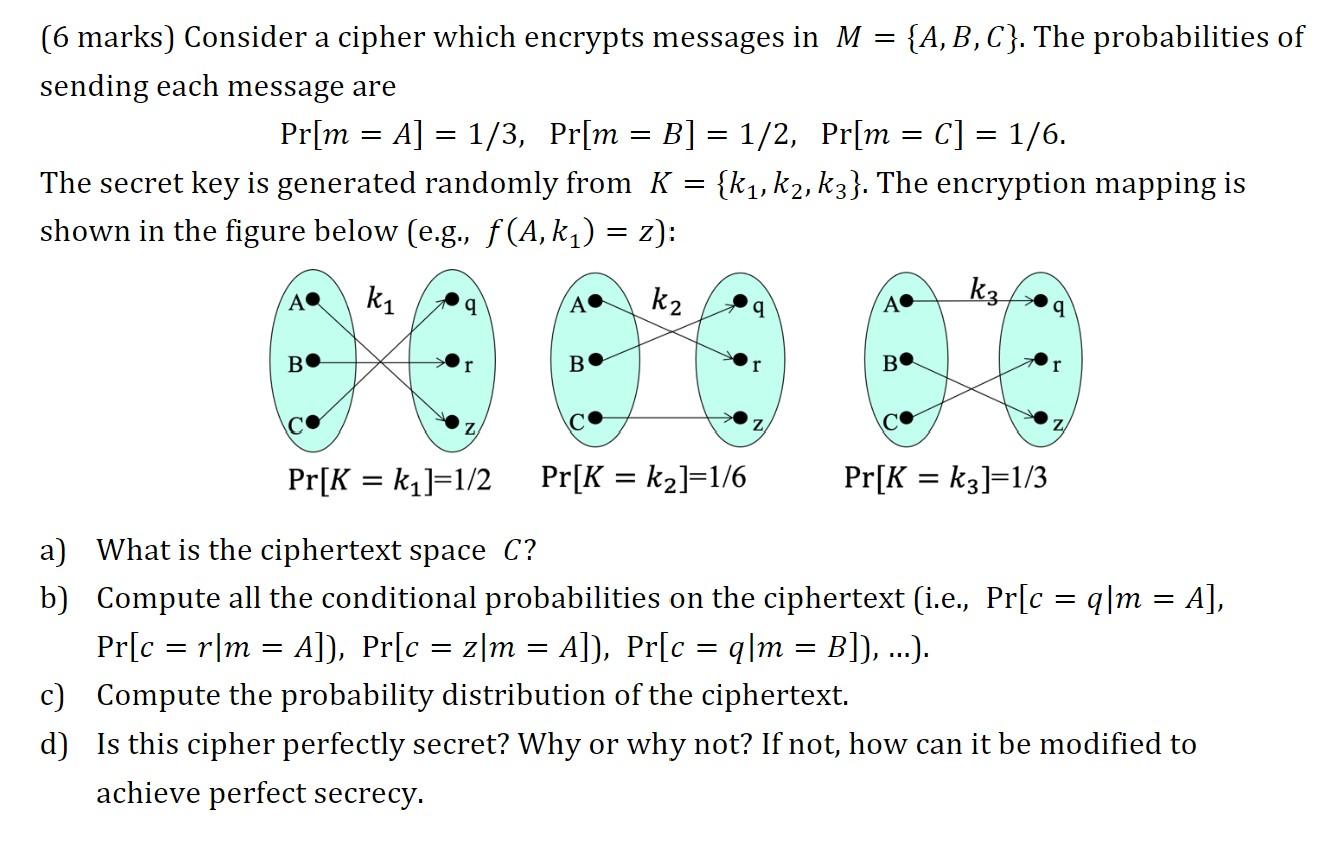
(6 marks) Consider a cipher which encrypts messages in M = {A,B,C}. The probabilities of sending each message are Pr[m = A] = 1/3, Pr[m = B] = 1/2, Pr[m = C] = 1/6. The secret key is generated randomly from K = {k, k2, k3}. The encryption mapping is shown in the figure below (e.g., f(A, k) = z): = = = k k3 q A kz q A q BO B BO r Pr[K = k1]=1/2 = - Pr[K = k2]=1/6 Pr[K = kz]=1/3 = = = = = = = = = a) What is the ciphertext space C? b) Compute all the conditional probabilities on the ciphertext (i.e., Pr[c = q m = A], Pr[c = r[m = A]), Pr[c = z[m = A]), Pr[c =q|m = B]), ...). c) Compute the probability distribution of the ciphertext. d) Is this cipher perfectly secret? Why or why not? If not, how can it be modified to achieve perfect secrecy
Step by Step Solution
There are 3 Steps involved in it

Get step-by-step solutions from verified subject matter experts
 Study Help