







Question: 6. Multiple Regression: Predicting the Total Number of Wins using Average Points Scored and Average Relative Skill You created a multiple regression model with the
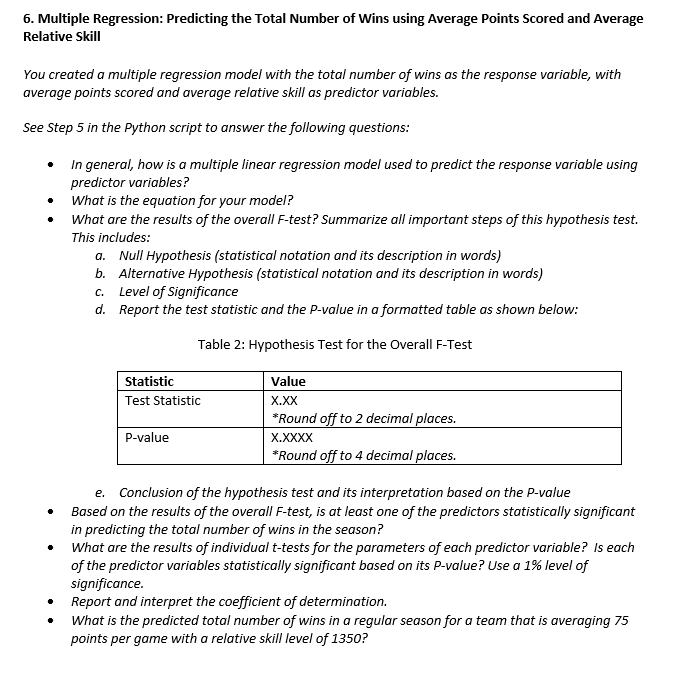
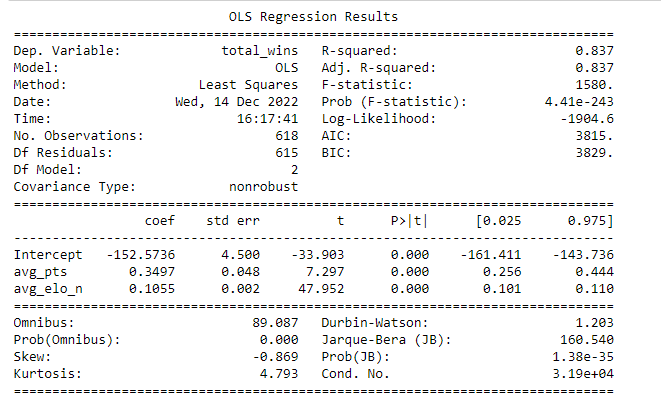

6. Multiple Regression: Predicting the Total Number of Wins using Average Points Scored and Average Relative Skill You created a multiple regression model with the total number of wins as the response variable, with average points scored and average relative skill as predictor variables. See Step 5 in the Python script to answer the following questions: In general, how is a multiple linear regression model used to predict the response variable using predictor variables? What is the equation for your model? . . What are the results of the overall F-test? Summarize all important steps of this hypothesis test. This includes: . Null Hypothesis (statistical notation and its description in words) b. Alternative Hypothesis (statistical notation and its description in words) C. Level of Significance d. Report the test statistic and the P-value in a formatted table as shown below: Table 2: Hypothesis Test for the Overall F-Test Statistic Value Test Statistic X.xx `Round off to 2 decimal places. P-value X.XXXX *Round off to 4 decimal places. e. Conclusion of the hypothesis test and its interpretation based on the P-value . Based on the results of the overall F-test, is at least one of the predictors statistically significant in predicting the total number of wins in the season? What are the results of individual t-tests for the parameters of each predictor variable? Is each of the predictor variables statistically significant based on its P-value? Use a 1% level of significance. Report and interpret the coefficient of determination. . . What is the predicted total number of wins in a regular season for a team that is averaging 75 points per game with a relative skill level of 1350?\fimport statsmodels . formula . api as smf # Multiple Regression # - - - - TODO: make your edits here - -- model2 = smf. ols ( ' total_wins ~ avg_pts + avg_elo_n', nba_wins_df) . fit() print (model2 . summary ( ) )
Step by Step Solution
There are 3 Steps involved in it

Get step-by-step solutions from verified subject matter experts
 Study Help