







Question: 6. Produce a line graph instead of a boxplot for this problem, and for 2-way ANOVA's in general in the course. Follow directions in course
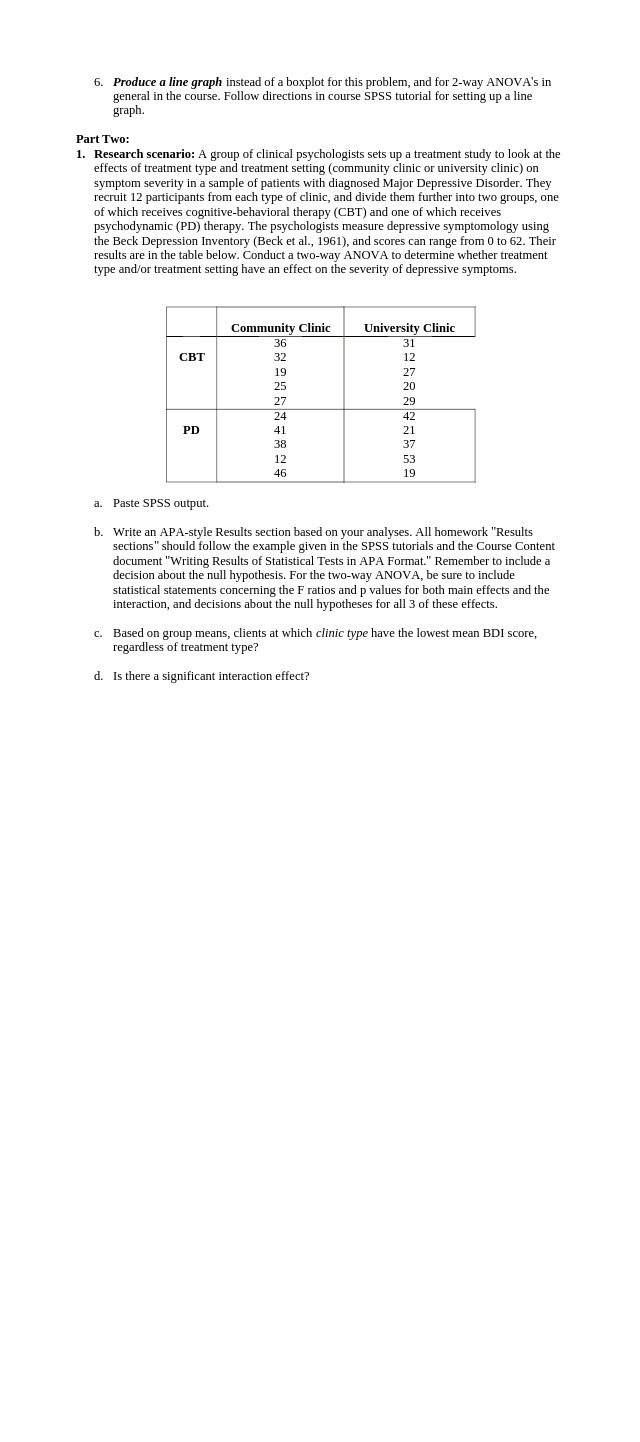
6. Produce a line graph instead of a boxplot for this problem, and for 2-way ANOVA's in general in the course. Follow directions in course SPSS tutorial for setting up a line graph. Part Two: 1. Research scenario: A group of clinical psychologists sets up a treatment study to look at the effects of treatment type and treatment setting (community clinic or university clinic) on symptom severity in a sample of patients with diagnosed Major Depressive Disorder. They recruit 12 participants from each type of clinic, and divide them further into two groups, one of which receives cognitive-behavioral therapy (CBT) and one of which receives psychodynamic (PD) therapy. The psychologists measure depressive symptomology using the Beck Depression Inventory (Beck et al., 1961), and scores can range from 0 to 62. Their results are in the table below. Conduct a two-way ANOVA to determine whether treatment type and/or treatment setting have an effect on the severity of depressive symptoms. Community Clinic University Clinic 36 31 CBT 32 12 19 27 25 20 27 29 24 42 PD 41 21 38 37 12 53 46 19 a. Paste SPSS output. b. Write an APA-style Results section based on your analyses. All homework "Results sections" should follow the example given in the SPSS tutorials and the Course Content document "Writing Results of Statistical Tests in APA Format." Remember to include a decision about the null hypothesis. For the two-way ANOVA, be sure to include statistical statements concerning the F ratios and p values for both main effects and the interaction, and decisions about the null hypotheses for all 3 of these effects. Based on group means, clients at which clinic type have the lowest mean BDI score, regardless of treatment type? d. Is there a significant interaction effect
Step by Step Solution
There are 3 Steps involved in it

Get step-by-step solutions from verified subject matter experts
 Study Help