







Question: 6. Repeat steps 2 and 4 with light source to screen distances of 90 cm, 80 cm, '70 cm, 60 cm, and 50 cm. For
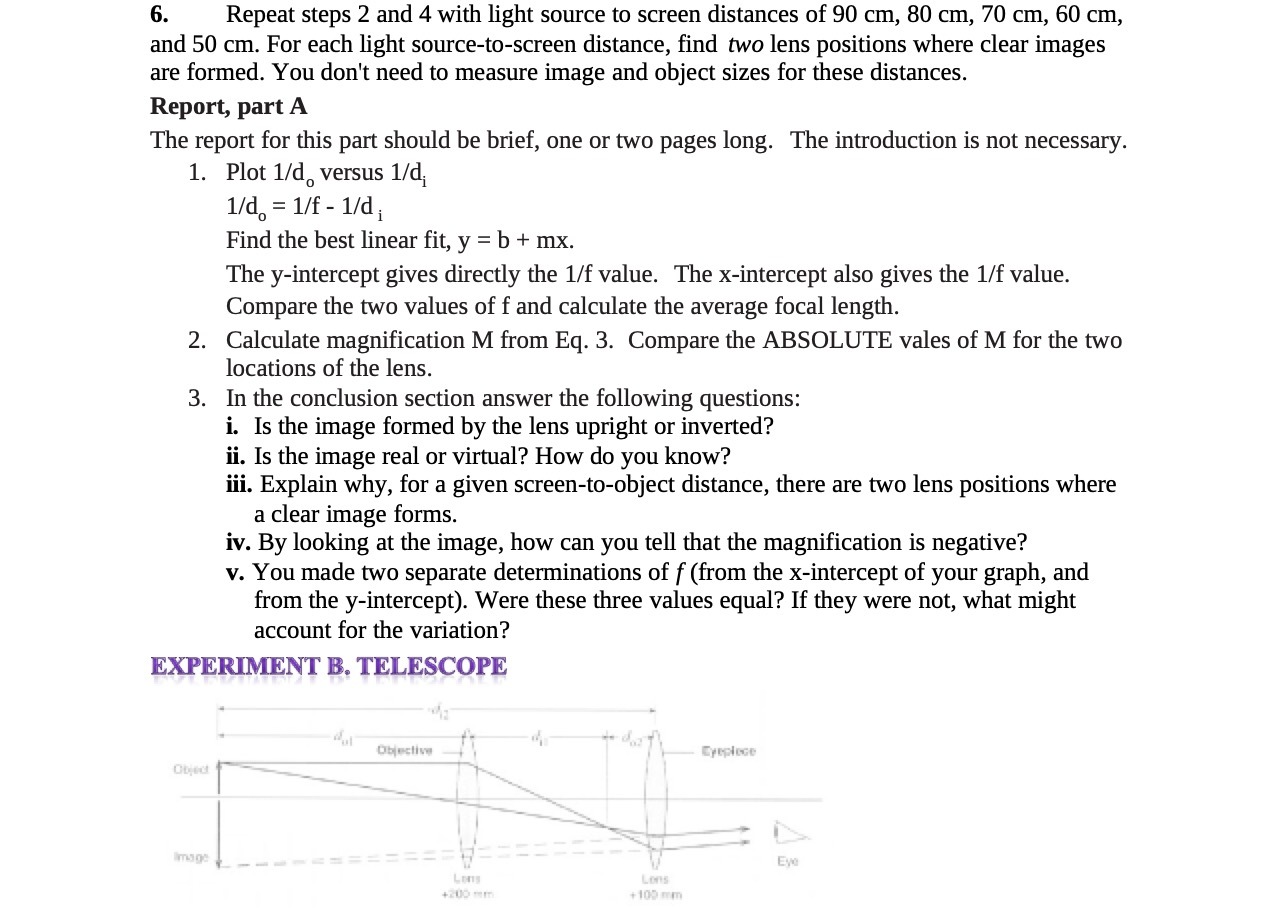
6. Repeat steps 2 and 4 with light source to screen distances of 90 cm, 80 cm, '70 cm, 60 cm, and 50 cm. For each light source-to-screen distance, nd two lens positions where clear images are formed. You don't need to measure image and object sizes for these distances. Report, part A The report for this part should be brief, one or two pages long. The introduction is not necessary. 1. Plot 1/da versus 1/di 11du = 11f - lidi Find the best linear fit, y = b + mx. The yintercept gives directly the lff value. The xintercept also gives the l/f value. Compare the two values of f and calculate the average focal length. 2. Calculate magnication M from Eq. 3. Compare the ABSOLUTE vales of M for the two locations of the lens. 3. In the conclusion section answer the following questions: i. Is the image formed by the lens upright or inverted? ii. Is the image real or virtual? How do you know? iii. Explain why, for a given screentoobject distance, there are two lens positions where a clear image forms. iv. By looking at the image, how can you tell that the magnication is negative? v. You made two separate determinations of f (from the xintercept of your graph, and from the y-intercept). Were these three values equal? If they were not, what might account for the variation? EXPERIMENT B. TELESCOPE - : l_I:1|.-_I|Iw . . . l'"""'"
Step by Step Solution
There are 3 Steps involved in it

Get step-by-step solutions from verified subject matter experts
 Study Help