







Question: 6 Return on Invested Capital The basic source of value creation is competitive advantage. The following expression expands the expression of ROIC proposed in Chapter
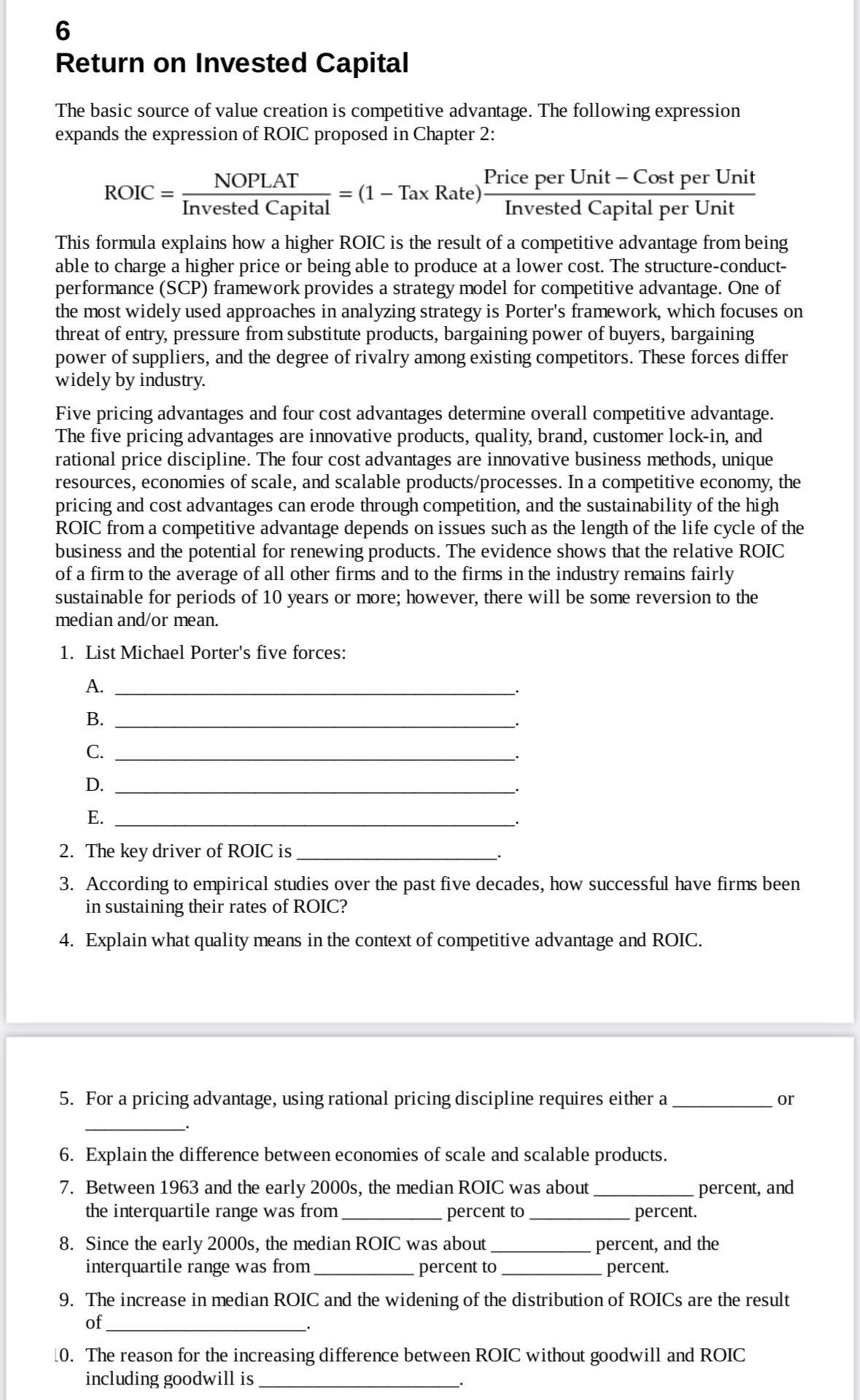
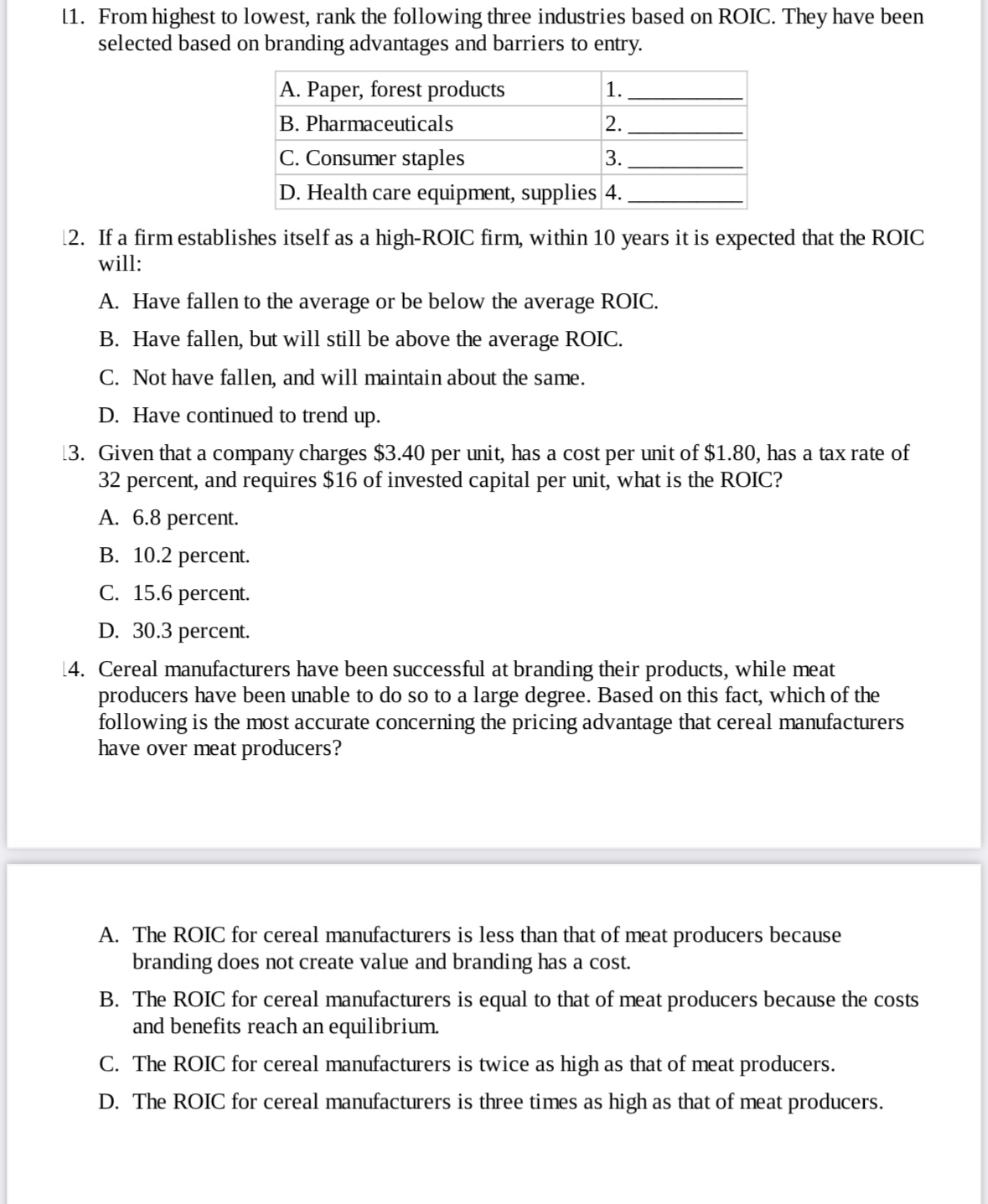
6 Return on Invested Capital The basic source of value creation is competitive advantage. The following expression expands the expression of ROIC proposed in Chapter 2: ROIC=InvestedCapitalNOPLAT=(1TaxRate)InvestedCapitalperUnitPriceperUnitCostperUnit This formula explains how a higher ROIC is the result of a competitive advantage from being able to charge a higher price or being able to produce at a lower cost. The structure-conductperformance (SCP) framework provides a strategy model for competitive advantage. One of the most widely used approaches in analyzing strategy is Porter's framework, which focuses on threat of entry, pressure from substitute products, bargaining power of buyers, bargaining power of suppliers, and the degree of rivalry among existing competitors. These forces differ widely by industry. Five pricing advantages and four cost advantages determine overall competitive advantage. The five pricing advantages are innovative products, quality, brand, customer lock-in, and rational price discipline. The four cost advantages are innovative business methods, unique resources, economies of scale, and scalable products/processes. In a competitive economy, the pricing and cost advantages can erode through competition, and the sustainability of the high ROIC from a competitive advantage depends on issues such as the length of the life cycle of the business and the potential for renewing products. The evidence shows that the relative ROIC of a firm to the average of all other firms and to the firms in the industry remains fairly sustainable for periods of 10 years or more; however, there will be some reversion to the median and/or mean. 1. List Michael Porter's five forces: A. B. C. D. E. 2. The key driver of ROIC is 3. According to empirical studies over the past five decades, how successful have firms been in sustaining their rates of ROIC? 4. Explain what quality means in the context of competitive advantage and ROIC. 5. For a pricing advantage, using rational pricing discipline requires either a or 6. Explain the difference between economies of scale and scalable products. 7. Between 1963 and the early 2000s, the median ROIC was about percent, and the interquartile range was from percent to percent. 8. Since the early 2000s, the median ROIC was about percent, and the interquartile range was from percent to percent. 9. The increase in median ROIC and the widening of the distribution of ROICs are the result of L. The reason for the increasing difference between ROIC without goodwill and ROIC including goodwill is 11. From highest to lowest, rank the following three industries based on ROIC. They have been selected based on branding advantages and barriers to entry. 2. If a firm establishes itself as a high-ROIC firm, within 10 years it is expected that the ROIC will: A. Have fallen to the average or be below the average ROIC. B. Have fallen, but will still be above the average ROIC. C. Not have fallen, and will maintain about the same. D. Have continued to trend up. 3. Given that a company charges $3.40 per unit, has a cost per unit of $1.80, has a tax rate of 32 percent, and requires $16 of invested capital per unit, what is the ROIC? A. 6.8 percent. B. 10.2 percent. C. 15.6 percent. D. 30.3 percent. 4. Cereal manufacturers have been successful at branding their products, while meat producers have been unable to do so to a large degree. Based on this fact, which of the following is the most accurate concerning the pricing advantage that cereal manufacturers have over meat producers? A. The ROIC for cereal manufacturers is less than that of meat producers because branding does not create value and branding has a cost. B. The ROIC for cereal manufacturers is equal to that of meat producers because the costs and benefits reach an equilibrium. C. The ROIC for cereal manufacturers is twice as high as that of meat producers. D. The ROIC for cereal manufacturers is three times as high as that of meat producers
Step by Step Solution
There are 3 Steps involved in it

Get step-by-step solutions from verified subject matter experts
 Study Help