







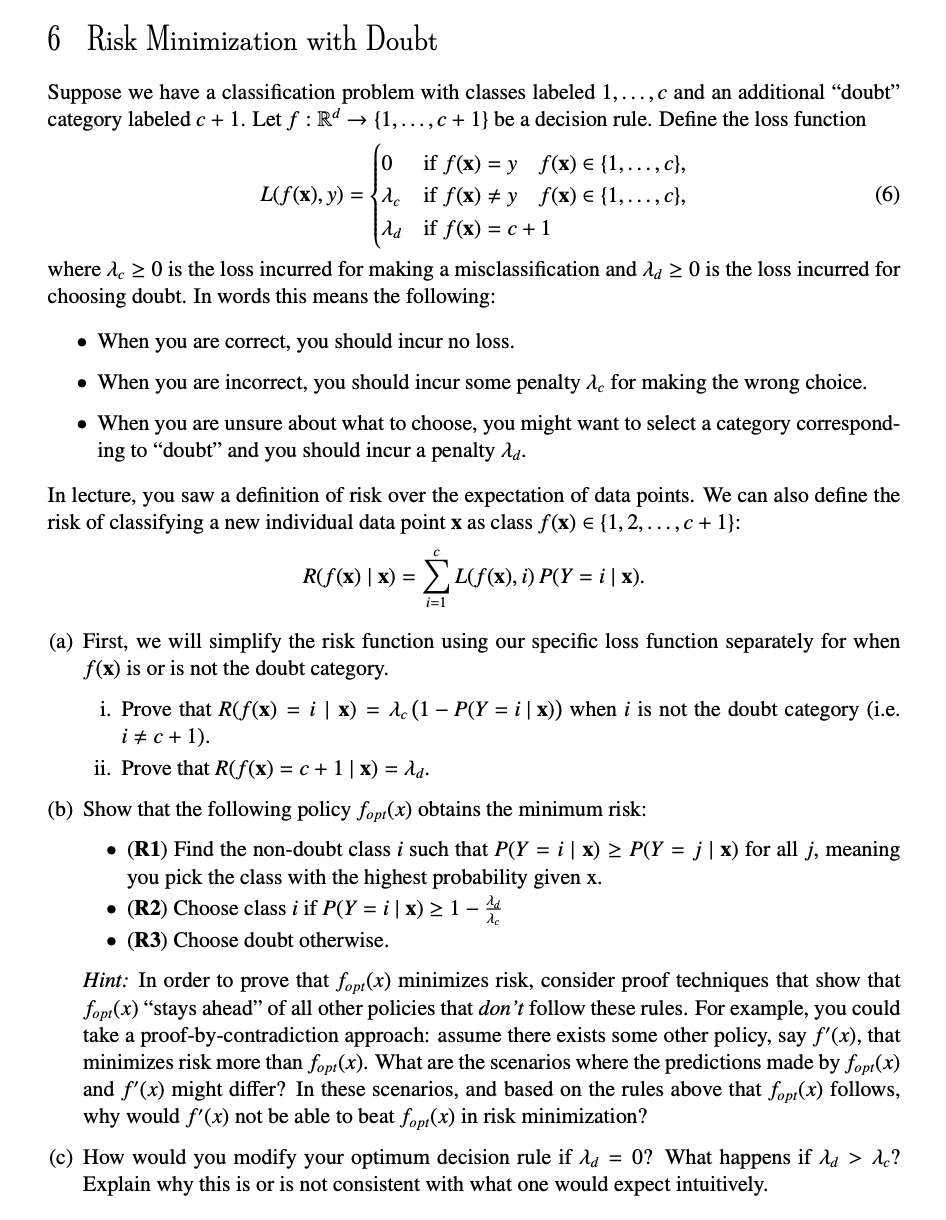
Question: 6 Risk Minimization with Doubt Suppose we have a classification problem with classes labeled 1 , dots,c and an additional doubt category labeled c +
Risk Minimization with Doubt
Suppose we have a classification problem with classes labeled dots,c and an additional "doubt"
category labeled c Let f:Rddots,c be a decision rule. Define the loss function
Lfxy if fxyfxindots,clambda c if fxyfxindots,clambda d if fxc:
where lambda c is the loss incurred for making a misclassification and lambda d is the loss incurred for
choosing doubt. In words this means the following:
When you are correct, you should incur no loss.
When you are incorrect, you should incur some penalty lambda c for making the wrong choice.
When you are unsure about what to choose, you might want to select a category correspond
ing to "doubt" and you should incur a penalty lambda d
In lecture, you saw a definition of risk over the expectation of data points. We can also define the
risk of classifying a new individual data point x as class fxindots,c :
Rfxxsumic LfxiPYix
a First, we will simplify the risk function using our specific loss function separately for when
fx is or is not the doubt category.
i Prove that Rfxixlambda cPYix when iic
ii Prove that Rfxcxlambda d
b Show that the following policy fopt x obtains the minimum risk:
R Find the nondoubt class i such that PYixPYjx for all j meaning
you pick the class with the highest probability given x
R Choose class i if PYixlambda dlambda c
R Choose doubt otherwise.
Hint: In order to prove that fopt x minimizes risk, consider proof techniques that show that
fopt x "stays ahead" of all other policies that don't follow these rules. For example, you could
take a proofbycontradiction approach: assume there exists some other policy, say fx that
minimizes risk more than fopt x What are the scenarios where the predictions made by fopt x
and fx might differ? In these scenarios, and based on the rules above that fopt x follows,
why would fx not be able to beat fopt x in risk minimization?
c How would you modify your optimum decision rule if lambda d What happens if lambda dlambda c
Explain why this is or is not consistent with what one would expect intuitively.
Step by Step Solution
There are 3 Steps involved in it
1 Expert Approved Answer
Step: 1 Unlock

Question Has Been Solved by an Expert!
Get step-by-step solutions from verified subject matter experts
Step: 2 Unlock
Step: 3 Unlock
 Study Help