







Question: 6. The long run is a time frame in which A) the quantities of some factors of production are fixed and the quantities of other
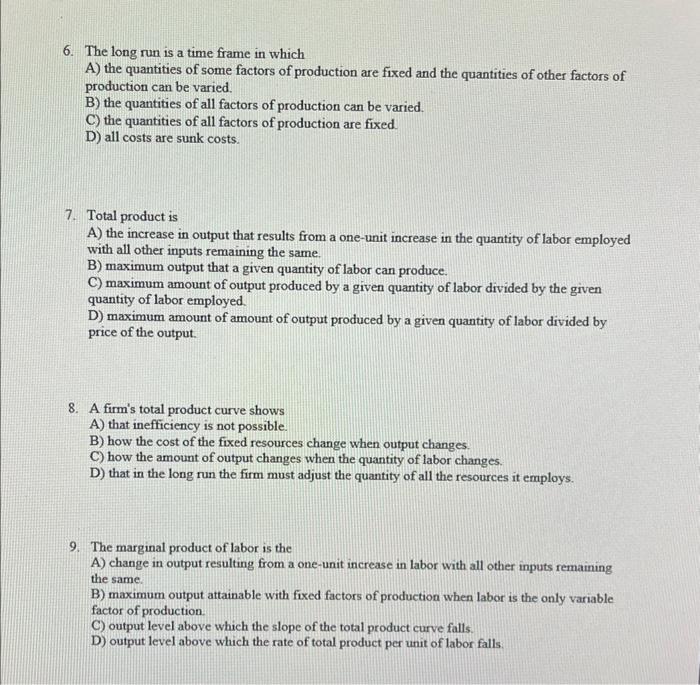
6. The long run is a time frame in which A) the quantities of some factors of production are fixed and the quantities of other factors of production can be varied. B) the quantities of all factors of production can be varied. C) the quantities of all factors of production are fixed. D) all costs are sunk costs. 7. Total product is A) the increase in output that results from a one-unit increase in the quantity of labor employed with all other inputs remaining the same. B) maximum output that a given quantity of labor can produce. C) maximum amount of output produced by a given quantity of labor divided by the given quantity of labor employed. D) maximum amount of amount of output produced by a given quantity of labor divided by price of the output. 8. A firm's total product curve shows A) that inefficiency is not possible. B) how the cost of the fixed resources change when output changes. C) how the amount of output changes when the quantity of labor changes. D) that in the long run the firm must adjust the quantity of all the resources it employs. 9. The marginal product of labor is the A) change in output resulting from a one-unit increase in labor with all other inputs remaining the same. B) maximum output attainable with fixed factors of production when labor is the only variable factor of production. C) output level above which the slope of the total product curve falls. D) output level above which the rate of total product per unit of labor falls
Step by Step Solution
There are 3 Steps involved in it

Get step-by-step solutions from verified subject matter experts
 Study Help