







Question: 6. There are two bins: Bin 1 initially has 3 white balls and 1 red ball. Bin 2 has 4 white balls. In every round,
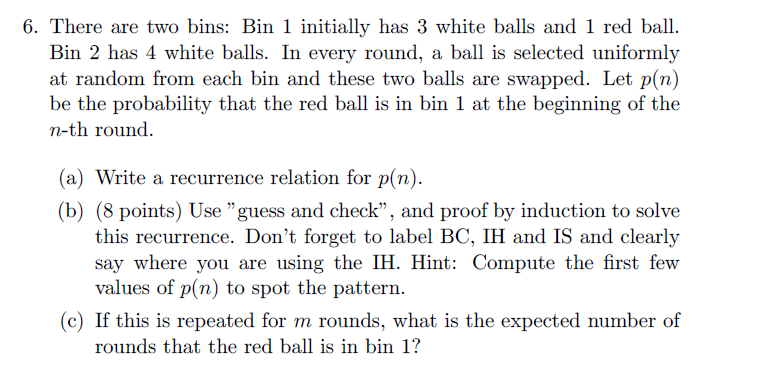
6. There are two bins: Bin 1 initially has 3 white balls and 1 red ball. Bin 2 has 4 white balls. In every round, a ball is selected uniformly at random from each bin and these two balls are swapped. Let p(n) be the probability that the red ball is in bin 1 at the beginning of the n-th round. (a) Write a recurrence relation for p(n). (b) (8 points) Use "guess and check, and proof by induction to solve this recurrence. Don't forget to label BC, IH and IS and clearly say where you are using the IH. Hint: Compute the first few values of p(n) to spot the pattern. (c) If this is repeated for m rounds, what is the expected number of rounds that the red ball is in bin 1? 6. There are two bins: Bin 1 initially has 3 white balls and 1 red ball. Bin 2 has 4 white balls. In every round, a ball is selected uniformly at random from each bin and these two balls are swapped. Let p(n) be the probability that the red ball is in bin 1 at the beginning of the n-th round. (a) Write a recurrence relation for p(n). (b) (8 points) Use "guess and check, and proof by induction to solve this recurrence. Don't forget to label BC, IH and IS and clearly say where you are using the IH. Hint: Compute the first few values of p(n) to spot the pattern. (c) If this is repeated for m rounds, what is the expected number of rounds that the red ball is in bin 1
Step by Step Solution
There are 3 Steps involved in it

Get step-by-step solutions from verified subject matter experts
 Study Help