







Question: 6) Use mylagrange in this problem. a) Plot the five Lagrange polynomials for the abscissas of the data points (1,3), (3,4), (4,2) (5,-1), (8,5)} for
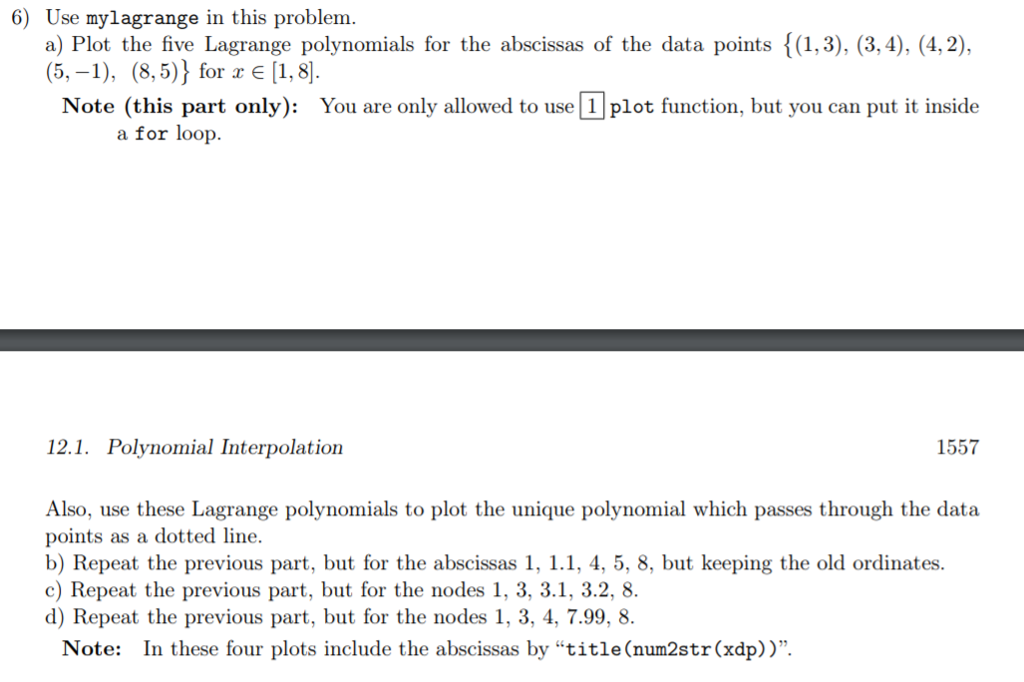
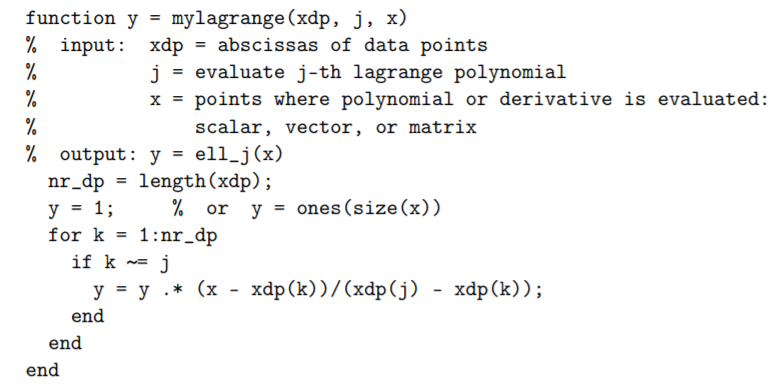
6) Use mylagrange in this problem. a) Plot the five Lagrange polynomials for the abscissas of the data points (1,3), (3,4), (4,2) (5,-1), (8,5)} for x ?[1,8]. Note (this part only): You are only allowed to use plot function, but you can put it inside a for loop 12.1. Polynomial Interpolation 1557 Also, use these Lagrange polynomials to plot the unique polynomial which passes through the data points as a dotted line. b) Repeat the previous part, but for the abscissas 1 11, 4, 5, 8, but keeping the old ordinates. c) Repeat the previous part, but for the nodes 1, 3, 3.1, 3.2, 8 d) Repeat the previous part, but for the nodes 1, 3, 4, 7.99, 8. Note: In these four plots include the abscissas by "title (num2str(xdp))" 6) Use mylagrange in this problem. a) Plot the five Lagrange polynomials for the abscissas of the data points (1,3), (3,4), (4,2) (5,-1), (8,5)} for x ?[1,8]. Note (this part only): You are only allowed to use plot function, but you can put it inside a for loop 12.1. Polynomial Interpolation 1557 Also, use these Lagrange polynomials to plot the unique polynomial which passes through the data points as a dotted line. b) Repeat the previous part, but for the abscissas 1 11, 4, 5, 8, but keeping the old ordinates. c) Repeat the previous part, but for the nodes 1, 3, 3.1, 3.2, 8 d) Repeat the previous part, but for the nodes 1, 3, 4, 7.99, 8. Note: In these four plots include the abscissas by "title (num2str(xdp))
Step by Step Solution
There are 3 Steps involved in it

Get step-by-step solutions from verified subject matter experts
 Study Help