Question: 60). The second case is about Greg Mortense (1990). The second promote schools and peace when he was accused of 1, about Betty Ford, former
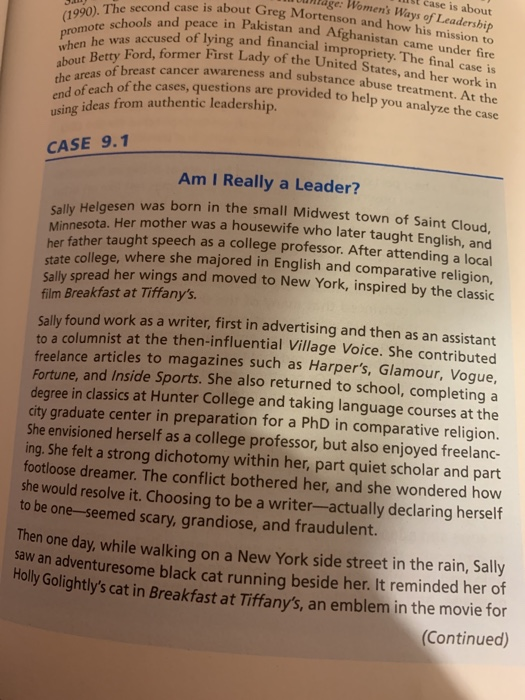
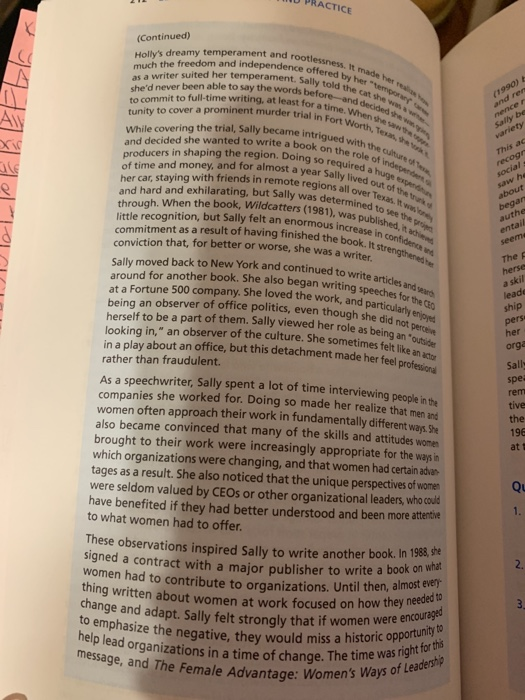
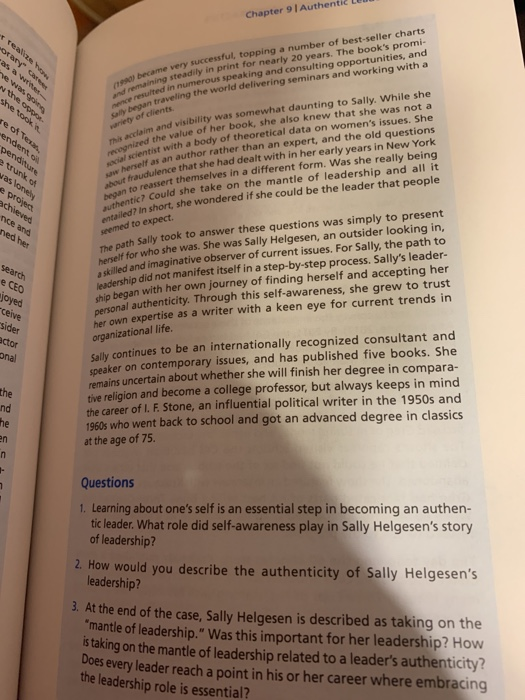
60). The second case is about Greg Mortense (1990). The second promote schools and peace when he was accused of 1, about Betty Ford, former First I the areas of breast cancer 111st case is about rage: Women's Ways of Leadership Greg Mortenson and how his mission to d peace in Pakistan and Afghanistan came under fire used of lying and financial impropriety. The final case is mer First Lady of the United States, and her work in cancer awareness and substance abuse treatment. At the estions are provided to help you analyze the case end of each of the sing ideas from authentic leadership. CASE 9.1 Am I Really a Leader? telgesen was born in the small Midwest town of Saint Cloud. cota. Her mother was a housewife who later taught English, and of father taught speech as a college professor. After attending a local ate college, where she majored in English and comparative religion pread her wings and moved to New York, inspired by the classic film Breakfast at Tiffany's. Sally found work as a writer, first in advertising and then as an assistant to a columnist at the then-influential Village Voice. She contributed freelance articles to magazines such as Harper's, Glamour, Voque. Fortune, and Inside Sports. She also returned to school, completing a degree in classics at Hunter College and taking language courses at the city graduate center in preparation for a PhD in comparative religion. She envisioned herself as a college professor, but also enjoyed freelanc- ing. She felt a strong dichotomy within her, part quiet scholar and part footloose dreamer. The conflict bothered her, and she wondered how she would resolve it. Choosing to be a writer-actually declaring herself to be one-seemed scary, grandiose, and fraudulent. en one day, while walking on a New York side street in the rain, Sally venturesome black cat running beside her. It reminded her of ugntly's cat in Breakfast at Tiffany's, an emblem in the movie for (Continued) Holly Golightly's cat in MD PRACTICE (Continued) Molly's dreamy temperament and rootie ich the freedom and independence of a writer suited her temperament. Sally dnever been able to say the words befo to commit to full-time writing, at least for tunity to cover a prominent murder trial ness. It made het te ered by the sold the cathew and decided the ime. Wiven Fort Worth, Texas, the with the culture dle of de equired a huge te ved out of the truth over Texas ermined to see the and decided she wanted to JULLEREDO Sally be variety This ac recogr socials about was pubistved, Increase in confident ook. It strengthenede began authe entail seemd The f herse a skil while covering the trial, Sally became intrigu ed she wanted to write a book on the role producers in shaping the region. Doing sore of time and money, and for almost a year Sally ber car staying with friends in remote regions and hard and exhilarating, but Sally was deter through. When the book, Wildcatters (1981) little recognition, but Sally felt an enormous in commitment as a result of having finished the book it conviction that, for better or worse, she was a writer Sally moved back to New York and continued to write around for another book. She also began writing se at a Fortune 500 company. She loved the work, and partie being an observer of office politics, even though she did herself to be a part of them. Sally viewed her role as being looking in," an observer of the culture. She sometimes felt lib. in a play about an office, but this detachment made her to rather than fraudulent. As a speechwriter, Sally spent a lot of time interviewing companies she worked for. Doing so made her realize that men women often approach their work in fundamentally different also became convinced that many of the skills and attitudes wome brought to their work were increasingly appropriate for the ways in which organizations were changing, and that women had certain adva tages as a result. She also noticed that the unique perspectives of women were seldom valued by CEOs or other organizational leaders, who cove have benefited if they had better understood and been more attent to what women had to offer. to write artides and writing speeches for the to particularly ripped she did not perce role as being an outside imes felt like an act ade her feel professional leade ship of the cultured her role as did not pers her orga Sall: spe. rem tive the att signed a contract with a major publish women had to contribute to organi thing written about wome change and adapt. Sally felt strongly that if women w emphasize the negative they would miss a niston help lead organizations in a tim bservations inspired Sally to write another book. In 1988, a contract with a maior publisher to write a book on dd to contribute to organizations. Until then, almost the ten about women at work focused on how they nes If women were encouraged a historic opportunity to message, and The Fema "ganizations in a time of change. The time was rig and The Female Advantage: Women's Ways or me was right for this en's Ways of Leadership Chapter 9 | Authentic Le orary Cat ( me very successful, topping a number of best-seller charts ing steadily in print for nearly 20 years. The book's promi- sted in numerous speaking and consulting opportunities, and traveling the world delivering seminars and working with a ervdent penditure turkch Naslovely proper achieved nice and de resulted in Sy began traveling variety of clients The acclaim and magned the value a scientist with wherself as an about fraudulence and visibility was somewhat daunting to Sally. While she the value of her book, she also knew that she was not a ist with a body of theoretical data on women's issues. She alf as an author rather than an expert, and the old questions Julence that she had dealt with in her early years in New York assert themselves in a different form. Was she really being ic? Could she take on the mantle of leadership and all it 7 In short, she wondered if she could be the leader that people began to reassert then authentic? Could entailed in short she seemed to expect. red her e demoga search e CEO joyed wath Sally took to answer these questions was simply to present elf for who she was. She was Sally Helgesen, an outsider looking in, skilled and imaginative observer of current issues, For Sally, the path to adership did not manifest itself in a step-by-step process. Sally's leader- ship began with her own journey of finding herself and accepting her personal authenticity. Through this self-awareness, she grew to trust her own expertise as a writer with a keen eye for current trends in organizational life. ceive sider actor onal Sally continues to be an internationally recognized consultant and speaker on contemporary issues, and has published five books. She remains uncertain about whether she will finish her degree in compara- tive religion and become a college professor, but always keeps in mind the career of I. F. Stone, an influential political writer in the 1950s and 1960s who went back to school and got an advanced degree in classics at the age of 75. Questions 1. Learning about one's self is an essential step in becoming an authen- tic leader. What role did self-awareness play in Sally Helgesen's story of leadership? 2. How would you describe the authenticity of Sally Helgesen's leadership? 5. At the end of the case, Sally Helgesen is described as taking on the mantle of leadership." Was this important for her leadership? How s taking on the mantle of leadership related to a leader's authenticity? Does every leader reach a point in his or her career where embracing the leadership role is essential









 Study Help