







Question: 6.To hardwire the sign bit for Floating Point Multiplication / Division: a) AND the sign bits of both operands b) use the sign bit of
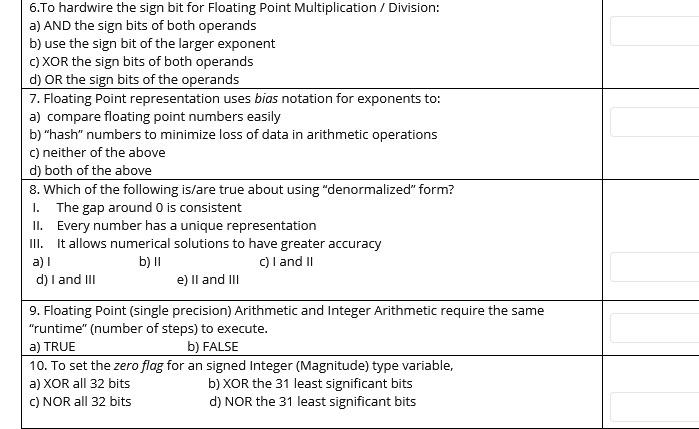
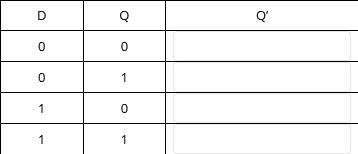
6.To hardwire the sign bit for Floating Point Multiplication / Division: a) AND the sign bits of both operands b) use the sign bit of the larger exponent C) XOR the sign bits of both operands d) OR the sign bits of the operands 7. Floating Point representation uses bias notation for exponents to: a) compare floating point numbers easily b) "hash" numbers to minimize loss of data in arithmetic operations c) neither of the above d) both of the above 8. Which of the following is/are true about using "denormalized" form? 1. The gap around O is consistent II. Every number has a unique representation It allows numerical solutions to have greater accuracy a) b) | C) I and II d) I and III e) II and III 9. Floating Point (single precision) Arithmetic and Integer Arithmetic require the same "runtime" (number of steps) to execute. a) TRUE b) FALSE 10. To set the zero flag for an signed Integer (Magnitude) type variable, a) XOR all 32 bits b) XOR the 31 least significant bits C) NOR all 32 bits d) NOR the 31 least significant bits III. D Q Q 0 0 0 1 1 0 1 1
Step by Step Solution
There are 3 Steps involved in it

Get step-by-step solutions from verified subject matter experts
 Study Help