







Question: 7. (10 pts.) Suppose a stream cipher uses the CRC checksum algorithm CRC-32Q algorithm (http://crccalc.com) that uses an initial value of zero and without post-processing
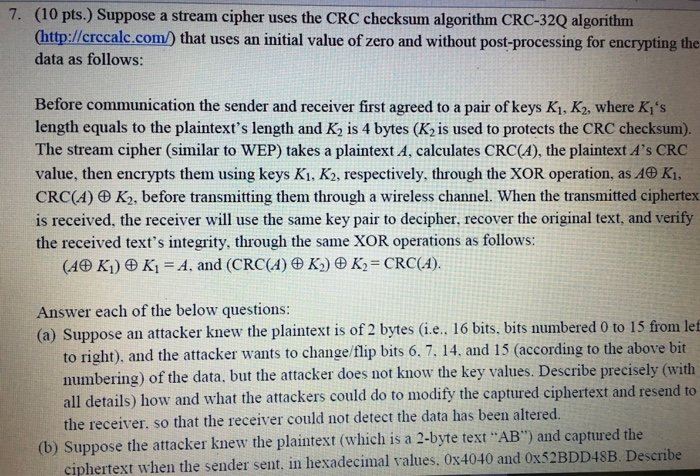

7. (10 pts.) Suppose a stream cipher uses the CRC checksum algorithm CRC-32Q algorithm (http://crccalc.com) that uses an initial value of zero and without post-processing for encrypting the data as follows: Before communication the sender and receiver first agreed to a pair of keys Ki, K2, where K's length equals to the plaintext's length and K2 is 4 bytes (K2 is used to protects the CRC checksum) The stream cipher (similar to WEP) takes a plaintext A, calculates CRC(A), the plaintext A's CRC value, then encrypts them using keys Ki, K2, respectively, through the XOR operation, as AKi CRC(d)K2, before transmitting them through a wireless channel, when the transmitted ciphertex is received, the receiver will use the same key pair to decipher, recover the original text, and verify the received text's integrity, through the same XOR operations as follows: Answer each of the below questions: (a) Suppose an attacker knew the plaintext is of 2 bytes (i.e. 16 bits, bits numbered 0 to 15 from le to right), and the attacker wants to change/flip bits 6. 7, 14, and 15 (according to the above bit numbering) of the data, but the attacker does not know the key values. Describe precisely (with all details) how and what the attackers could do to modify the captured ci the receiver. so that the receiver could not detect the data has been altered. phertext and resend to (b) Suppose the attacker knew the plaintext (which is a 2-byte text AB") and captured the ciphertext when the sender sent, in lhexadecimal values. 0x4040 and 0x52BDD48B. Describ
Step by Step Solution
There are 3 Steps involved in it

Get step-by-step solutions from verified subject matter experts
 Study Help