







Question: 7. /5 Generate a frequency table and histogram for one of question 1-17 that does result in a symmetrical-unimodal distribution. Question #_ Score Frequency 1
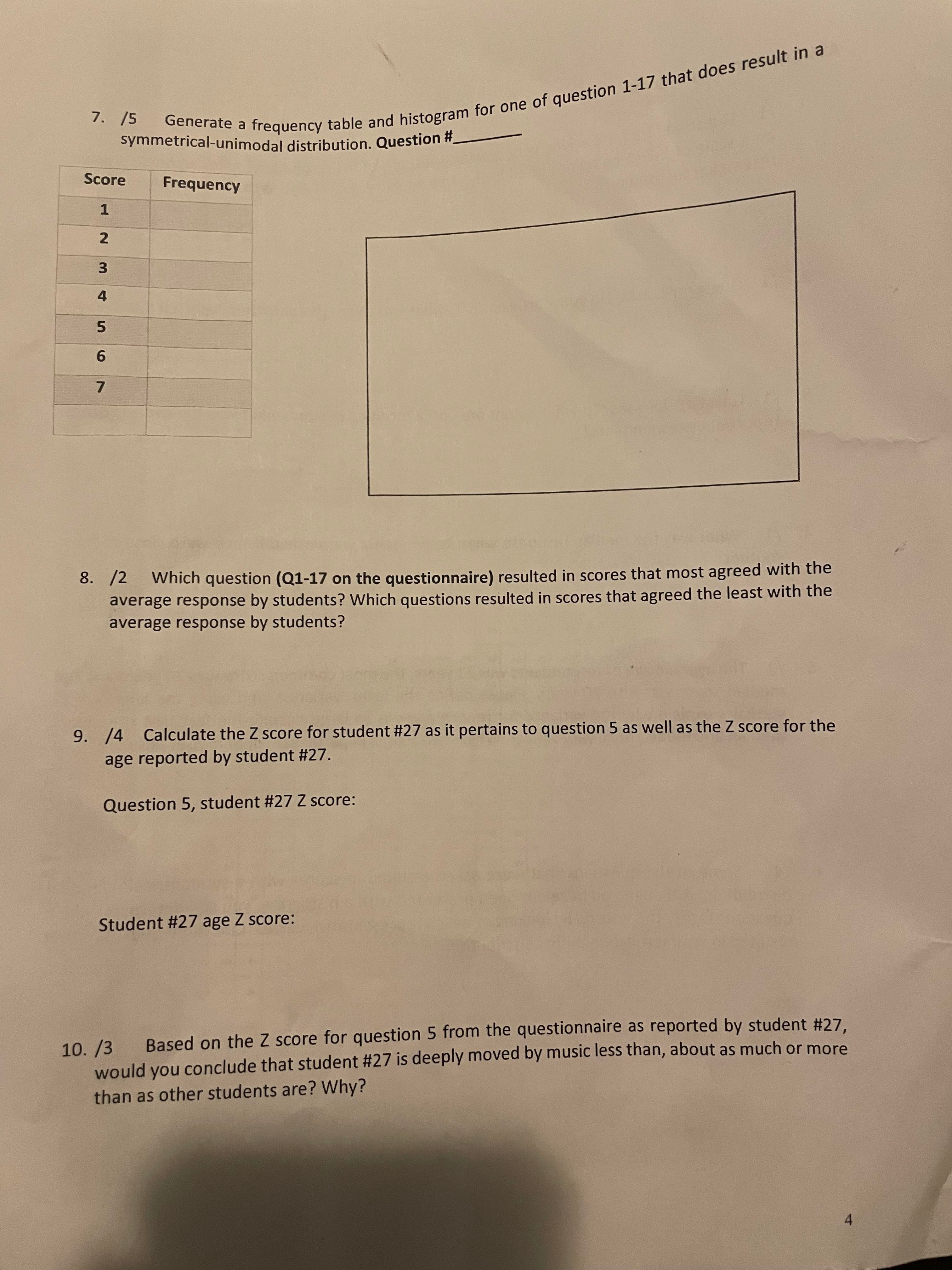
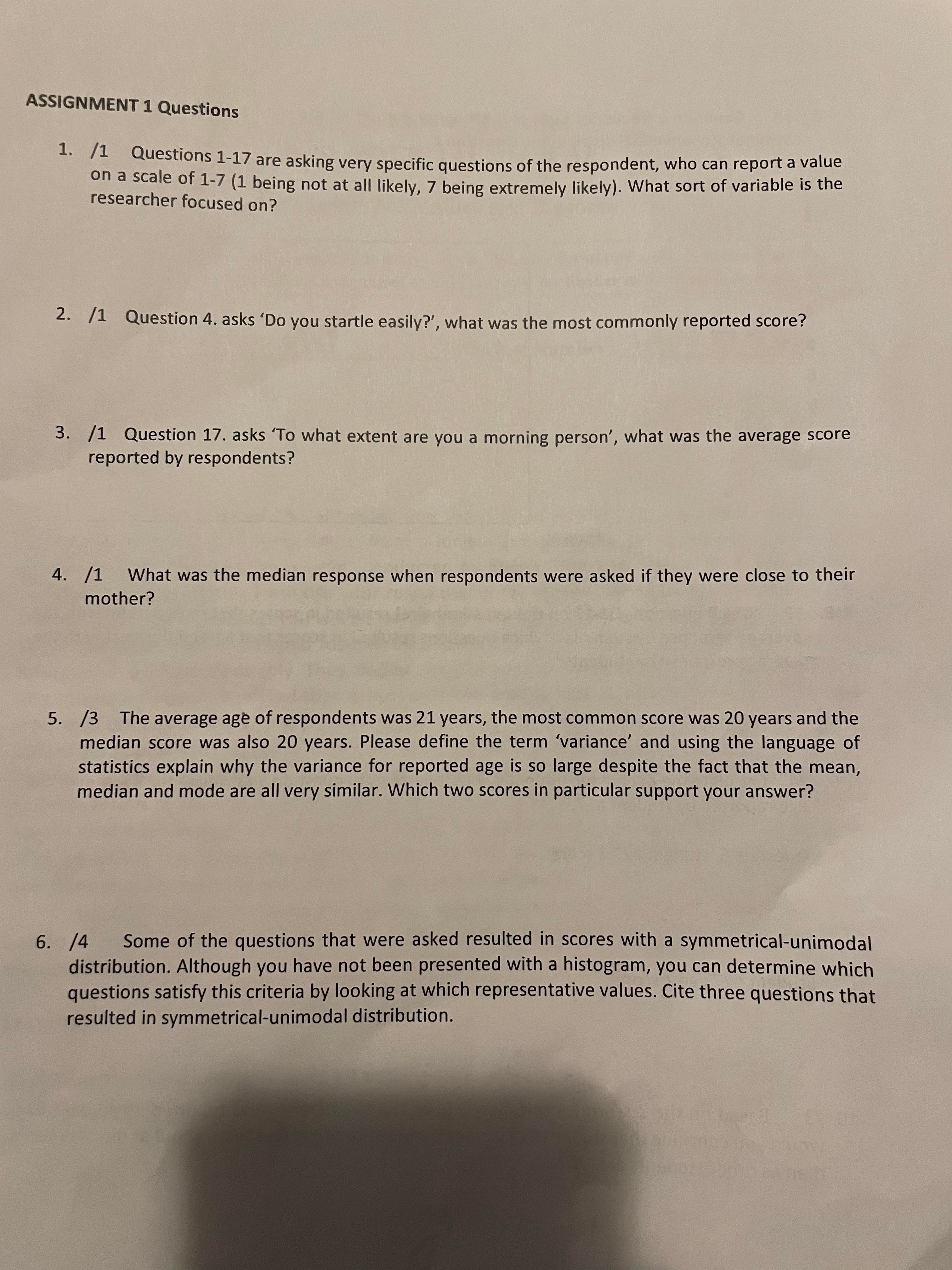
7. /5 Generate a frequency table and histogram for one of question 1-17 that does result in a symmetrical-unimodal distribution. Question #_ Score Frequency 1 2 W 4 6 7 8. /2 Which question (Q1-17 on the questionnaire) resulted in scores that most agreed with the average response by students? Which questions resulted in scores that agreed the least with the average response by students? 9. /4 Calculate the Z score for student #27 as it pertains to question 5 as well as the Z score for the age reported by student #27. Question 5, student #27 Z score: Student #27 age Z score: 10. /3 Based on the Z score for question 5 from the questionnaire as reported by student #27, would you conclude that student #27 is deeply moved by music less than, about as much or more than as other students are? Why?ASSIGNMENT 1 Questions 1. /1 Questions 1-17 are asking very specific questions of the respondent, who can report a value on a scale of 1-7 (1 being not at all likely, 7 being extremely likely). What sort of variable is the researcher focused on? 2. /1 Question 4. asks 'Do you startle easily?', what was the most commonly reported score? 3. /1 Question 17. asks 'To what extent are you a morning person', what was the average score reported by respondents? 4. /1 What was the median response when respondents were asked if they were close to their mother? 5. /3 The average age of respondents was 21 years, the most common score was 20 years and the median score was also 20 years. Please define the term 'variance' and using the language of statistics explain why the variance for reported age is so large despite the fact that the mean, median and mode are all very similar. Which two scores in particular support your answer? 6. /4 Some of the questions that were asked resulted in scores with a symmetrical-unimodal distribution. Although you have not been presented with a histogram, you can determine which questions satisfy this criteria by looking at which representative values. Cite three questions that resulted in symmetrical-unimodal distribution
Step by Step Solution
There are 3 Steps involved in it

Get step-by-step solutions from verified subject matter experts
 Study Help