







Question: 7. 8. 9. An experiment is conducted using a fin as shown below. Temperature readings are collected along the length of the fin, which
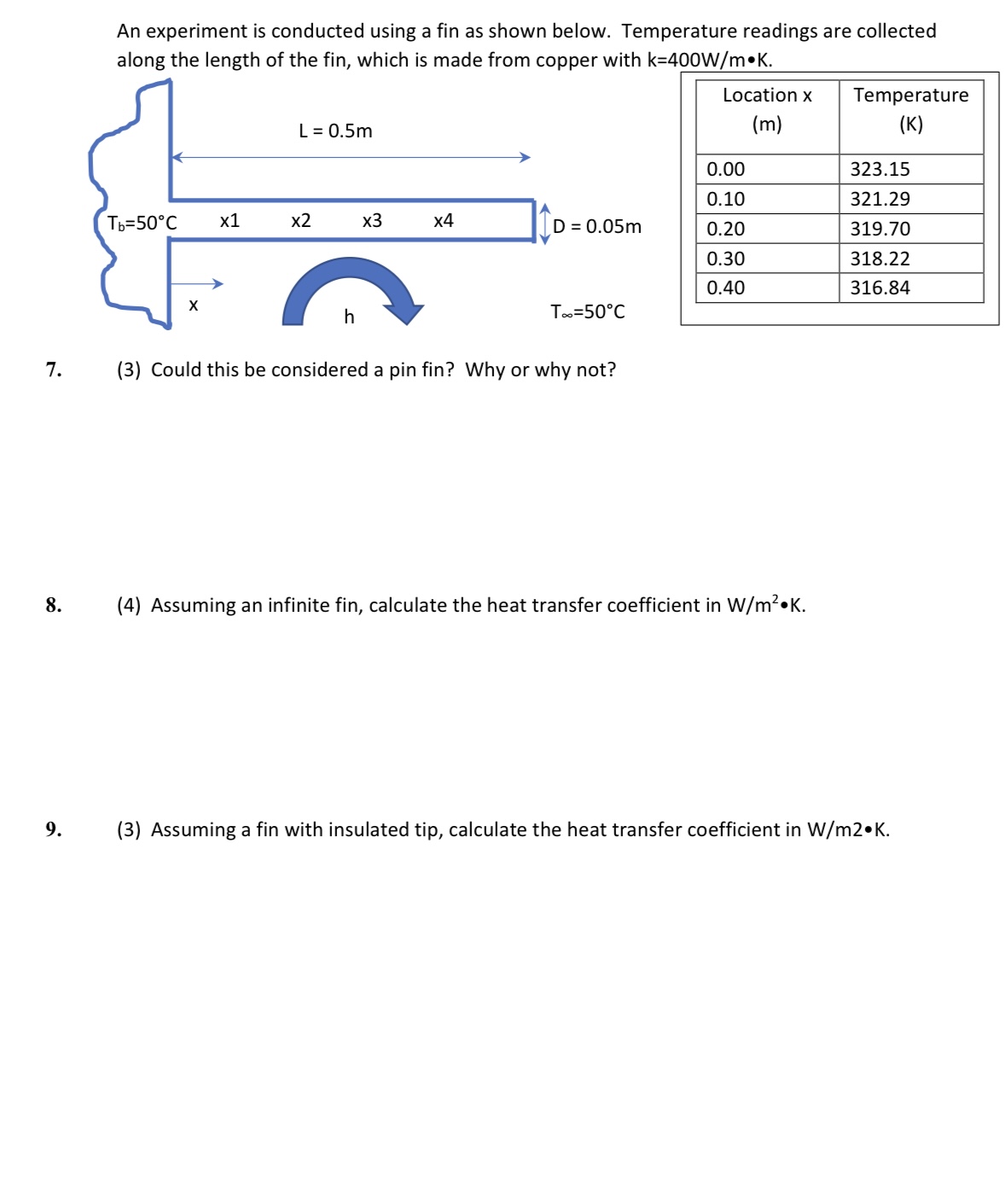
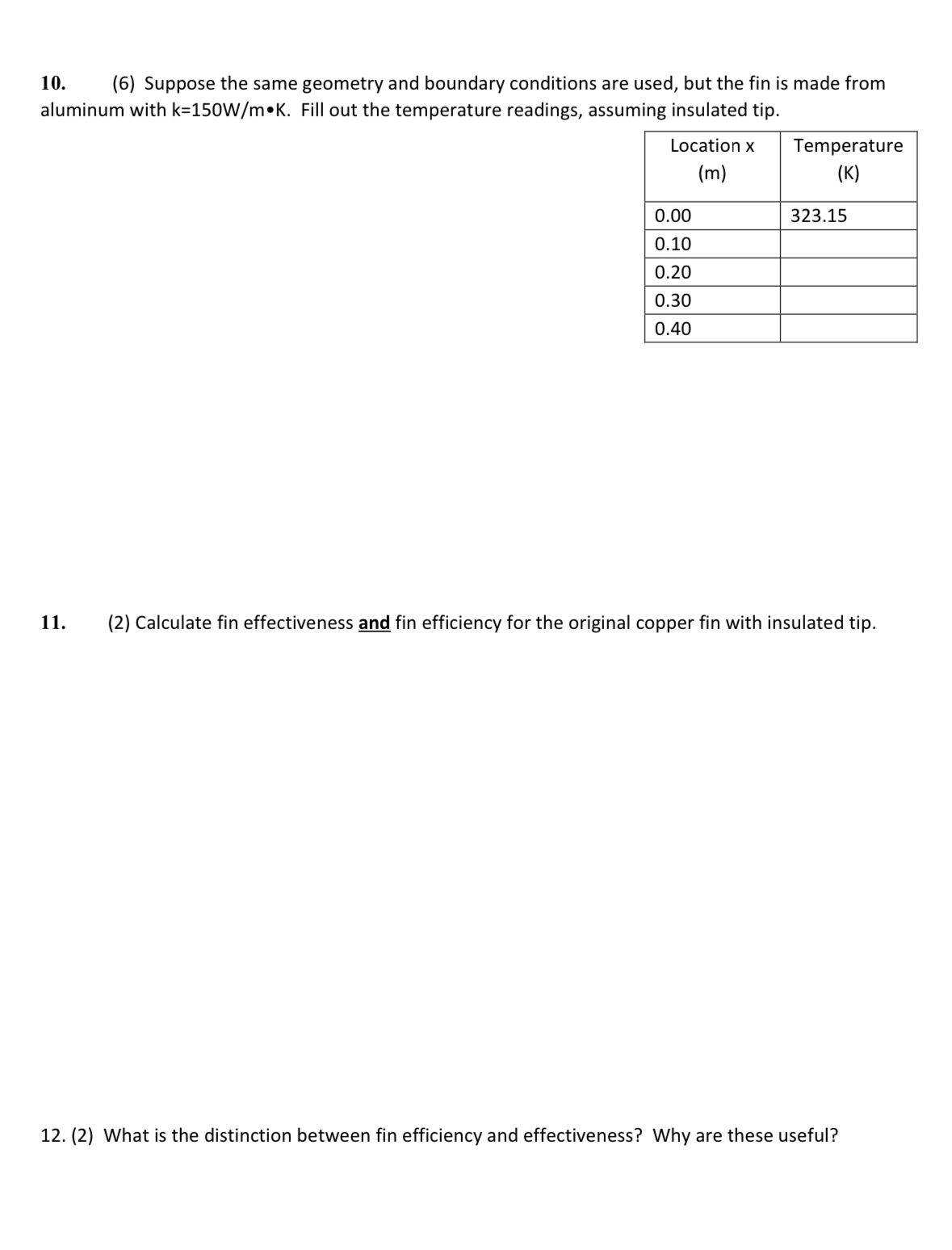
7. 8. 9. An experiment is conducted using a fin as shown below. Temperature readings are collected along the length of the fin, which is made from copper with k-400W/m.K. Tb=50C x1 X L = 0.5m x2 h x3 x4 D = 0.05m T=50C (3) Could this be considered a pin fin? Why or why not? Location x (m) 0.00 0.10 0.20 0.30 0.40 (4) Assuming an infinite fin, calculate the heat transfer coefficient in W/m.K. Temperature (K) 323.15 321.29 319.70 318.22 316.84 (3) Assuming a fin with insulated tip, calculate the heat transfer coefficient in W/m2.K. 10. (6) Suppose the same geometry and boundary conditions are used, but the fin is made from aluminum with k=150W/m K. Fill out the temperature readings, assuming insulated tip. Location x (m) 0.00 0.10 0.20 0.30 0.40 Temperature (K) 323.15 11. (2) Calculate fin effectiveness and fin efficiency for the original copper fin with insulated tip. 12. (2) What is the distinction between fin efficiency and effectiveness? Why are these useful?
Step by Step Solution
There are 3 Steps involved in it
Solutions Step 1 Yes it is a pin fin because heat transfer from the fin surface is evident Pin fins ... View full answer

Get step-by-step solutions from verified subject matter experts
 Study Help