







Question: 7. (8 points) Utility. Suppose we have two cities, 1 and 2. Assume every individual has the same utility function given by: u(wy, tj) =
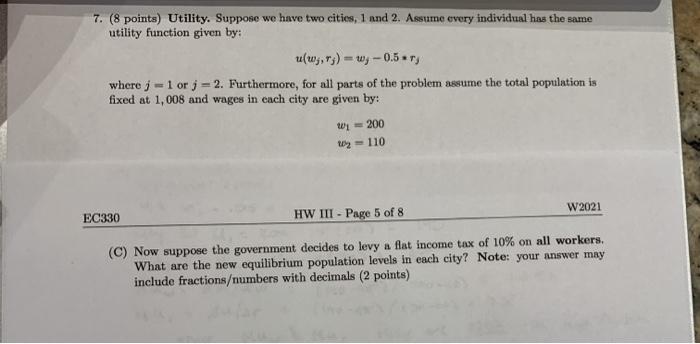
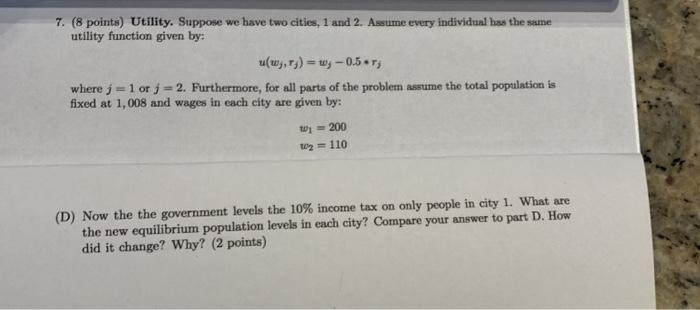
7. (8 points) Utility. Suppose we have two cities, 1 and 2. Assume every individual has the same utility function given by: u(wy, tj) = w; -0.5- where j - 1 or j = 2. Furthermore, for all parts of the problem assume the total population is fixed at 1,008 and wages in each city are given by: to 200 t2 = 110 W2021 EC330 HW III - Page 5 of 8 (C) Now suppose the government decides to levy a flat income tax of 10% on all workers. What are the new equilibrium population levels in each city? Note: your answer may include fractionsumbers with decimals (2 points) 7. (8 points) Utility. Suppose we have two cities, 1 and 2. Assume every individual has the same utility function given by: u(wy, ty) = -0.5.73 where j = 1 or j = 2. Furthermore, for all parts of the problem assume the total population is fixed at 1,008 and wages in each city are given by: to = 200 02 = 110 (D) Now the the government levels the 10% income tax on only people in city 1. What are the new equilibrium population levels in each city? Compare your answer to part D. How did it change? Why? (2 points) 7. (8 points) Utility. Suppose we have two cities, 1 and 2. Assume every individual has the same utility function given by: u(wy, tj) = w; -0.5- where j - 1 or j = 2. Furthermore, for all parts of the problem assume the total population is fixed at 1,008 and wages in each city are given by: to 200 t2 = 110 W2021 EC330 HW III - Page 5 of 8 (C) Now suppose the government decides to levy a flat income tax of 10% on all workers. What are the new equilibrium population levels in each city? Note: your answer may include fractionsumbers with decimals (2 points) 7. (8 points) Utility. Suppose we have two cities, 1 and 2. Assume every individual has the same utility function given by: u(wy, ty) = -0.5.73 where j = 1 or j = 2. Furthermore, for all parts of the problem assume the total population is fixed at 1,008 and wages in each city are given by: to = 200 02 = 110 (D) Now the the government levels the 10% income tax on only people in city 1. What are the new equilibrium population levels in each city? Compare your answer to part D. How did it change? Why? (2 points)
Step by Step Solution
There are 3 Steps involved in it

Get step-by-step solutions from verified subject matter experts
 Study Help