



Question: 7. Agency conflicts between managers and shareholders Remember, an agency relationship can degenerate into an agency confict when an agent acts in a manner that
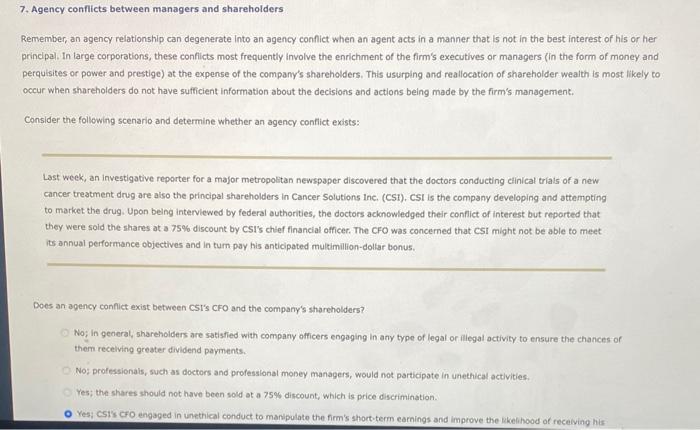
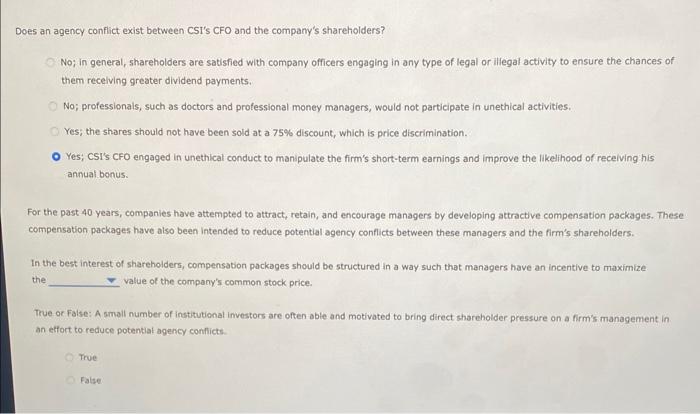
7. Agency conflicts between managers and shareholders Remember, an agency relationship can degenerate into an agency confict when an agent acts in a manner that is not in the best interest of his or her prindipal. In large corporations, these conflicts most frequently involve the enrichment of the firm's executives or managers (in the form of money and perquisites or power and prestige) at the expense of the company's shareholders. This usurping and reallocation of shareholder wealth is most likely to occur when shareholders do not have sufficient information about the decisions and actions being made by the firm's management. Consider the following scenario and determine whether an agency conflict exists: Last week, an investigative reporter for a major metropolitan newspaper discovered that the doctors conducting elinical triais of a new Cancer treatment drug are also the principal shareholders in Cancer Solutions inc. (CS1). CSI is the company developing and attempting to market the drug. Upon belng interviewed by federal authorities, the doctors acknowledged their conflict of interest but reported that they were sold the shares at a 75% discount by CSI's chlef financial officer. The CFO was concerned that CSI might not be able to meet its annual performance objectives and in turn pay his anticipated multimillion-dollar bonus. Does an agency confict exist between CSI's CFO and the company's shareholders? No; in generat, shareholders are satisfied with company officers engaging in any type of legal or illegal activity to ensure the chances of them recelving greater dividend payments. No: professionals, such as doctors and professional money managers, would not participate in unethical activities. Yes; the shares should not have been sold at a 75% ditcount, which is price discrimination. Yes; CSIs cro engaged in unethical conduct to manipulate the firm's shortiterm earnings and improve the likeihood of receiving his Does an agency conflict exist between CSI's CFO and the company's shareholders? No; in general, shareholders are satisfied with company officers engaging in any type of legal or illegal activity to ensure the chances of them recelving greater dividend payments. No; professionals, such as doctors and professional money managers, would not participate in unethical activities. Yes; the shares should not have been sold at a 75% discount, which is price discrimination. Yes; CSI's CFO engaged in unethical conduct to manipulate the firm's short-term earnings and improve the likelihood of receiving his annualbonus. For the past 40 years, companies have attempted to attract, retain, and encourage managers by developing attractive compensation packages. These compensation packages have also been intended to reduce potential agency conflicts between these managers and the firm's shareholders. In the best interest of shareholders, compensation packages should be structured in a way such that managers have an incentive to maximize the value of the company's common stock price. Thue or False: A small number of institutional investors are often able and motivated to bring direct shareholder pressure on a firm's management in an effort to reduce potential agency conflicts. True False
Step by Step Solution
There are 3 Steps involved in it

Get step-by-step solutions from verified subject matter experts