







Question: 7. Besides fork... join and begin... end, SystemVerilog introduces fork.. join none and fork_.. join any to create threads. Please write the outputs of
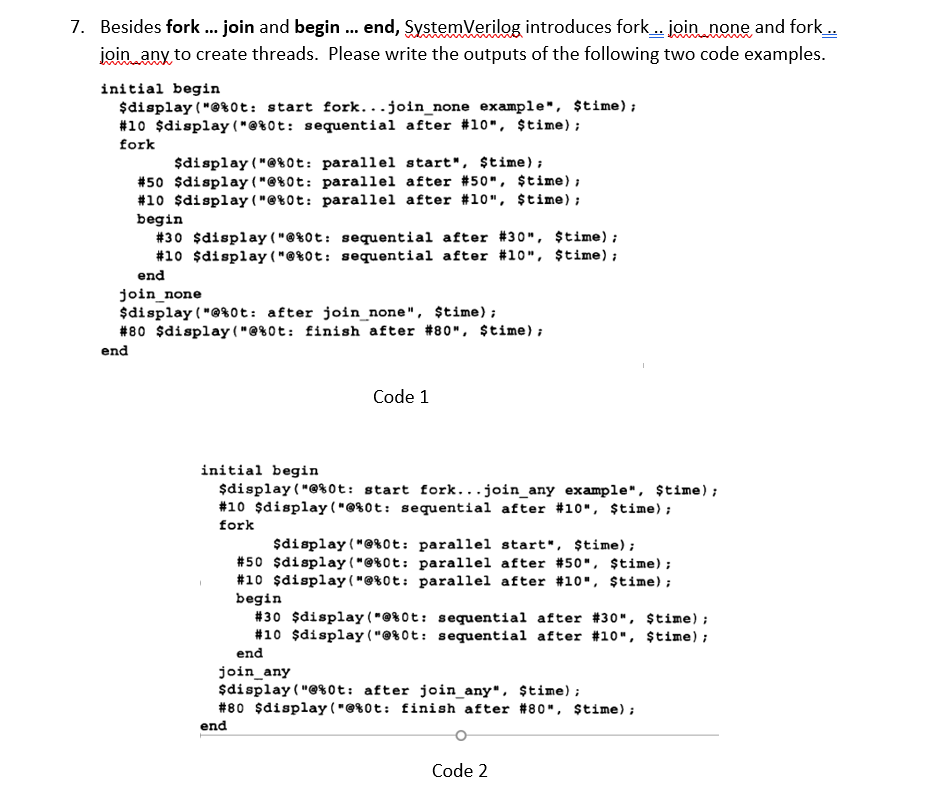
7. Besides fork... join and begin... end, SystemVerilog introduces fork.. join none and fork_.. join any to create threads. Please write the outputs of the following two code examples. initial begin $display("@%0t: start fork...join_none example", $time); #10 $display ("@%0t: sequential after #10", $time); fork $display ("@%0t: parallel start", $time); #50 $display ("@80t: parallel after #50", $time); #10 $display ("@%0t: parallel after #10", $time); begin #30 $display ("@%0t: sequential after # 30", $time); # 10 $display ("@%0t: sequential after #10", $time); end join_none $display ("@%0t: after join_none", $time); #80 $display("@%0t: finish after #80", $time); end Code 1 initial begin $display ("@%0t: start fork...join_any example", $time); #10 $display("@%0t: sequential after # 10", $time); fork $display("@%0t: parallel start", $time); #50 $display("@%0t: parallel after #50", $time); # 10 $display("@%0t: parallel after # 10", $time); begin # 30 $display("@%0t: sequential after #30", $time); # 10 $display("@80t: sequential after #10", $time); end join any $display("@%0t: after join_any", $time); # 80 $display("@%0t: finish after #80", $time); end Code 2
Step by Step Solution
There are 3 Steps involved in it
fork joinnone this is a block in which the block will only start the threads inside the block bu... View full answer

Get step-by-step solutions from verified subject matter experts
 Study Help