







Question: 7. Consider a communication channel with a one-way propagation delay of 100 msec and transmission rate of 100 Mbps. There is no processing delay and
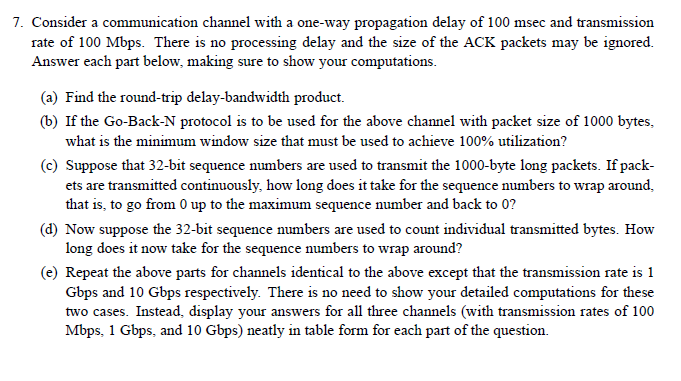
7. Consider a communication channel with a one-way propagation delay of 100 msec and transmission rate of 100 Mbps. There is no processing delay and the size of the ACK packets may be ignored. Answer each part below, making sure to show your computations (a) Find the round-trip delay-bandwidth product. (b) If the Go-Back-N protocol is to be used for the above channel with packet size of 1000 bytes, what is the minimum window size that must be used to achieve 100% utilization? (c) Suppose that 32-bit sequence numbers are used to transmit the 1000-byte long packets. If pack- ets are transmitted continuously, how long does it take for the sequence numbers to wrap around, that is, to go from 0 up to the maximum sequence number and back to 0? (d) Now suppose the 32-bit sequence numbers are used to count individual transmitted bytes. How long does it now take for the sequence numbers to wrap around? (e) Repeat the above parts for channels identical to the above except that the transmission rate is1 Gbps and 10 Gbps respectively. There is no need to show your detailed computations for these two cases. Instead, display your answers for all three channels (with transmission rates of 100 Mbps, 1 Gbps, and 10 Gbps) neatly in table form for each part of the question. 7. Consider a communication channel with a one-way propagation delay of 100 msec and transmission rate of 100 Mbps. There is no processing delay and the size of the ACK packets may be ignored. Answer each part below, making sure to show your computations (a) Find the round-trip delay-bandwidth product. (b) If the Go-Back-N protocol is to be used for the above channel with packet size of 1000 bytes, what is the minimum window size that must be used to achieve 100% utilization? (c) Suppose that 32-bit sequence numbers are used to transmit the 1000-byte long packets. If pack- ets are transmitted continuously, how long does it take for the sequence numbers to wrap around, that is, to go from 0 up to the maximum sequence number and back to 0? (d) Now suppose the 32-bit sequence numbers are used to count individual transmitted bytes. How long does it now take for the sequence numbers to wrap around? (e) Repeat the above parts for channels identical to the above except that the transmission rate is1 Gbps and 10 Gbps respectively. There is no need to show your detailed computations for these two cases. Instead, display your answers for all three channels (with transmission rates of 100 Mbps, 1 Gbps, and 10 Gbps) neatly in table form for each part of the
Step by Step Solution
There are 3 Steps involved in it

Get step-by-step solutions from verified subject matter experts
 Study Help