







Question: 7. Consider a price-taking, profit-maximizing firm whose output is determined by the quantities of capital (K) and labor (L) it employs: q = f(K, L).
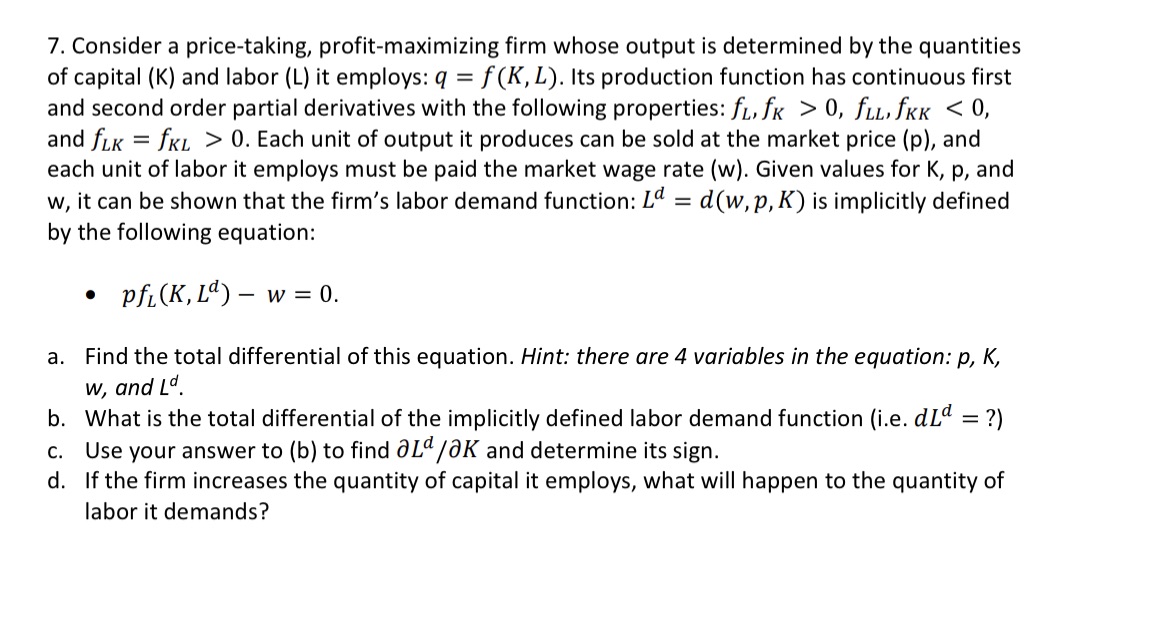
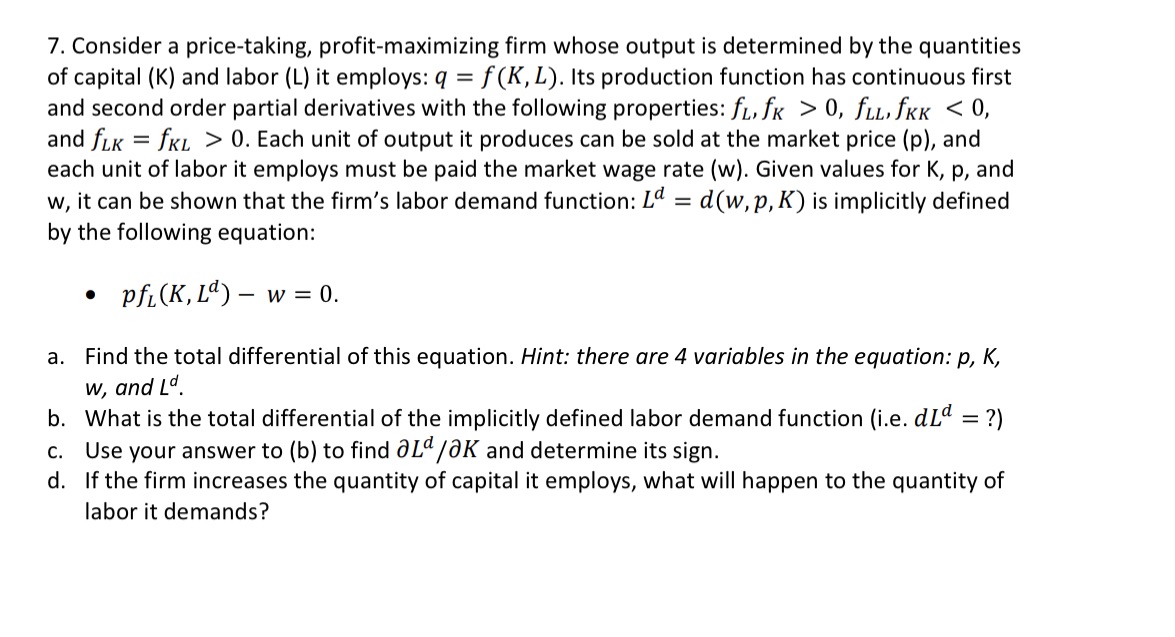
7. Consider a price-taking, profit-maximizing firm whose output is determined by the quantities of capital (K) and labor (L) it employs: q = f(K, L). its production function has continuous first and second order partial derivatives with the following properties: fL,fK > 0, fLL,fKK 0. Each unit of output it produces can be sold at the market price (p), and each unit of labor it employs must be paid the market wage rate (w). Given values for K, p, and w, it can be shown that the firm's labor demand function: L'1 = (1041, p, K) is implicitly defined by the following equation: 0 prGCLd) w = 0. a. Find the total differential of this equation. Hint: there are 4 variables in the equation: ,0, K, w, and it". b. What is the total differential of the implicitly defined labor demand function (Le. de = ?) Use your answer to (b) to find 6Ld/6K and determine its sign. d. if the firm increases the quantity of capital it employs, what will happen to the quantity of labor it demands? P
Step by Step Solution
There are 3 Steps involved in it

Get step-by-step solutions from verified subject matter experts
 Study Help