



Question: 7'. Consider a typical aggregate demand and supply curve ofan economy operating at its longrun equilibrium. a . rm l1. Express the condition for longrun
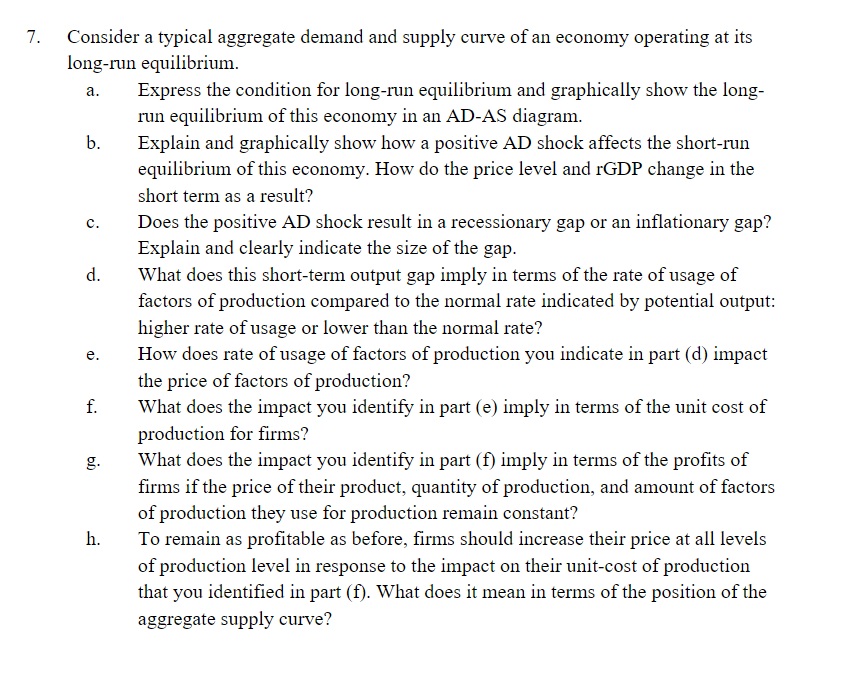
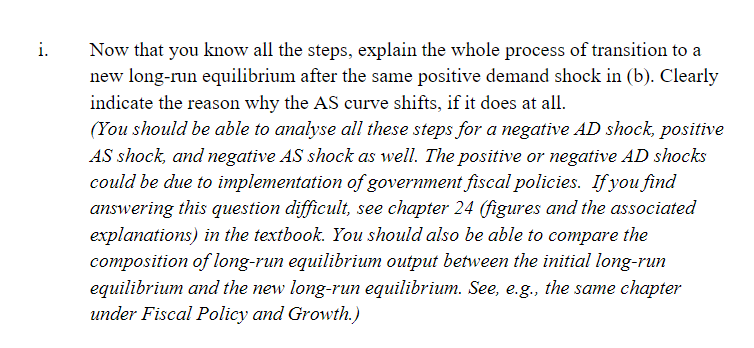
7'. Consider a typical aggregate demand and supply curve ofan economy operating at its longrun equilibrium. a . rm l1. Express the condition for longrun equilibrium and graphically show the long run equilibrium of this economy in an ADAS diagram. Explain and graphically show how a positive AD shock affects the shortrun equilibrium of this economy. How do the price level and rGDP change in the short term as a result? Does the positive AD shock result in a recessionary gap or an inflationary gap? Explain and clearly indicate the size of the gap. What does this shortterm output gap imply in terms of the rate of usage of factors of production compared to the normal rate indicated by potential output: higher rate of usage or lower than the normal rate? How does rate of usage of factors of production you indicate in part {d} impact the price of factors of production? What does the impact you identify in part {e) imply in terms of the unit cost of production for firms'.j What does the impact you identify in part {f} imply in terms of the profits of firms if the price of their product quantity of production. and amount of factors of production they use for production remain constant? To remain as profitable as before firms should increase their price at all levels of production level in response to the impact on their unitcost of production that you identified in part [f]. TWhat does it mean in terms of the position of the aggregate supply curve? Now that you know all the steps, explain the whole process of transition to a new long-run equilibrium after the same positive demand shock in (b). Clearly indicate the reason why the AS curve shifts, if it does at all. (You should be able to analyse all these steps for a negative AD shock, positive AS shock, and negative AS shock as well. The positive or negative AD shocks could be due to implementation of government fiscal policies. If you find answering this question difficult, see chapter 24 (figures and the associated explanations) in the textbook. You should also be able to compare the composition of long-run equilibrium output between the initial long-run equilibrium and the new long-run equilibrium. See, e.g., the same chapter under Fiscal Policy and Growth.)
Step by Step Solution
There are 3 Steps involved in it

Get step-by-step solutions from verified subject matter experts