





Question: 7. Correcting for negative externalities - Taxes versus tradablepermits Paper factories emit chemicals as a waste product. This generates a cost to society that is
7. Correcting for negative externalities - Taxes
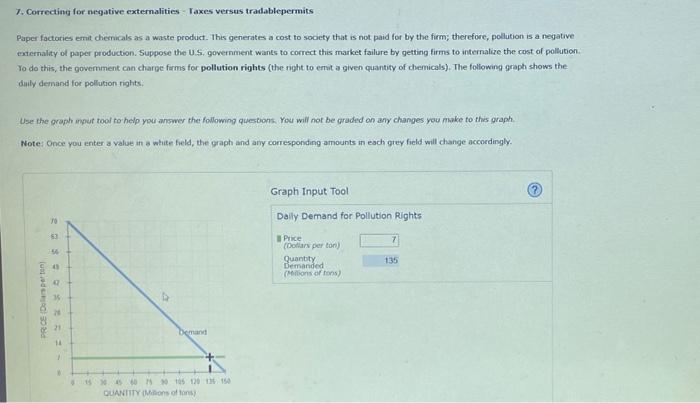
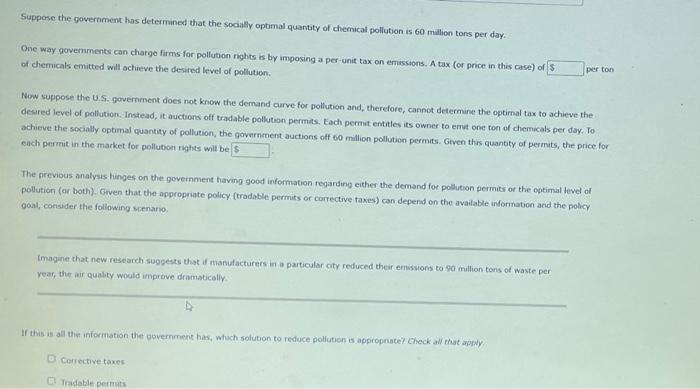
7. Correcting for negative externalities - Taxes versus tradablepermits Paper factories emit chemicals as a waste product. This generates a cost to society that is not paid for by the firm, therefore, pollution is a negative externality of paper production. Suppose the US government wants to correct this market failure by getting firms to internalize the cost of pollution Yo do this, the government can charge firms for pollution rights (the night to emit a given quantity of chemicals). The following graph shows the daily demand for pollution rights Use the graph pur tool to help you answer the following questions. You will not be graded on any changes you make to this graph Note: Once you enter a value in a white field, the graph and any corresponding amounts on each grey field will change accordingly. Graph Input Tool ? Daily Demand for Pollution Rights TO 53 7 56 Price (Dollars per con) Quantity Demanded (Millions of tons) 135 PRCED perton 21 Demand 1 1 105 1201 154 QUANTITY Mons of los Suppose the government has determined that the socially optimal quantity of chemical pollution is 60 million tons per day One way governments can charge firms for pollution rights is by imposing a per unit tax on emissions. A tax (or pnce in this case) of 5 of chemicals emitted will achieve the desired level of pollution per ton Now suppose the US government does not know the demand curve for pollution and, therefore, cannot determine the optimal tax to achieve the desired level of pollution. Instead, it auctions off tradable pollution permits. Each permit entities its owner to emut one ton of chemicals per day. To achieve the socially optimal Quantity of pollution, the government auctions off 60 million pollution permits. Given the quantity of permits, the price for each permit in the market for pollution rights will be The previous analysis hinges on the government having good information regarding either the demand for pollution permits or the optimal level of pollution (or both). Given that the appropriate policy (tradable permits or corrective taxes) can depend on the available information and the policy goal, consider the following scenario Imagine that new research suggests that if manufacturers in a particular city reduced their emissions to 90 million tons of waste per year, the air quality would improve dramatically If this is all the information the government has, which solution to reduce pollution is appropriate? Check all that apply Corrective taxes Tradable permits

Step by Step Solution

There are 3 Steps involved in it

1 Expert Approved Answer
Step: 1 Unlock blur-text-image

Question Has Been Solved by an Expert!

Get step-by-step solutions from verified subject matter experts

Step: 2 Unlock
Step: 3 Unlock

Students Have Also Explored These Related General Management Questions!