







Question: 7. Given the following structure declaration definition. typedef struct Emp { int idnum; float salary; Emp* next; } *Employee; Employee head; Assume that head is
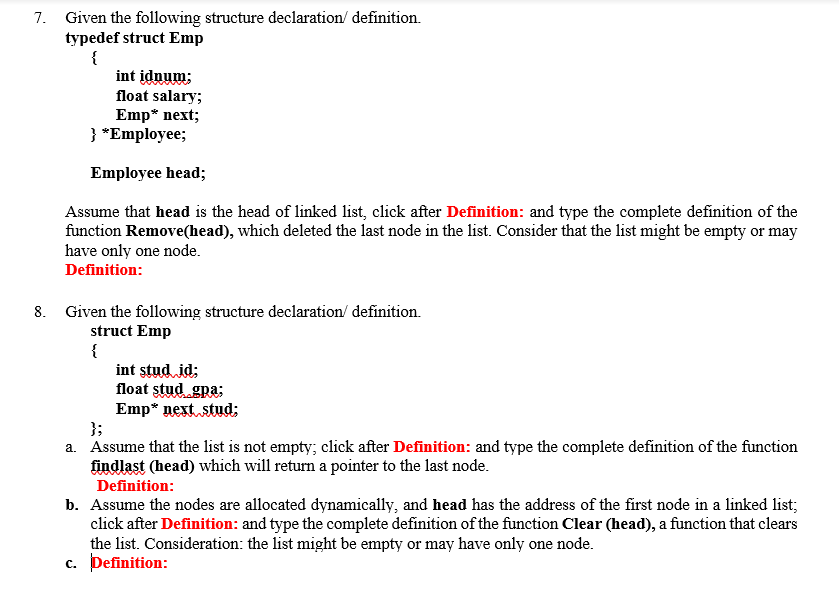
7. Given the following structure declaration definition. typedef struct Emp { int idnum; float salary; Emp* next; } *Employee; Employee head; Assume that head is the head of linked list, click after Definition: and type the complete definition of the function Remove(head), which deleted the last node in the list. Consider that the list might be empty or may have only one node. Definition: 8. Given the following structure declaration definition. struct Emp { int stud id; float studgpa; Emp* next stud; }; a. Assume that the list is not empty, click after Definition: and type the complete definition of the function findlast (head) which will return a pointer to the last node. Definition: b. Assume the nodes are allocated dynamically, and head has the address of the first node in a linked list; click after Definition: and type the complete definition of the function Clear (head), a function that clears the list. Consideration: the list might be empty or may have only one node. c. Definition
Step by Step Solution
There are 3 Steps involved in it

Get step-by-step solutions from verified subject matter experts
 Study Help