Question: 7. In many engineering applications we are interested in flow through a network. The flow could consist of water or air through pipes or ductwork
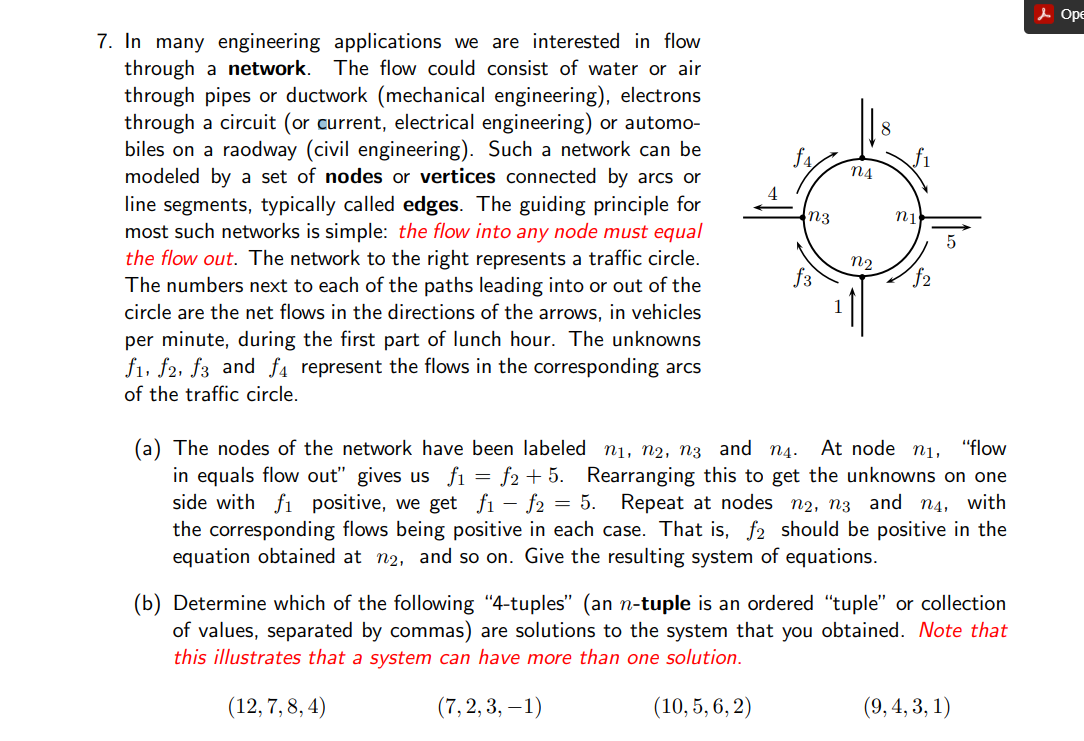
7. In many engineering applications we are interested in flow through a network. The flow could consist of water or air through pipes or ductwork [mechanical engineering), electrons through a circuit (or lurrent, electrical engineering) or automo- biles on a raodway (civil engineering). Such a network can be modeled by a set of nodes or vertices connected by arcs or line segments, typically called edges. The guiding principle for most such networks is simple: the flow into any node must equal the flow out. The network to the right represents a traffic circle. The numbers next to each of the paths leading into or out ofthe circle are the net flows in the directions of the arrows. in vehicles per minute, during the first part of lunch hour. The unknowns f1. f2, f3 and f4 represent the flows in the corresponding arcs of the traffic circle. (a) The nodes of the network have been labeled n.1, n2, R3 and \"314. At node n1, "flow in equals flow out" gives us f1 2 f2 + 5. Rearranging this to get the unknowns on one side with f1 positive, we get f1 f2 = 5. Repeat at nodes n2, 113 and cm, with the corresponding flows being positive in each case. That is. f2 should be positive in the equation obtained at m, and so on. Give the resulting system of equations. (b) Determine which of the following "4-tuples" (an ntuple is an ordered "tuple" or collection of values, separated by commas) are solutions to the system that you obtained. Note that this illustrates that a system can have more than one solution. (12, 7, 8,4) (7, 2, 3, 1) (10, 5, 6, 2) (9,4,3,1)
Step by Step Solution
There are 3 Steps involved in it
1 Expert Approved Answer
Step: 1 Unlock
Question Has Been Solved by an Expert!
Get step-by-step solutions from verified subject matter experts
Step: 2 Unlock
Step: 3 Unlock
Students Have Also Explored These Related Mathematics Questions!









 Study Help