







Question: 7. In quantum mechanics, any state vector | a) can be expressed in terms of a complete set of basis vectors {| a;)} in
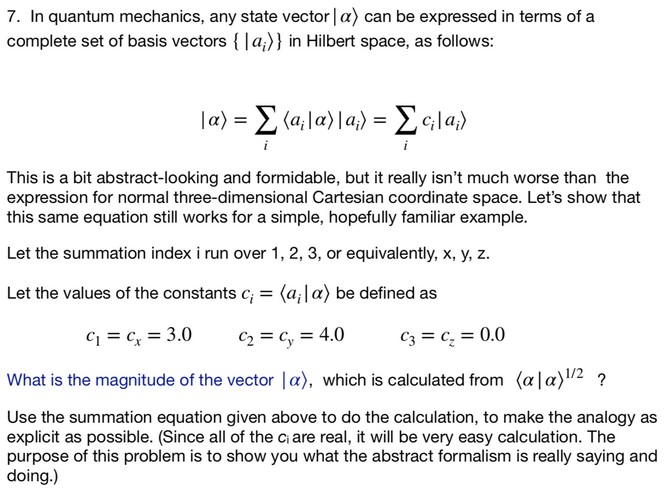
7. In quantum mechanics, any state vector | a) can be expressed in terms of a complete set of basis vectors {| a;)} in Hilbert space, as follows: |a)=(aa)|a) =c| a;) This is a bit abstract-looking and formidable, but it really isn't much worse than the expression for normal three-dimensional Cartesian coordinate space. Let's show that this same equation still works for a simple, hopefully familiar example. Let the summation index i run over 1, 2, 3, or equivalently, x, y, z. Let the values of the constants c; = (a; a) be defined as C = cx = 3.0 C = C = 4.0 C3=C = 0.0 What is the magnitude of the vector (a), which is calculated from (aa) 1/2 ? Use the summation equation given above to do the calculation, to make the analogy as explicit as possible. (Since all of the ci are real, it will be very easy calculation. The purpose of this problem is to show you what the abstract formalism is really saying and doing.)
Step by Step Solution
There are 3 Steps involved in it

Get step-by-step solutions from verified subject matter experts
 Study Help