


Question: 7. Lean System Design - Contracts for Strategic Sourcing (20): After meeting with one of their major retailers, ECO Guitars has leamed that there are
7. Lean System Design - Contracts for Strategic

7. Lean System Design - Contracts for Strategic

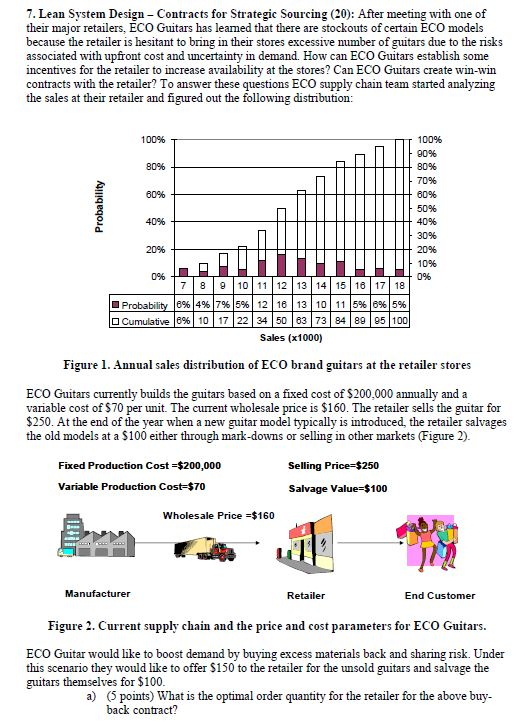
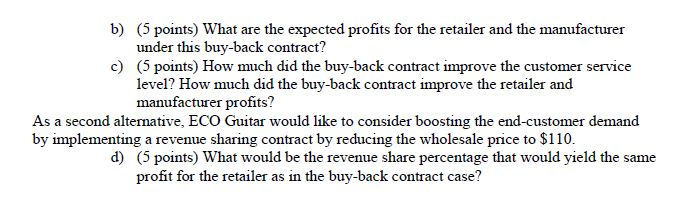
7. Lean System Design - Contracts for Strategic Sourcing (20): After meeting with one of their major retailers, ECO Guitars has leamed that there are stockouts of because the retailer is hesitant to bring in their stores excessive number of guitars due to the risks associated with upfront cost and uncertainty in demand. How can ECO Guitars establish some incentives for the retailer to increase availability at the stores? Can ECO Guitars create win-win contracts with the retailer? To answer these questions ECO supply chain team started analyzing the sales at their retailer and figured out the following distribution: 100% 100% 80% 70% 80% Probability 50% 40% 7 8 9 10 11 12 13 14 15 16 Probability 0% 4% 7% 5% 12 10 13 10 11 5% 6% Cumulative 8% 1017 22 34 50 63 73 84 89 95 100 Sales (x1000) Figure 1. Annual sales distribution of ECO brand guitars at the retailer stores ECO Guitars currently builds the guitars based on a fixed cost of $200,000 annually and a variable cost of $ 70 per unit. The current wholesale price is $160. The retailer sells the guitar for $250. At the end of the year when a new guitar model typically is introduced, the retailer salvages the old models at a $100 either through mark-downs or selling in other markets (Figure 2). Fixed Production Cost =$200,000 Variable Production Cost-$70 Selling Price=$250 Salvage Value=$100 Wholesale Price =$160 JU Manufacturer Retailer End Customer Figure 2. Current supply chain and the price and cost parameters for ECO Guitars. ECO Guitar would like to boost demand by buying excess materials back and sharing risk. Under this scenario they would like to offer $150 to the retailer for the unsold guitars and salvage the guitars themselves for $100. a) (5 points) What is the optimal order quantity for the retailer for the above buy- back contract? b) (5 points) What are the expected profits for the retailer and the manufacturer under this buy-back contract? c) (5 points) How much did the buy-back contract improve the customer service level? How much did the buy-back contract improve the retailer and manufacturer profits? As a second alternative, ECO Guitar would like to consider boosting the end-customer demand by implementing a revenue sharing contract by reducing the wholesale price to $110. d) (5 points) What would be the revenue share percentage that would yield the same profit for the retailer as in the buy-back contract case? 7. Lean System Design - Contracts for Strategic Sourcing (20): After meeting with one of their major retailers, ECO Guitars has leamed that there are stockouts of because the retailer is hesitant to bring in their stores excessive number of guitars due to the risks associated with upfront cost and uncertainty in demand. How can ECO Guitars establish some incentives for the retailer to increase availability at the stores? Can ECO Guitars create win-win contracts with the retailer? To answer these questions ECO supply chain team started analyzing the sales at their retailer and figured out the following distribution: 100% 100% 80% 70% 80% Probability 50% 40% 7 8 9 10 11 12 13 14 15 16 Probability 0% 4% 7% 5% 12 10 13 10 11 5% 6% Cumulative 8% 1017 22 34 50 63 73 84 89 95 100 Sales (x1000) Figure 1. Annual sales distribution of ECO brand guitars at the retailer stores ECO Guitars currently builds the guitars based on a fixed cost of $200,000 annually and a variable cost of $ 70 per unit. The current wholesale price is $160. The retailer sells the guitar for $250. At the end of the year when a new guitar model typically is introduced, the retailer salvages the old models at a $100 either through mark-downs or selling in other markets (Figure 2). Fixed Production Cost =$200,000 Variable Production Cost-$70 Selling Price=$250 Salvage Value=$100 Wholesale Price =$160 JU Manufacturer Retailer End Customer Figure 2. Current supply chain and the price and cost parameters for ECO Guitars. ECO Guitar would like to boost demand by buying excess materials back and sharing risk. Under this scenario they would like to offer $150 to the retailer for the unsold guitars and salvage the guitars themselves for $100. a) (5 points) What is the optimal order quantity for the retailer for the above buy- back contract? b) (5 points) What are the expected profits for the retailer and the manufacturer under this buy-back contract? c) (5 points) How much did the buy-back contract improve the customer service level? How much did the buy-back contract improve the retailer and manufacturer profits? As a second alternative, ECO Guitar would like to consider boosting the end-customer demand by implementing a revenue sharing contract by reducing the wholesale price to $110. d) (5 points) What would be the revenue share percentage that would yield the same profit for the retailer as in the buy-back contract case

Step by Step Solution

There are 3 Steps involved in it

1 Expert Approved Answer
Step: 1 Unlock blur-text-image

Question Has Been Solved by an Expert!

Get step-by-step solutions from verified subject matter experts

Step: 2 Unlock
Step: 3 Unlock

Students Have Also Explored These Related General Management Questions!