







Question: 7. Let (, F, P) be a probability space. We consider a symmetric random walk such that the j-step is defined as Zj =
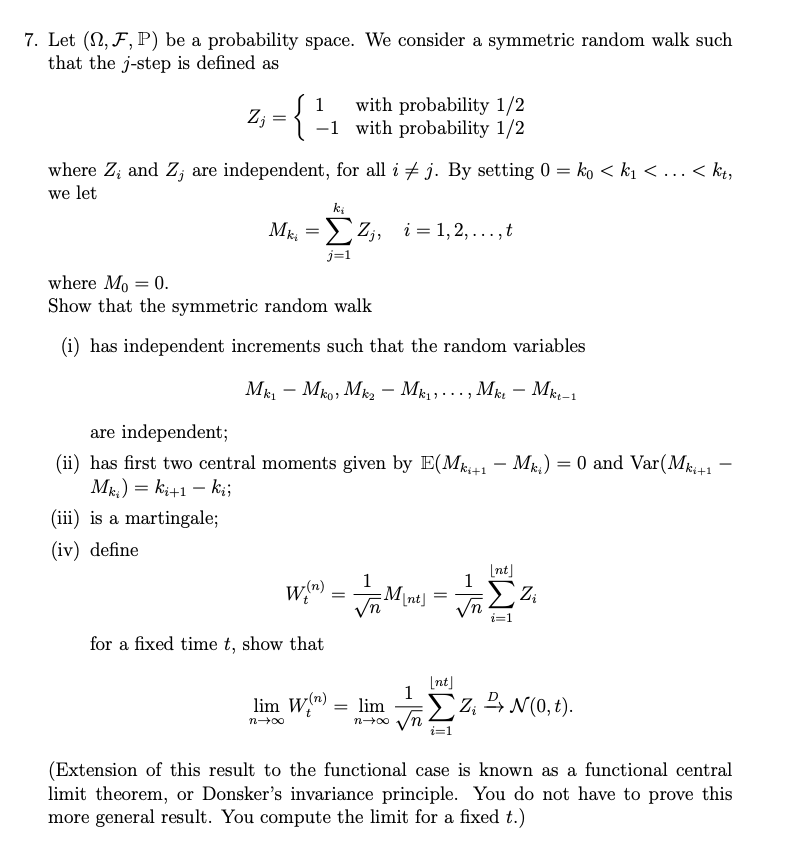
7. Let (, F, P) be a probability space. We consider a symmetric random walk such that the j-step is defined as Zj = :{ 1 with probability 1/2 -1 with probability 1/2 where Zi and Z; are independent, for all i j. By setting 0 = ko < k < ... < kt, we let MkZ, i=1, 2, ..., t = where Mo = 0. j=1 Show that the symmetric random walk (i) has independent increments such that the random variables are independent; Mk - Mko, Mk2 - Mk, Mke - Mke-1 (ii) has first two central moments given by E(Mk+1 - Mk.) = 0 and Var(Mk4+1 Mk) = ki+1 ki; (iii) is a martingale; (iv) define [nt] W*(n) 1 = M, [nt] = Zi i=1 for a fixed time t, show that - EZAN(0,t). [nt] 1 lim W(n) = lim 004-2 004-2 i=1 (Extension of this result to the functional case is known as a functional central limit theorem, or Donsker's invariance principle. You do not have to prove this more general result. You compute the limit for a fixed t.)
Step by Step Solution
There are 3 Steps involved in it

Get step-by-step solutions from verified subject matter experts
 Study Help