







Question: 7. Let X1, X2, X3, X4 be a random sample of size 4 from a standard normal population. Find the sampling distribution (if possible) and
7. Let X1, X2, X3, X4 be a random sample of size 4 from a standard normal
population. Find the sampling distribution (if possible) and moment generating function of the statistic 2X2
1 +3X2
2 +X2
3 +4X2
4 . What is the probability
distribution of the sample?
8. Let X equal the maximal oxygen intake of a human on a treadmill, where
the measurement are in milliliters of oxygen per minute per kilogram of
weight. Assume that for a particular population the mean of X is = 54.03
and the standard deviation is ? = 5.8. Let X be the sample mean of a random
sample X1, X2, ..., X47 of size 47 drawn from X. Find the probability that
the sample mean is between 52.761 and 54.453.
9. Let X1, X2, ..., Xn be a random sample from a normal distribution with
mean and variance ?2. What is the variance of V 2 = 1
n
n
i=1
Xi ? X2 ?
What are the mean and standard deviation of the standard normal distribution?
(b) What would be the mean and standard deviation of a distribution created by
multiplying the standard normal distribution by 8 and then adding 75?
3. The normal distribution is defined by two parameters. What are they?
4. What proportion of a normal distribution is within one standard deviation of the
mean? (b) What proportion is more than 2.0 standard deviations from the mean?
(c) What proportion is between 1.25 and 2.1 standard deviations above the mean?
5. A test is normally distributed with a mean of 70 and a standard deviation of 8.
(a) What score would be needed to be in the 85th percentile? (b) What score
would be needed to be in the 22nd percentile?
6. Assume a normal distribution with a mean of 70 and a standard deviation of 12.
What limits would include the middle 65% of the cases?
7. A normal distribution has a mean of 20 and a standard deviation of 4. Find the Z
scores for the following numbers: (a) 28 (b) 18 (c) 10 (d) 23
8. Assume the speed of vehicles along a stretch of I-10 has an approximately
normal distribution with a mean of 71 mph and a standard deviation of 8 mph.
a. The current speed limit is 65 mph. What is the proportion of vehicles less than
or equal to the speed limit?
b. What proportion of the vehicles would be going less than 50 mph?
267c. A new speed limit will be initiated such that approximately 10% of vehicles
will be over the speed limit. What is the new speed limit based on this criterion?
d. In what way do you think the actual distribution of speeds differs from a
normal distribution?
9. A variable is normally distributed with a mean of 120 and a standard deviation
of 5. One score is randomly sampled. What is the probability it is above 127?
10. You want to use the normal distribution to approximate the binomial
distribution. Explain what you need to do to find the probability of obtaining
exactly 7 heads out of 12 flips.
11. A group of students at a school takes a history test. The distribution is normal
with a mean of 25, and a standard deviation of 4. (a) Everyone who scores in
the top 30% of the distribution gets a certificate. What is the lowest score
someone can get and still earn a certificate? (b) The top 5% of the scores get to
compete in a statewide history contest. What is the lowest score someone can
get and still go onto compete with the rest of the state?
12. Use the normal distribution to approximate the binomial distribution and find
the probability of getting 15 to 18 heads out of 25 flips. Compare this to what
you get when you calculate the probability using the binomial distribution.
?
13. True/false: For any normal distribution, the mean, median, and mode will be
equal.
14. True/false: In a normal distribution, 11.5% of scores are greater than Z = 1.2.
15. True/false: The percentile rank for the mean is 50% for any normal distribution.
16. True/false: The larger the n, the better the normal distribution approximates the
binomial distribution.
17. True/false: A Z-score represents the number of standard deviations above or
below the mean
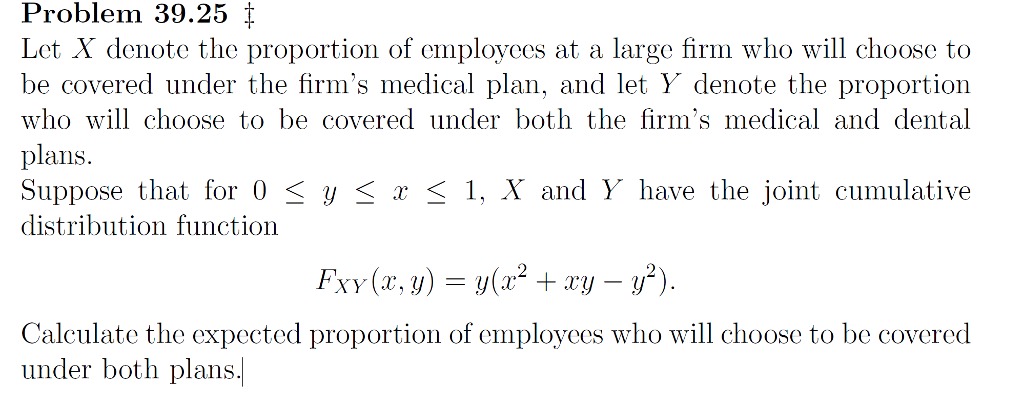
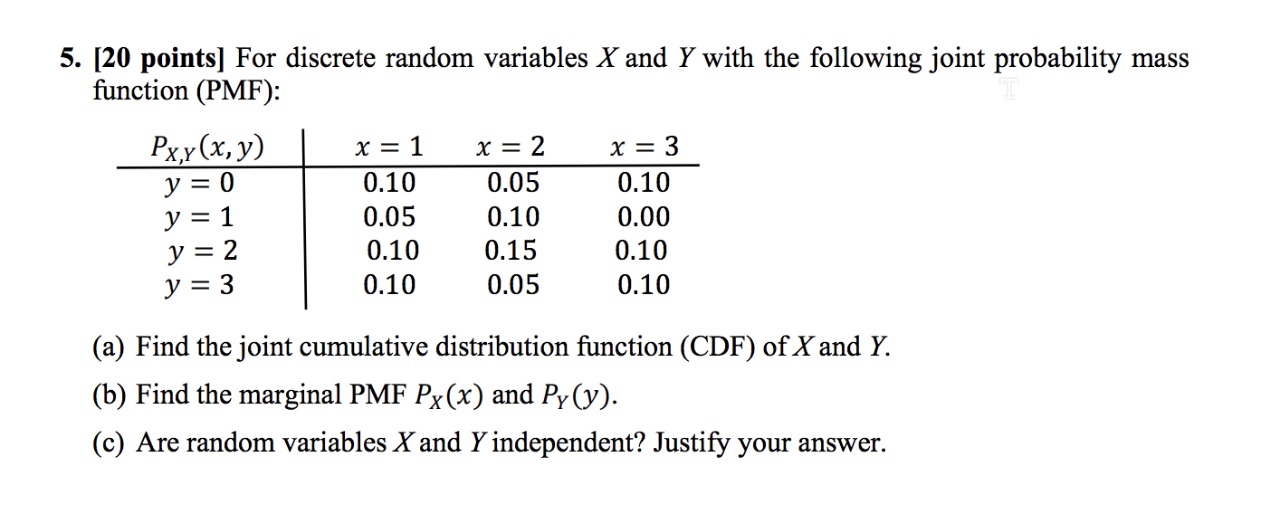
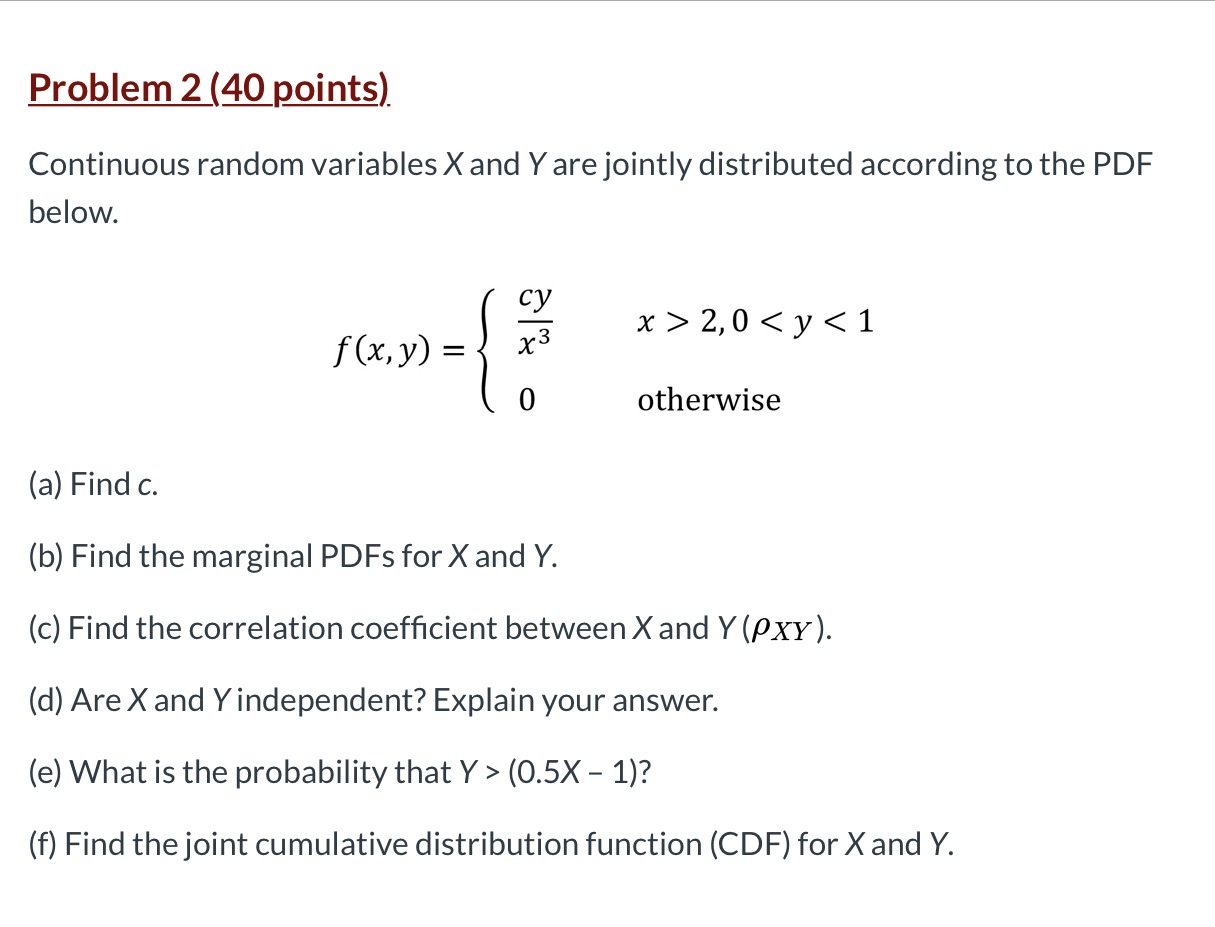
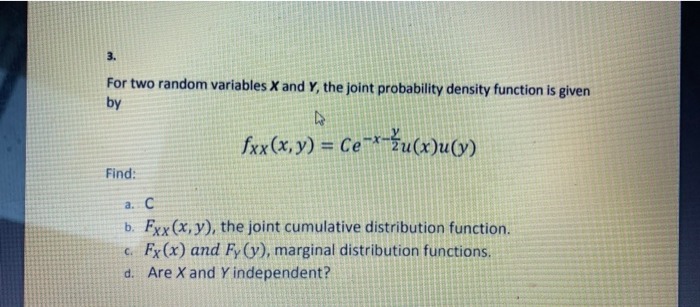
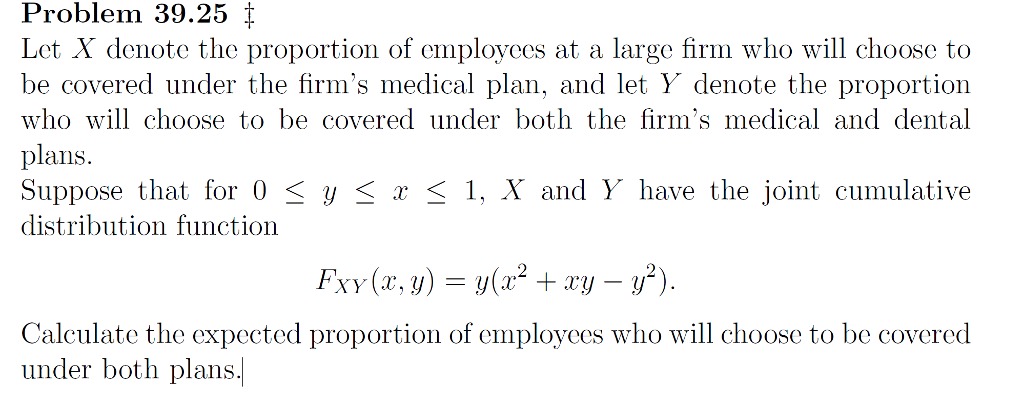
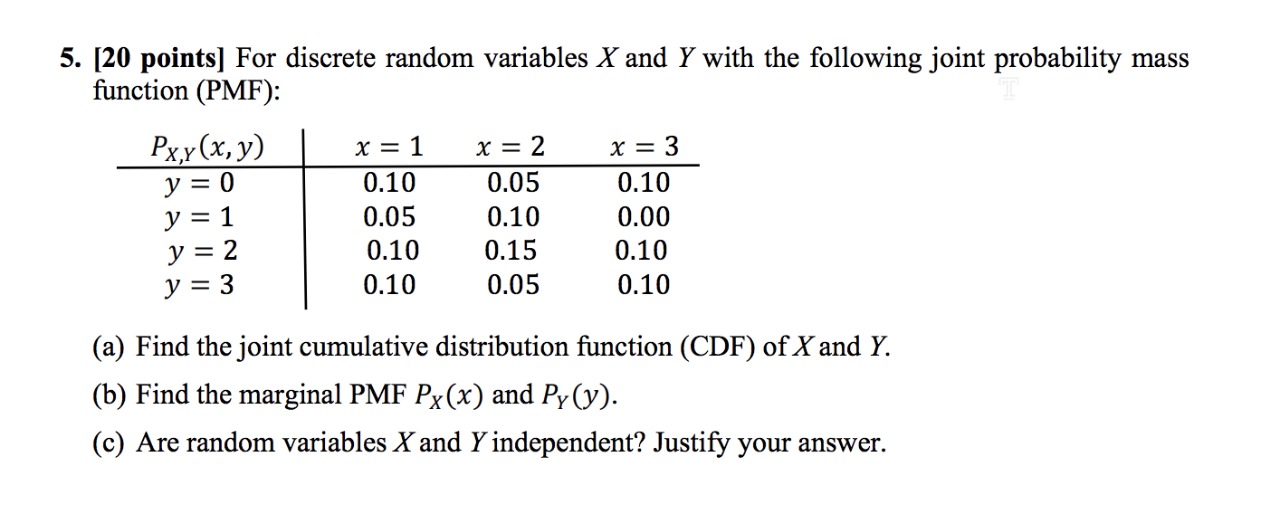
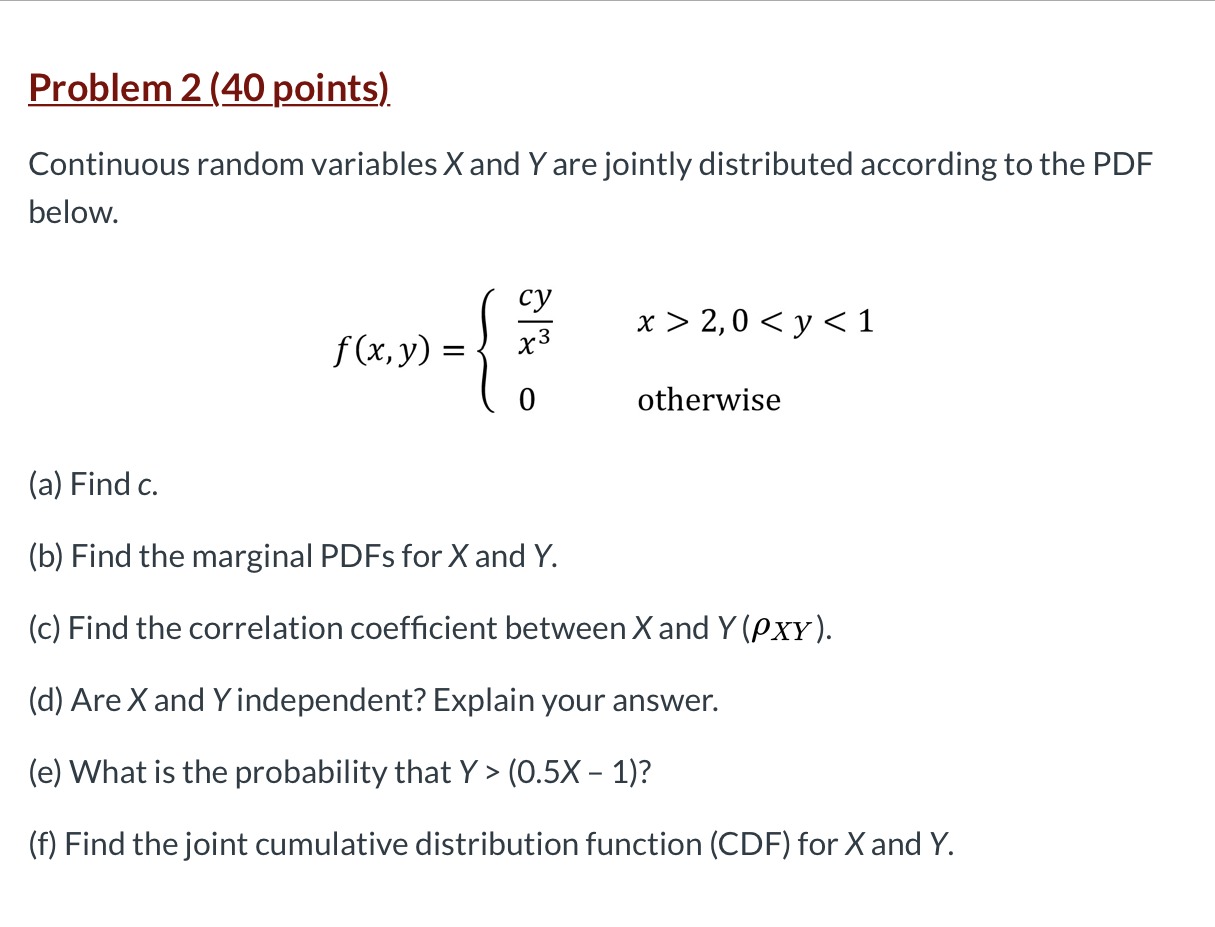
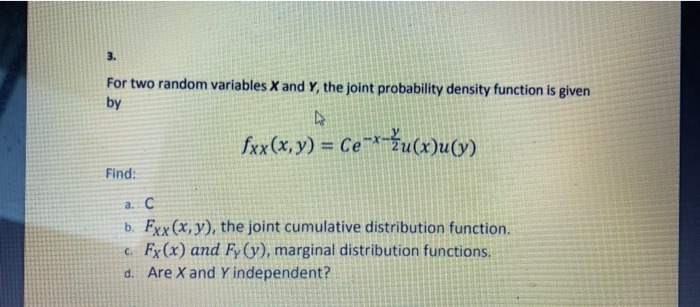
Problem 39.25 i Let X denote the proportion of oi'nployeos at a large rm who will choose to be covered under the rm's medical plan, and let Y denote the proportion who will choose to be covered under both the rm's medical and dental plans. Suppose that for 0 g y g :I: g 1, X and Y have the joint cumulative distribution function va(w, y) = Wig + 93:0 112)- Csleulste the expected proportion of employees who will choose to be covered under both plans.' 5. [20 points] For discrete random variables X and Y with the following joint probability mass function (PMF): Px, Y (x, y ) x =1 x = 2 x = 3 y = 0 0.10 0.05 0.10 y =1 0.05 0.10 0.00 y = 2 0.10 0.15 0.10 y = 3 0.10 0.05 0.10 (a) Find the joint cumulative distribution function (CDF) of X and Y. (b) Find the marginal PMF Px (x) and Py (y). (c) Are random variables X and Y independent? Justify your answer.Problem 2 (40 points). Continuous random variables X and Y are jointly distributed according to the PDF below. cy 73 x > 2,0
Step by Step Solution
There are 3 Steps involved in it

Get step-by-step solutions from verified subject matter experts
 Study Help