







Question: 7. Understanding Arrow's impossibility theorem Arrow's impossibility theorem states that under certain assumptions about preferences, no voting system exists that satisfies all of the following
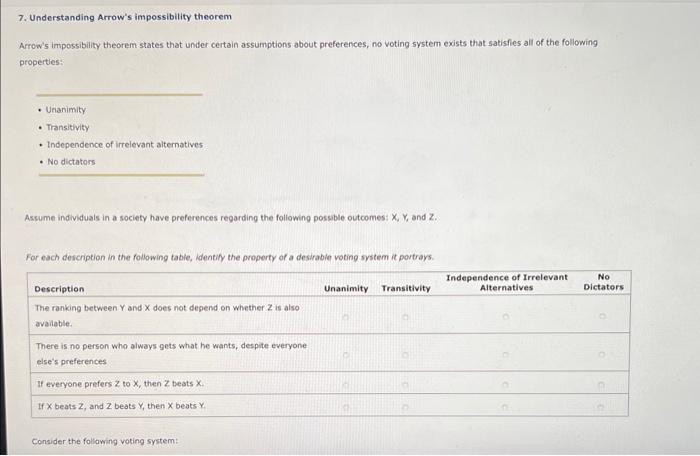
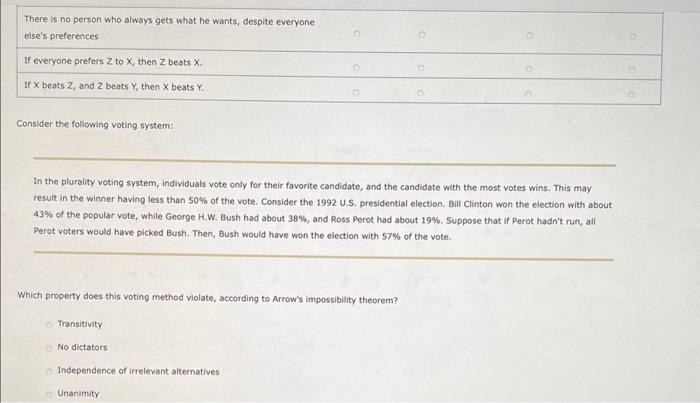
7. Understanding Arrow's impossibility theorem Arrow's impossibility theorem states that under certain assumptions about preferences, no voting system exists that satisfies all of the following properties: - Unanimity - Transitivity - Independence of irrelevant alternatives - No dictators Assume individuals in a society have preferences regarding the following possible outcomes: x,y, and z. For each description in the following tabie, identify the property of a desirabie voting srstem it portrays. Consider the following voting system: Consider the following voting system: In the plurality voting system, individuals vote only for their favorite candidate, and the candidate with the most votes wins. This may result in the winner having less than 50% of the vote. Consider the 1992 U.S. presidential eiection. Bill Clinton won the election with about 43% of the popular vote, while George H.W. Bush had about 38%, and Ross Perot had about 19%. Suppose that if Perot hadn't run, all Perot voters would have picked Bush. Then, Bush would have won the election with 57% of the vote. Which property does this voting method violate, according to Arrow's impossibility theorem? Transitivity No dictators Independence of ifrelevant aiternatives Unanimity
Step by Step Solution
There are 3 Steps involved in it

Get step-by-step solutions from verified subject matter experts
 Study Help