







Question: 7.4 Belief updating In this problem, you will derive recursion relations for real-time updating of beliefs based on incoming evidence. These relations are useful for
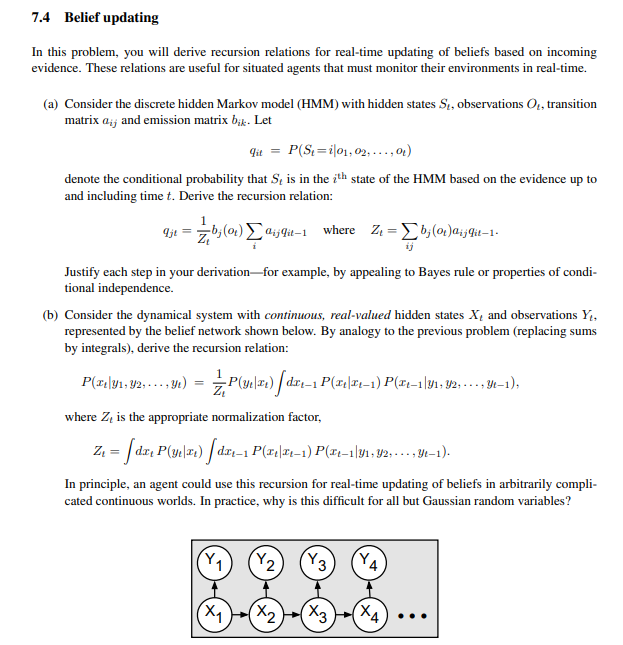
7.4 Belief updating In this problem, you will derive recursion relations for real-time updating of beliefs based on incoming evidence. These relations are useful for situated agents that must monitor their environments in real-time. (a) Consider the discrete hidden Markov model (HMM) with hidden states Sc, observations Or, transition matrix Qij and emission matrix bik. Let Lit = P(S=101,02,...,04) denote the conditional probability that S is in the ith state of the HMM based on the evidence up to and including time t. Derive the recursion relation: 9jt = 2.1;(0) 439-1 ij where 24 = 6; (01)0139-1 Justify each step in your derivation-for example, by appealing to Bayes rule or properties of condi- tional independence. (b) Consider the dynamical system with continuous, real-valued hidden states X and observations Y. represented by the belief network shown below. By analogy to the previous problem (replacing sums by integrals), derive the recursion relation: P(Xx|91, 92, . - - , Y) ZP (412) dx11 P(ta[r1) P(31191, 92..- , Ye-1), where Ze is the appropriate normalization factor, 2x = dx P(yle) | d111 P(|21-1) P(811|31, 92...,811). In principle, an agent could use this recursion for real-time updating of beliefs in arbitrarily compli- cated continuous worlds. In practice, why is this difficult for all but Gaussian random variables? - Y1 Y2 (Y3 Y4 X1 X2 (XA 7.4 Belief updating In this problem, you will derive recursion relations for real-time updating of beliefs based on incoming evidence. These relations are useful for situated agents that must monitor their environments in real-time. (a) Consider the discrete hidden Markov model (HMM) with hidden states Sc, observations Or, transition matrix Qij and emission matrix bik. Let Lit = P(S=101,02,...,04) denote the conditional probability that S is in the ith state of the HMM based on the evidence up to and including time t. Derive the recursion relation: 9jt = 2.1;(0) 439-1 ij where 24 = 6; (01)0139-1 Justify each step in your derivation-for example, by appealing to Bayes rule or properties of condi- tional independence. (b) Consider the dynamical system with continuous, real-valued hidden states X and observations Y. represented by the belief network shown below. By analogy to the previous problem (replacing sums by integrals), derive the recursion relation: P(Xx|91, 92, . - - , Y) ZP (412) dx11 P(ta[r1) P(31191, 92..- , Ye-1), where Ze is the appropriate normalization factor, 2x = dx P(yle) | d111 P(|21-1) P(811|31, 92...,811). In principle, an agent could use this recursion for real-time updating of beliefs in arbitrarily compli- cated continuous worlds. In practice, why is this difficult for all but Gaussian random variables? - Y1 Y2 (Y3 Y4 X1 X2 (XA
Step by Step Solution
There are 3 Steps involved in it

Get step-by-step solutions from verified subject matter experts
 Study Help