







Question: PLEASE ANSWER THE HIGHLIGHTED QUESTION :) 1. Consider the following simple belief updating task: There are two cups (A and B) each with three coloured
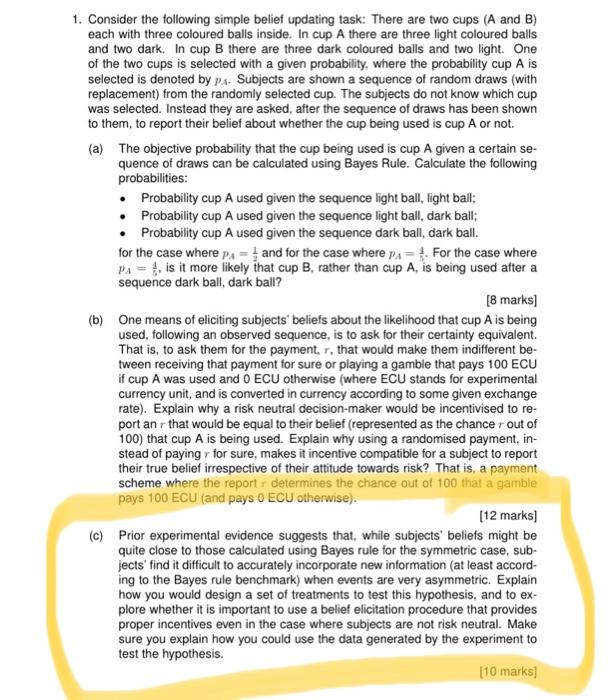
1. Consider the following simple belief updating task: There are two cups (A and B) each with three coloured balls inside. In cup A there are three light coloured balls and two dark. In cup B there are three dark coloured balls and two light. One of the two cups is selected with a given probability, where the probability cup A is selected is denoted by PA. Subjects are shown a sequence of random draws (with replacement) from the randomly selected cup. The subjects do not know which cup was selected. Instead they are asked, after the sequence of draws has been shown to them, to report their belief about whether the cup being used is cup A or not. (a) The objective probability that the cup being used is cup A given a certain se- quence of draws can be calculated using Bayes Rule. Calculate the following probabilities: Probability cup A used given the sequence light ball, light ball: Probability cup A used given the sequence light ball, dark ball: Probability cup A used given the sequence dark ball, dark ball. for the case where PA = 1 and for the case where PA . For the case where PA = $, is it more likely that cup B, rather than cup A, is being used after a sequence dark ball, dark ball? [8 marks] (b) One means of eliciting subjects' beliefs about the likelihood that cup A is being used, following an observed sequence, is to ask for their certainty equivalent. That is, to ask them for the payment, r, that would make them indifferent be- tween receiving that payment for sure or playing a gamble that pays 100 ECU if cup A was used and 0 ECU otherwise (where ECU stands for experimental currency unit, and is converted in currency according to some given exchange rate). Explain why a risk neutral decision-maker would be incentivised to re- port an r that would be equal to their belief (represented as the chancer out of 100) that cup A is being used. Explain why using a randomised payment, in- stead of paying r for sure, makes it incentive compatible for a subject to report their true belief irrespective of their attitude towards risk? That is, a payment scheme where the report determines the chance out of 100 that a gamble pays 100 ECU (and pays 0 ECU otherwise). [12 marks] (c) Prior experimental evidence suggests that, while subjects' beliefs might be quite close to those calculated using Bayes rule for the symmetric case, sub- jects' find it difficult to accurately incorporate new information (at least accord- ing to the Bayes rule benchmark) when events are very asymmetric. Explain how you would design a set of treatments to test this hypothesis, and to ex- plore whether it is important to use a belief elicitation procedure that provides proper incentives even in the case where subjects are not risk neutral. Make sure you explain how you could use the data generated by the experiment to test the hypothesis. [10 marks]
Step by Step Solution
There are 3 Steps involved in it

Get step-by-step solutions from verified subject matter experts
 Study Help