





Question: 8 1. The Alternative bread company is a small bread factory in New Zealand that produces a range of locally produced fresh breads for local
8 1. The Alternative bread company is a small
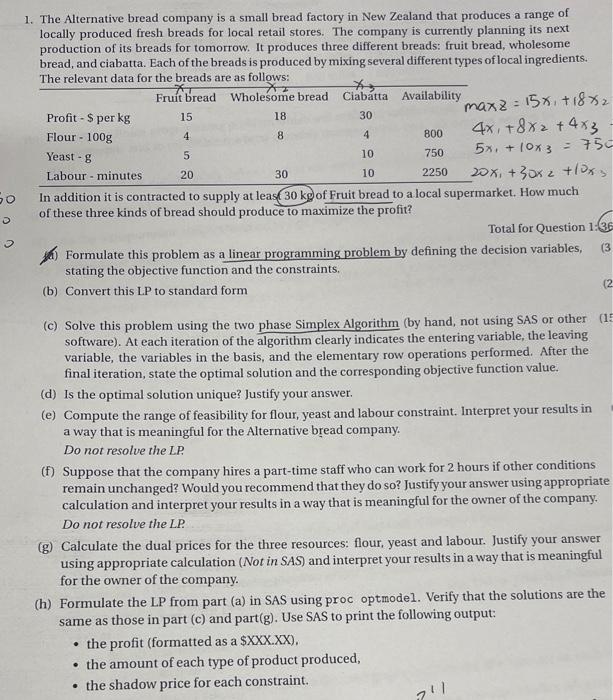
8 1. The Alternative bread company is a small bread factory in New Zealand that produces a range of locally produced fresh breads for local retail stores. The company is currently planning its next production of its breads for tomorrow. It produces three different breads: fruit bread, wholesome bread, and ciabatta. Each of the breads is produced by mixing several different types of local ingredients. The relevant data for the breads are as follows: Fruit bread Wholesome bread Ciabatta Availability 15%, + 1872 Profit - $ per kg max2 = 15 18 30 Flour - 100g 4 4 800 4x,+82 +4x3 5 10 750 5x. + 10x3 = 750 Labour - minutes 20 30 10 2250 20x, +30x2 tlox In addition it is contracted to supply at least 30 kg of Fruit bread to a local supermarket. How much of these three kinds of bread should produce to maximize the profit? Total for Question 1:36 ta Formulate this problem as a linear programming problem by defining the decision variables, (3 stating the objective function and the constraints, (b) Convert this LP to standard form (2 Yeast - 8 > OD a way (c) Solve this problem using the two phase Simplex Algorithm (by hand, not using SAS or other (15 software). At each iteration of the algorithm clearly indicates the entering variable, the leaving variable, the variables in the basis, and the elementary row operations performed. After the final iteration, state the optimal solution and the corresponding objective function value. (d) Is the optimal solution unique? Justify your answer. (e) Compute the range of feasibility for flour, yeast and labour constraint. Interpret your results in that is meaningful for the Alternative bread company. Do not resolve the LP (f) Suppose that the company hires a part-time staff who can work for 2 hours if other conditions remain unchanged? Would you recommend that they do so? Justify your answer using appropriate calculation and interpret your results in a way that is meaningful for the owner of the company. Do not resolve the LP. (g) Calculate the dual prices for the three resources: flour, yeast and labour. Justify your answer using appropriate calculation (Not in SAS) and interpret your results in a way that is meaningful for the owner of the company. (h) Formulate the LP from part (a) in SAS using proc optmodel. Verify that the solutions are the same as those in part (c) and part(g). Use SAS to print the following output: the profit (formatted as a $XXX.XX). the amount of each type of product produced, the shadow price for each constraint. 711

Step by Step Solution

There are 3 Steps involved in it

1 Expert Approved Answer
Step: 1 Unlock blur-text-image

Question Has Been Solved by an Expert!

Get step-by-step solutions from verified subject matter experts

Step: 2 Unlock
Step: 3 Unlock

Students Have Also Explored These Related General Management Questions!