



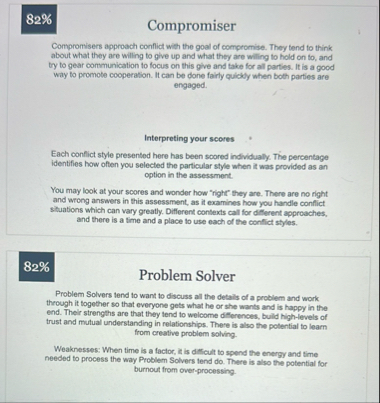
Question: 8 2 % Compromiser Compromisers approach conflict with the goal of compromise. They tend to think about what they are willing to give up and
Compromiser
Compromisers approach conflict with the goal of compromise. They tend to think about what they are willing to give up and what they are willing to hold on to and try to gear communication to focus on this give and take for all parties. It is a good way to promote cooperation. It can be done fairly quickly when both porties are engaged.
Interpreting your scores
Each confict style presented here has been scored individually. The percentage identifies how often you selected the particular style when it was provided as an option in the assessment.
You may look at your scores and wonder how "right" they are. There are no right and wrong answers in this assessment, as it examines how you handle conflict situations which can vary greatly. Different contexts call for different approaches, and there is a time and a place to use each of the conflict styles.
Problem Solver
Problem Solvers tend to want to discuss all the details of a problem and work through it together so that everyone gets what he or she wants and is happy in the end. Their strengths are that they tend to weicome differences, buld highlevels of trust and mutual understanding in relationships. There is also the potential to learn from creative problem solving.
Weaknesses: When time is a factor, it is diffeut to spend the energy and time needed to process the way Problem Solvers tend do There is also the potential for burnout from overprocessing.Each confict style presented here has been scored individually. The percentage identifies how offen you selected the particular style when it was provided as an option in the assessment.
You mary look at your scores and wonder how "right" they are. There are no right and wrong answers in this assessment, as it examines how you handle conflict situations which can vary greatly. Different confexts call for different approaches, and there is a time and a place to use each of the contict styles.
Avoider
Avoiders tend to step away from conflict. They often keep their opinions to themselves in conflict sibuations so as not to continue or escalate the contict. They are often admired for having a calming, quiet presence in the face of crisis.
Weaknesses: Avoiders sometimes keep their feelings bottled up and then aren't able to meet their own needs. This can result in a frustrating buldup of emotions.
Interpreting your scores
Each conflict style presented here has been scored individually. The percentage identifies how often you selected the particular style when it was provided as an option in the assessment.
You may look at your scores and wonder how "right" they are. There are no right and wrong answers in this assessment, as it examines how you handle conflict situations which can vary greatly. Different contexts cal for different approaches, and there is a time and a place to use each of the contict atyles
Accommodator
Accommodators have a harmonizing approach to contlict. They often focus on supporting others in a conflict situation and are adept at placating people in uncomfortable situations. Accommodators often gain strong appreciation from others involved in conflict.
Weaknesses: Accommodators may build up resentment from denying their own needs. It also may be difficult for those who want to get to the root of the problem to work with Accommodators who tend to focus on making others happy.
Interpreting your scores
Each conflict style presented here has been scored individually. The percentage identifies how often you selected the particular style when it was provided as an option in the assessment.
You may look at your scores and wonder how "right" they are. There are no right and wrong answers in this assessment, as it examines how you handle conflict situations which can vary greatly. Different contexts call for different approaches. and there is a time and a place to use each of the contlict styles.
Competer
Competers are known for being persuasive and direct. They know the result they want in a conflict situation, and they go for it Their strengths are that they are often passionate about their views and dedicated to pursuing their convictions. Competers are good at making quick decisions, and tend not to waste time, which is especially helphul in the time of crisis.
Weaknesses: Sometimes Competers wind up with unequal relationships with others, and feelings of others can be hut or overlooked with their decisionmaking style.Interpreting your scores
Each confict style presented here has been scored indiflually. The percentage identifies how often you selected the particular style when it was provided as an option in the assessment.
You may look at your sceres and wonder how "right" they are. There are no right and wrong answers in this assessment, as it examines how you handle conflict siluations which can vary greatly. Dfferent contexts call for different approaches, and there is a time and a place to use eac
Step by Step Solution
There are 3 Steps involved in it
1 Expert Approved Answer
Step: 1 Unlock

Question Has Been Solved by an Expert!
Get step-by-step solutions from verified subject matter experts
Step: 2 Unlock
Step: 3 Unlock