





Question: 8 a In the EOQ model, if no quantity discounts are allowed, then the unit purchase price of the materials is constant because it is
8 a In the EOQ model, if no quantity discounts

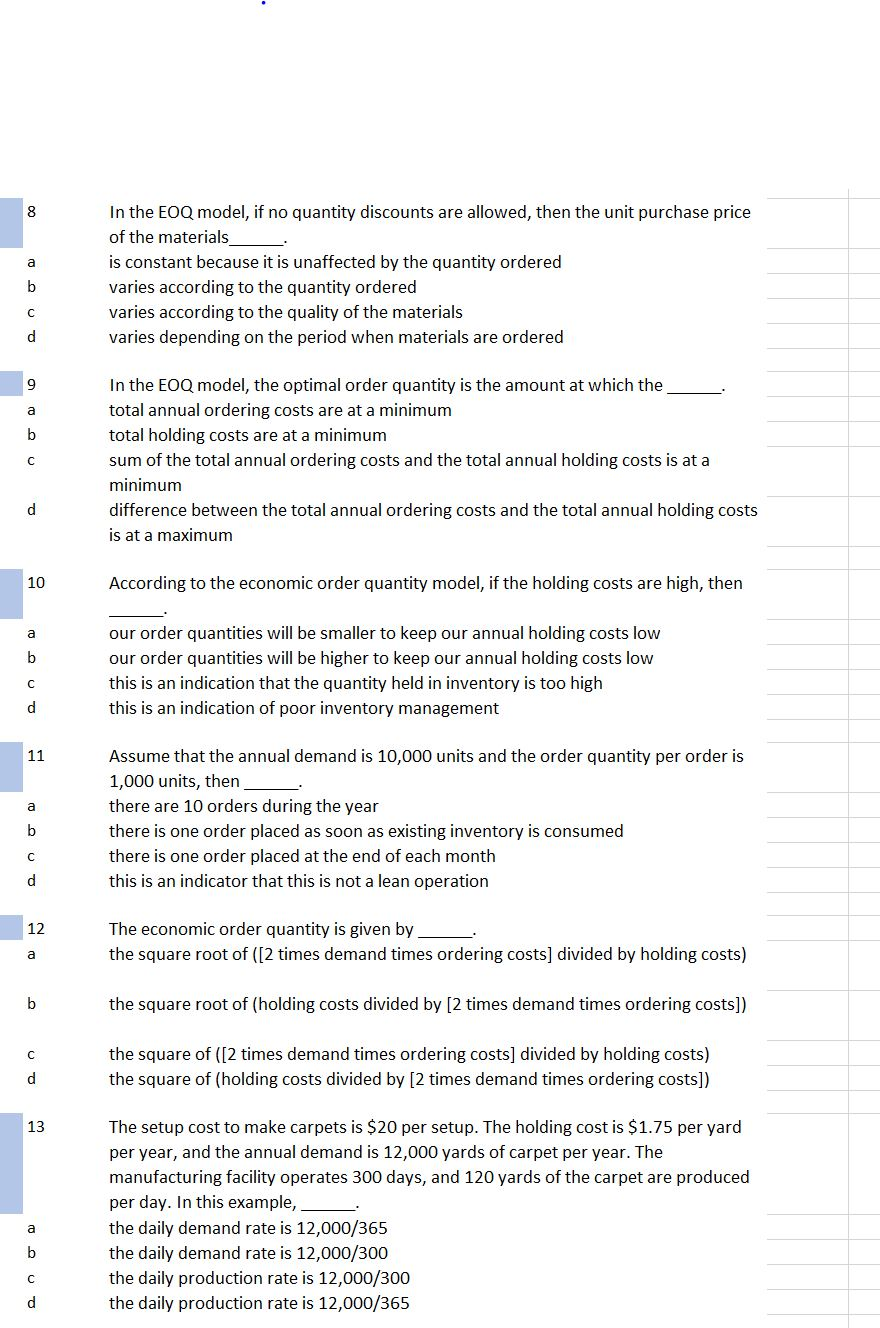
8 a In the EOQ model, if no quantity discounts are allowed, then the unit purchase price of the materials is constant because it is unaffected by the quantity ordered varies according to the quantity ordered varies according to the quality of the materials varies depending on the period when materials are ordered b d 9 a b In the EOQ model, the optimal order quantity is the amount at which the total annual ordering costs are at a minimum total holding costs are at a minimum sum of the total annual ordering costs and the total annual holding costs is at a minimum difference between the total annual ordering costs and the total annual holding costs is at a maximum d 10 According to the economic order quantity model, if the holding costs are high, then a b our order quantities will be smaller to keep our annual holding costs low our order quantities will be higher to keep our annual holding costs low this is an indication that the quantity held in inventory is too high this is an indication of poor inventory management d 11 a Assume that the annual demand is 10,000 units and the order quantity per order is 1,000 units, then there are 10 orders during the year there is one order placed as soon as existing inventory is consumed there is one order placed at the end of each month this is an indicator that this is not a lean operation b d 12 The economic order quantity is given by the square root of ([2 times demand times ordering costs] divided by holding costs) a b the square root of (holding costs divided by [2 times demand times ordering costs]) the square of ([2 times demand times ordering costs] divided by holding costs) the square of (holding costs divided by [2 times demand times ordering costs]) d 13 The setup cost to make carpets is $20 per setup. The holding cost is $1.75 per yard per year, and the annual demand is 12,000 yards of carpet per year. The manufacturing facility operates 300 days, and 120 yards of the carpet are produced per day. In this example, the daily demand rate is 12,000/365 the daily demand rate is 12,000/300 the daily production rate is 12,000/300 the daily production rate is 12,000/365 a b d

Step by Step Solution

There are 3 Steps involved in it

1 Expert Approved Answer
Step: 1 Unlock blur-text-image

Question Has Been Solved by an Expert!

Get step-by-step solutions from verified subject matter experts

Step: 2 Unlock
Step: 3 Unlock

Students Have Also Explored These Related General Management Questions!