



Question: 8. Graphs with Discrete or Continuous Domains and Ranges. For a given graph, the domain can be discrete or continuous depending on the context. Likewise,
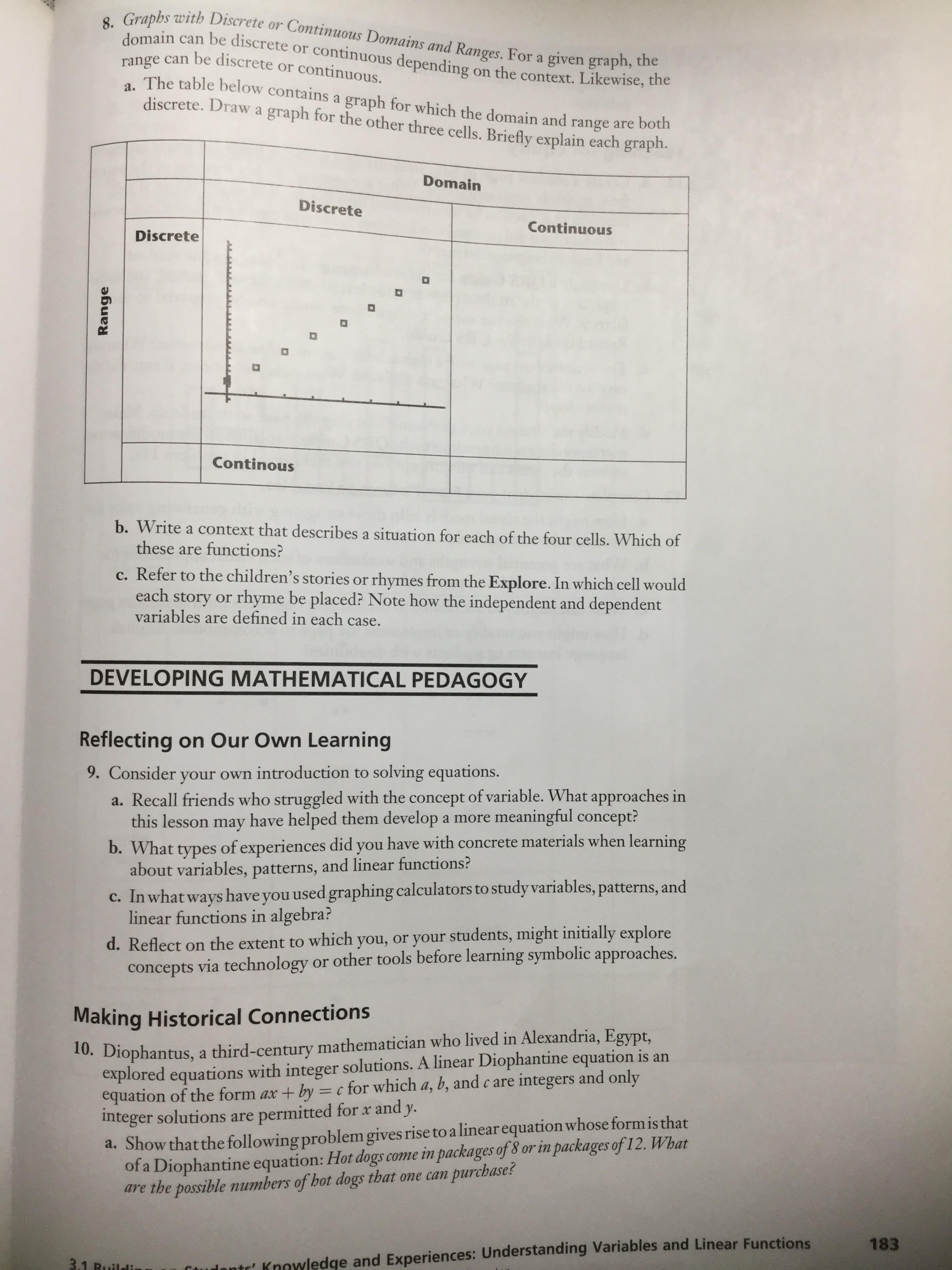
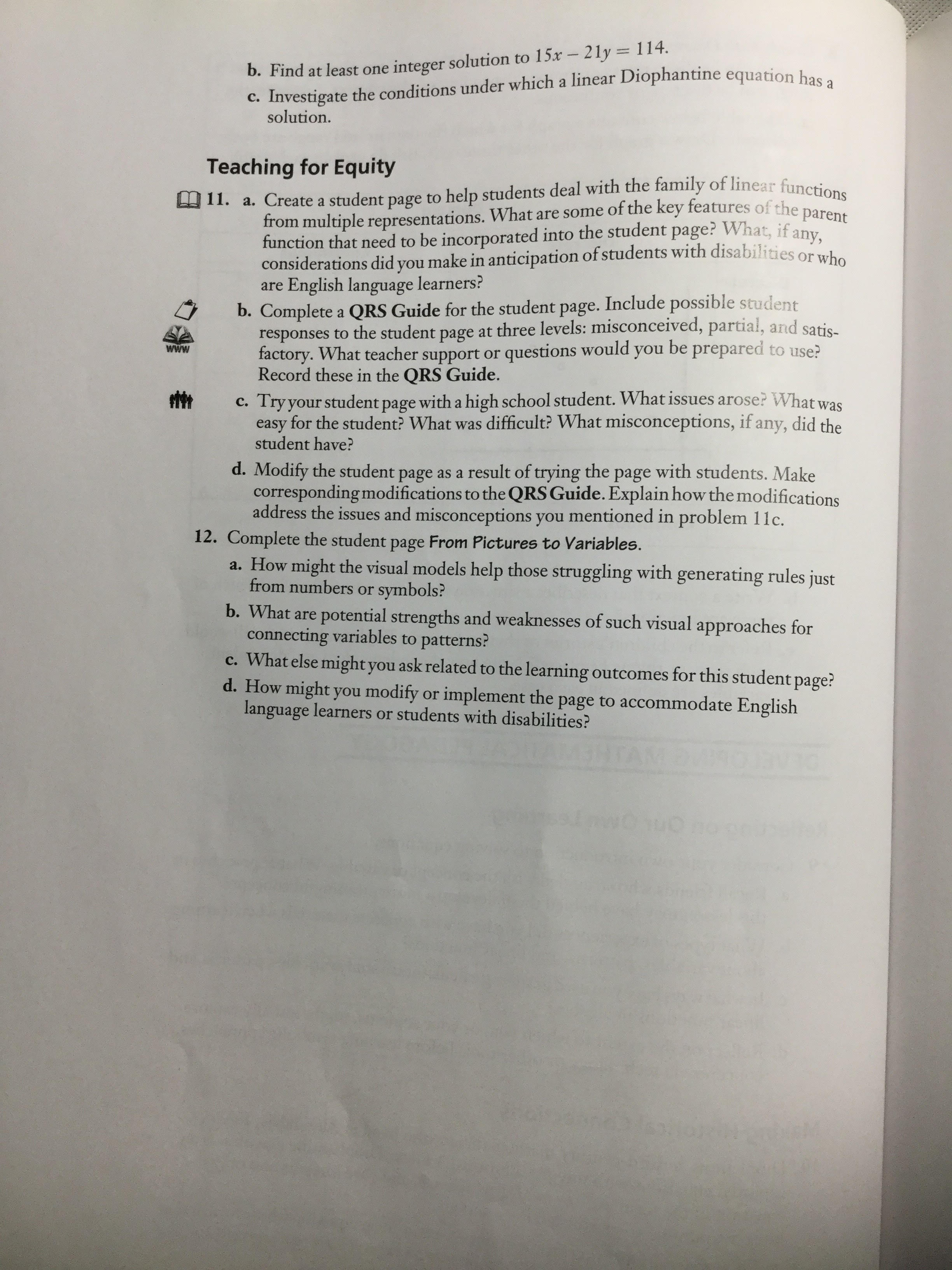
8. Graphs with Discrete or Continuous Domains and Ranges. For a given graph, the domain can be discrete or continuous depending on the context. Likewise, the range can be discrete or continuous. a. The table below contains a graph for which the domain and range are both discrete. Draw a graph for the other three cells. Briefly explain each graph. Domain Discrete Discrete Continuous Range Continous b. Write a context that describes a situation for each of the four cells. Which of these are functions? c. Refer to the children's stories or rhymes from the Explore. In which cell would each story or rhyme be placed? Note how the independent and dependent variables are defined in each case. DEVELOPING MATHEMATICAL PEDAGOGY Reflecting on Our Own Learning 9. Consider your own introduction to solving equations. a. Recall friends who struggled with the concept of variable. What approaches in this lesson may have helped them develop a more meaningful concept? b. What types of experiences did you have with concrete materials when learning about variables, patterns, and linear functions? c. In what ways have you used graphing calculators to study variables, patterns, and linear functions in algebra? d. Reflect on the extent to which you, or your students, might initially explore concepts via technology or other tools before learning symbolic approaches. Making Historical Connections 10. Diophantus, a third-century mathematician who lived in Alexandria, Egypt, explored equations with integer solutions. A linear Diophantine equation is an equation of the form ax + by = c for which a, b, and c are integers and only integer solutions are permitted for x and y. a. Show that the following problem gives rise to a linear equation whose form is that of a Diophantine equation: Hot dogs come in packages of 8 or in packages of 12. What are the possible numbers of hot dogs that one can purchase? dge and Experiences: Understanding Variables and Linear Functions 183b. Find at least one integer solution to 15x - 2ly = 114. C. Investigate the conditions under which a linear Diophantine equation solution. Teaching for Equity 11. a. Create a student page to help students deal with the family of linear functions from multiple representations. What are some of the key features of the parent function that need to be incorporated into the student page? What, if any, considerations did you make in anticipation of students with disabilities or who are English language learners? b. Complete a QRS Guide for the student page. Include possible student responses to the student page at three levels: misconceived, partial, and satis- factory. What teacher support or questions would you be prepared to use? Record these in the QRS Guide. ritt c. Try your student page with a high school student. What issues arose? What was student have? easy for the student? What was difficult? What misconceptions, if any, did the d. Modify the student page as a result of trying the page with students. Make corresponding modifications to the QRS Guide. Explain how the modifications address the issues and misconceptions you mentioned in problem 11c. 12. Complete the student page From Pictures to Variables. a. How might the visual models help those struggling with generating rules just from numbers or symbols? b. What are potential strengths and weaknesses of such visual approaches for connecting variables to patterns? c. What else might you ask related to the learning outcomes for this student page? d. How might you modify or implement the page to accommodate English language learners or students with disabilities
Step by Step Solution
There are 3 Steps involved in it

Get step-by-step solutions from verified subject matter experts