







Question: (8 pts) Consider the 2D system of linear ODEs defined by $ = AT, where a = ($1, (2) and A = Here a and
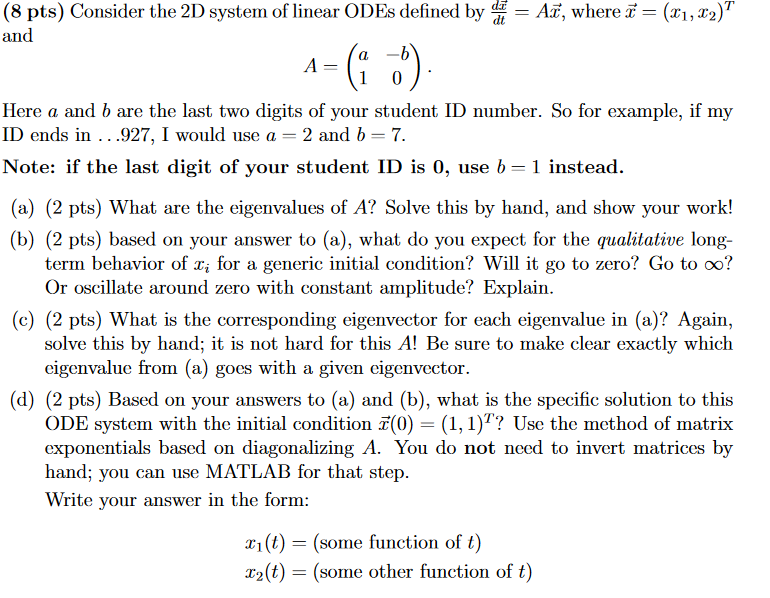
(8 pts) Consider the 2D system of linear ODEs defined by $ = AT, where a = ($1, (2)" and A = Here a and b are the last two digits of your student ID number. So for example, if my ID ends in . . .927, I would use a = 2 and b = 7. Note: if the last digit of your student ID is 0, use b = 1 instead. (a) (2 pts) What are the eigenvalues of A? Solve this by hand, and show your work! (b) (2 pts) based on your answer to (a), what do you expect for the qualitative long- term behavior of ; for a generic initial condition? Will it go to zero? Go to co? Or oscillate around zero with constant amplitude? Explain. (c) (2 pts) What is the corresponding eigenvector for each eigenvalue in (a)? Again, solve this by hand; it is not hard for this A! Be sure to make clear exactly which eigenvalue from (a) goes with a given eigenvector. (d) (2 pts) Based on your answers to (a) and (b), what is the specific solution to this ODE system with the initial condition (0) = (1, 1)"? Use the method of matrix exponentials based on diagonalizing A. You do not need to invert matrices by hand; you can use MATLAB for that step. Write your answer in the form: c1 (t) = (some function of t) X2(t) = (some other function of t)
Step by Step Solution
There are 3 Steps involved in it

Get step-by-step solutions from verified subject matter experts
 Study Help