







Question: 8. True/false: Ex ante (meaning before we know which MB is correct), the town should prefer a tax because marginal cost is relatively steep compared
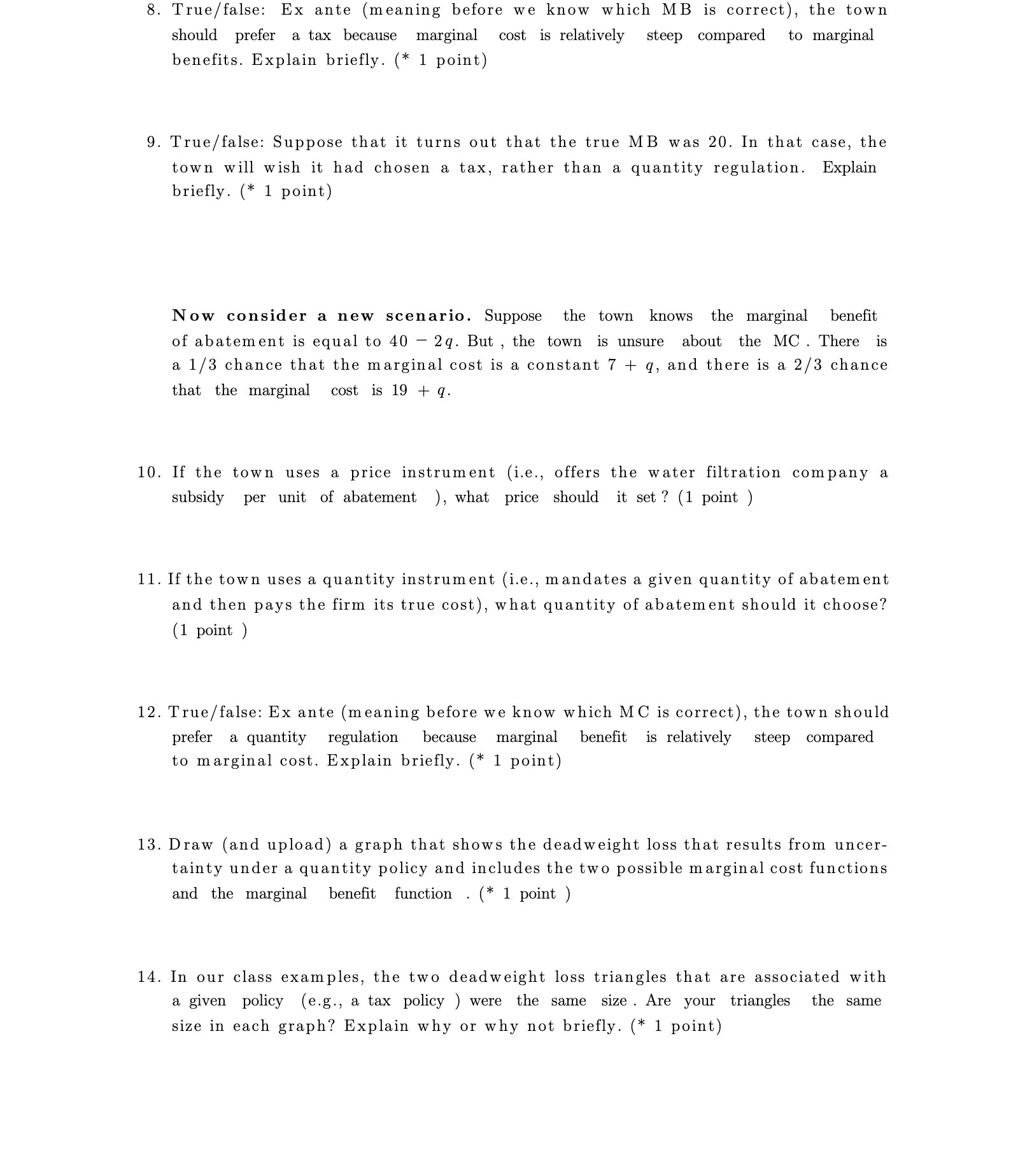
8. True/false: Ex ante (meaning before we know which MB is correct), the town should prefer a tax because marginal cost is relatively steep compared to marginal benefits. Explain briefly. (* 1 point) 9. True/false: Suppose that it turns out that the true MB was 20. In that case7 the 10. 11 12 13 14 town will wish it had chosen a tax, rather than a quantity regulation. Explain briefly. (* 1 point) Now consider a new scenario. Suppose the town knows the marginal benefit of abatement is equal to 40 7 2g. But 7 the town is unsure about the MC . There is a 1/3 chance that the marginal cost is a constant 7 + q, and there is a 2/3 chance that the marginal cost is 19 + 9'. If the town uses a price instrument (i.e., offers the water filtration company a subsidy per unit of abatement ), what price should it set '? (1 point ) . If the town uses a quantity instrument (i.e., mandates a given quantity of abatement and then pays the firm its true cost), what quantity of abatement should it choose? (1 point ) .True/false: Ex ante (meaning before we know which MC is correct), the town should prefer a quantity regulation because marginal benet is relatively steep compared to marginal cost. Explain briefly. (* 1 point) . Draw (and upload) a graph that shows the deadweight loss that results from uncer- tainty under a quantity policy and includes the two possible marginal cost functions and the marginal benefit function . (* 1 point ) . In our class examples, the two deadweight loss triangles that are associated with a given policy (e.g., a tax policy ) were the same size. Are your triangles the same size in each graph? Explain why or why not briefly. (* 1 point)
Step by Step Solution
There are 3 Steps involved in it

Get step-by-step solutions from verified subject matter experts
 Study Help