







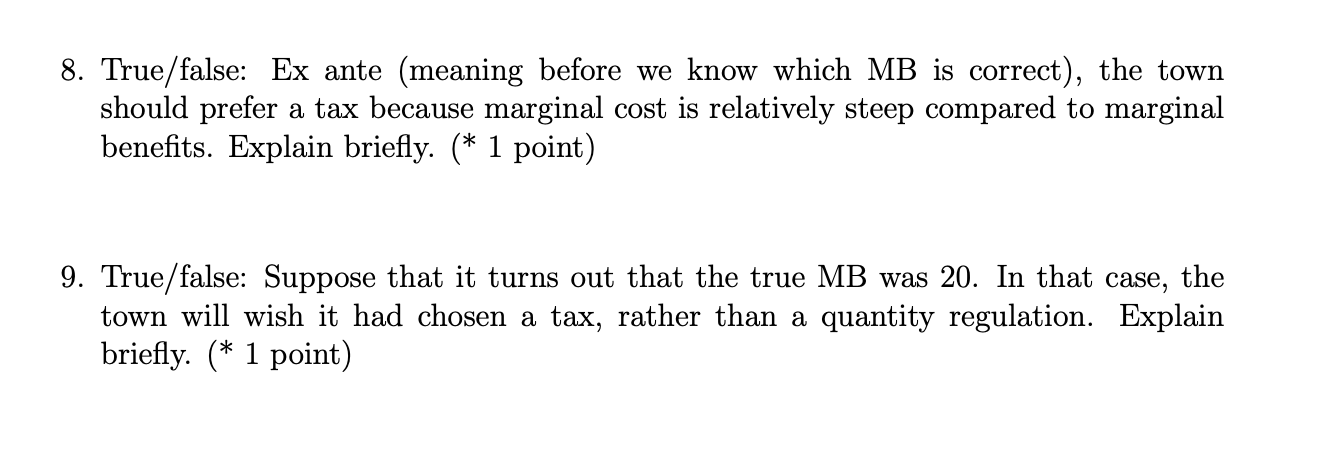
Question: Question 2: 8. True/false: Ex ante (meaning before we know which MB is correct), the town should prefer a tax because marginal cost is relatively
Question 2:
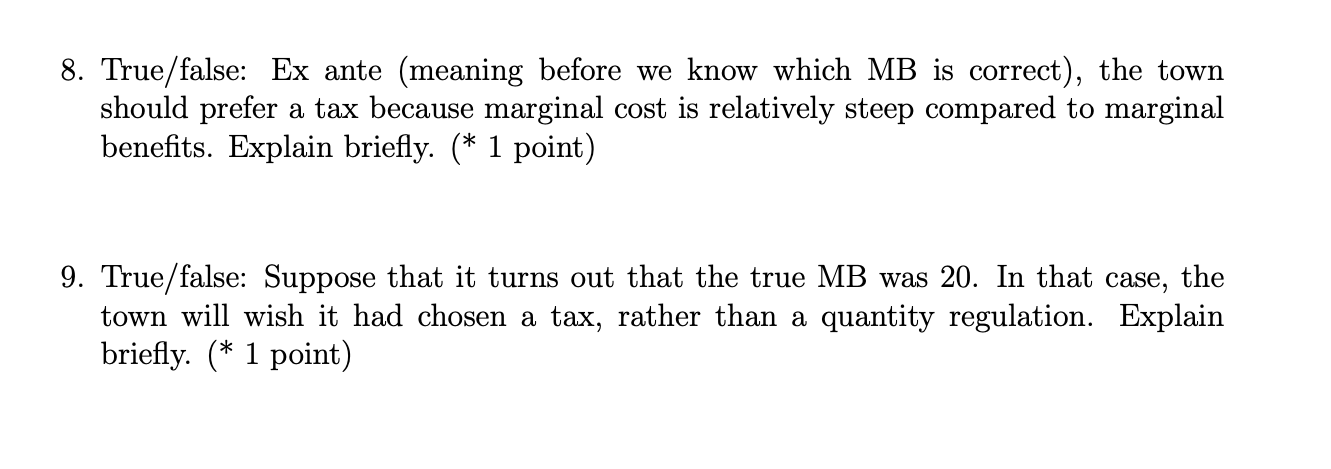
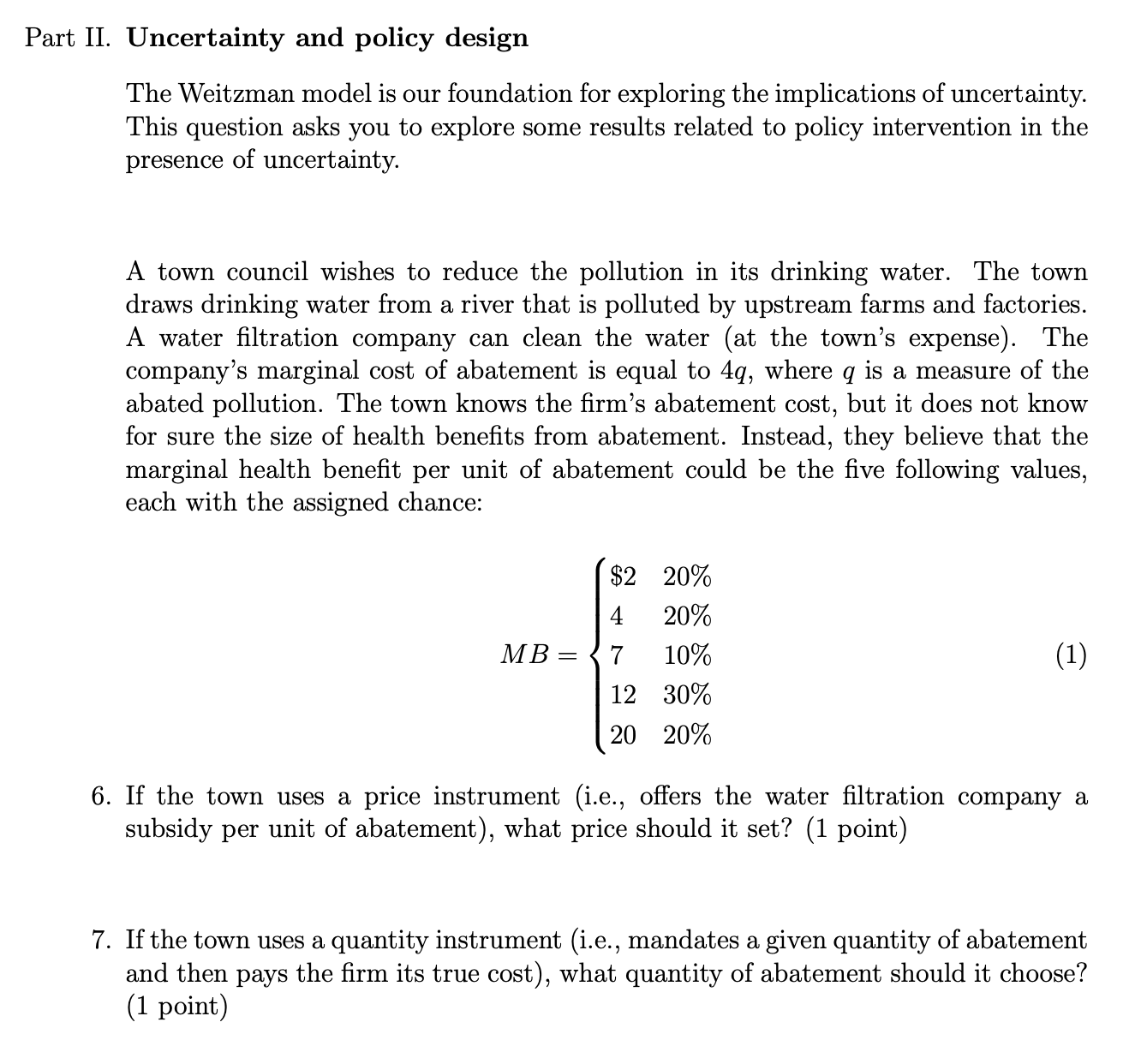
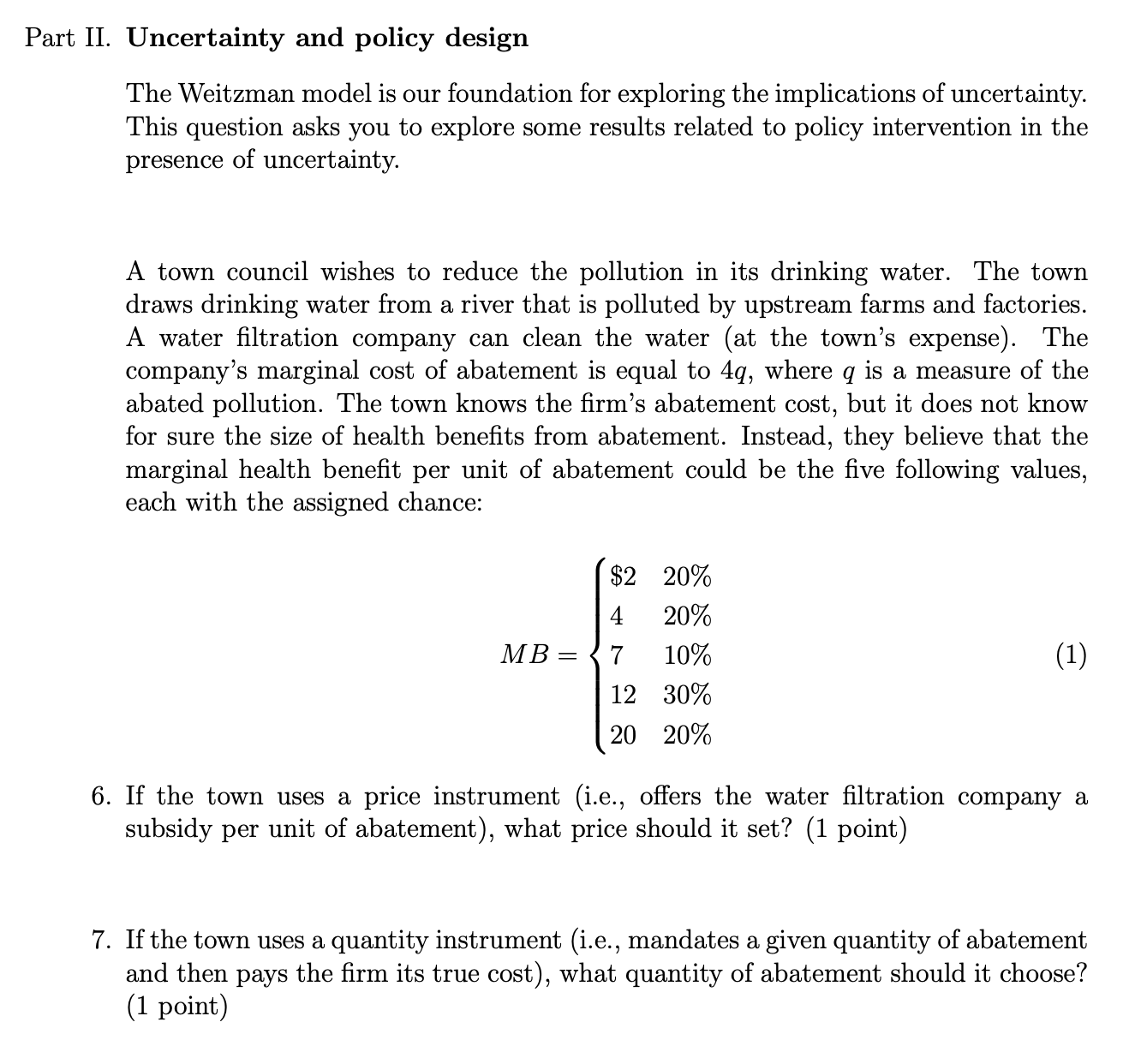
8. True/false: Ex ante (meaning before we know which MB is correct), the town should prefer a tax because marginal cost is relatively steep compared to marginal benets. Explain briey. (* 1 point) 9. True/false: Suppose that it turns out that the true MB was 20. In that case, the town will wish it had chosen a tax, rather than a quantity regulation. Explain briey. (* 1 point) Part II. Uncertainty and policy design The Weitzman model is our foundation for exploring the implications of uncertainty. This question asks you to explore some results related to policy intervention in the presence of uncertainty. A town council wishes to reduce the pollution in its drinking water. The town draws drinking water from a river that is polluted by upstream farms and factories. A water ltration company can clean the water (at the town's expense). The company's marginal cost of abatement is equal to 4g, where q is a measure of the abated pollution. The town knows the rm's abatement cost, but it does not know for sure the size of health benets from abatement. Instead, they believe that the marginal health benet per unit of abatement could be the ve following values, each with the assigned chance: $2 20% 4 20% MB: 7 10% (1) 12 30% 20 20% 6. If the town uses a price instrument (i.e., offers the water ltration company a subsidy per unit of abatement), what price should it set? (1 point) 7. If the town uses a quantity instrument (i.e., mandates a given quantity of abatement and then pays the rm its true cost), what quantity of abatement should it choose? (1 point)
Step by Step Solution
There are 3 Steps involved in it

Get step-by-step solutions from verified subject matter experts
 Study Help