







Question: 8.18. In Example 8.5. (a) How long does it take the particle to come to zero velocity? (b) How long does it take the particle
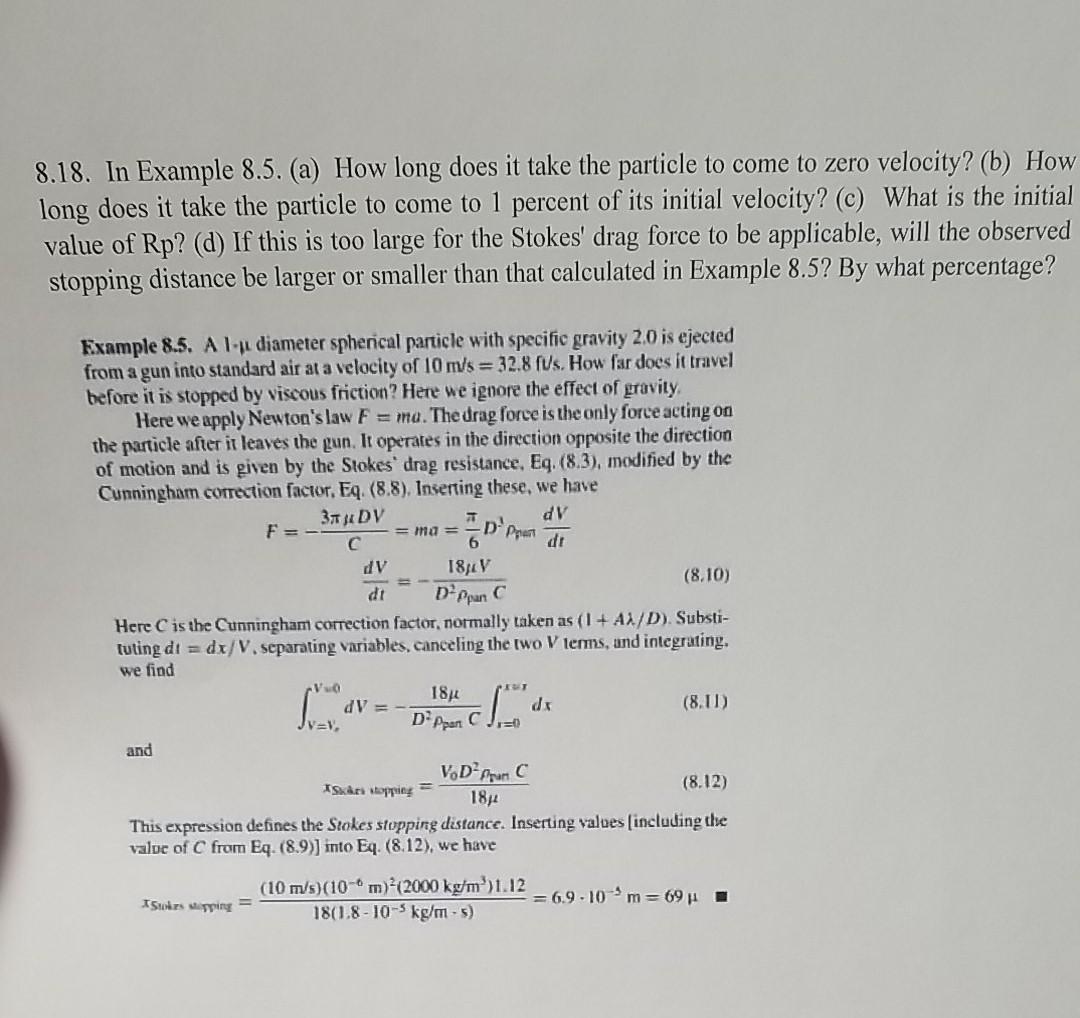
8.18. In Example 8.5. (a) How long does it take the particle to come to zero velocity? (b) How long does it take the particle to come to 1 percent of its initial velocity? (C) What is the initial value of Rp? (d) If this is too large for the Stokes' drag force to be applicable, will the observed stopping distance be larger or smaller than that calculated in Example 8.5? By what percentage? Example 8.5. A 1-1 diameter spherical particle with specific gravity 2.0 is ejected from a gun into standard air at a velocity of 10 m/s = 32.8 fus. How far does it travel before it is stopped by viscous friction? Here we ignore the effect of gravity Here we apply Newton's law F = ma. The drag force is the only force acting on the particle after it leaves the gun. It operates in the direction opposite the direction of motion and is given by the Stokes' drag resistance, Eq. (8.3), modified by the Cunningham correction factor, Eq. (8.8). Inserting these, we have dV F =- C dt dv 18,1V (8.10) dt D Ppan C Here is the Cunningham correction factor, normally taken as (1 + A1/D). Substi- tuting dt = dx/V separating variables, canceling the two V terms, and integrating, -D Pour = ma = we find 1814 S dV= FUT dx (8.1) D and VoD from C Skars stopping (8.12) 1841 This expression defines the Stokes stopping distance. Inserting values (including the value of C from Eq. (8.9) into Eq. (8.12), we have (10 m/s)(10 m) (2000 km') 1.12 = 6.9.10?m=09 Stors wyping 18(1.8 - 10-5 kg/m - 5)
Step by Step Solution
There are 3 Steps involved in it

Get step-by-step solutions from verified subject matter experts
 Study Help