







Question: 9 . 8 LAB: Support Vector Machines ( SVM ) for classification The Moons dataset consists of two features and one class label for 1
LAB: Support Vector Machines SVM for classification
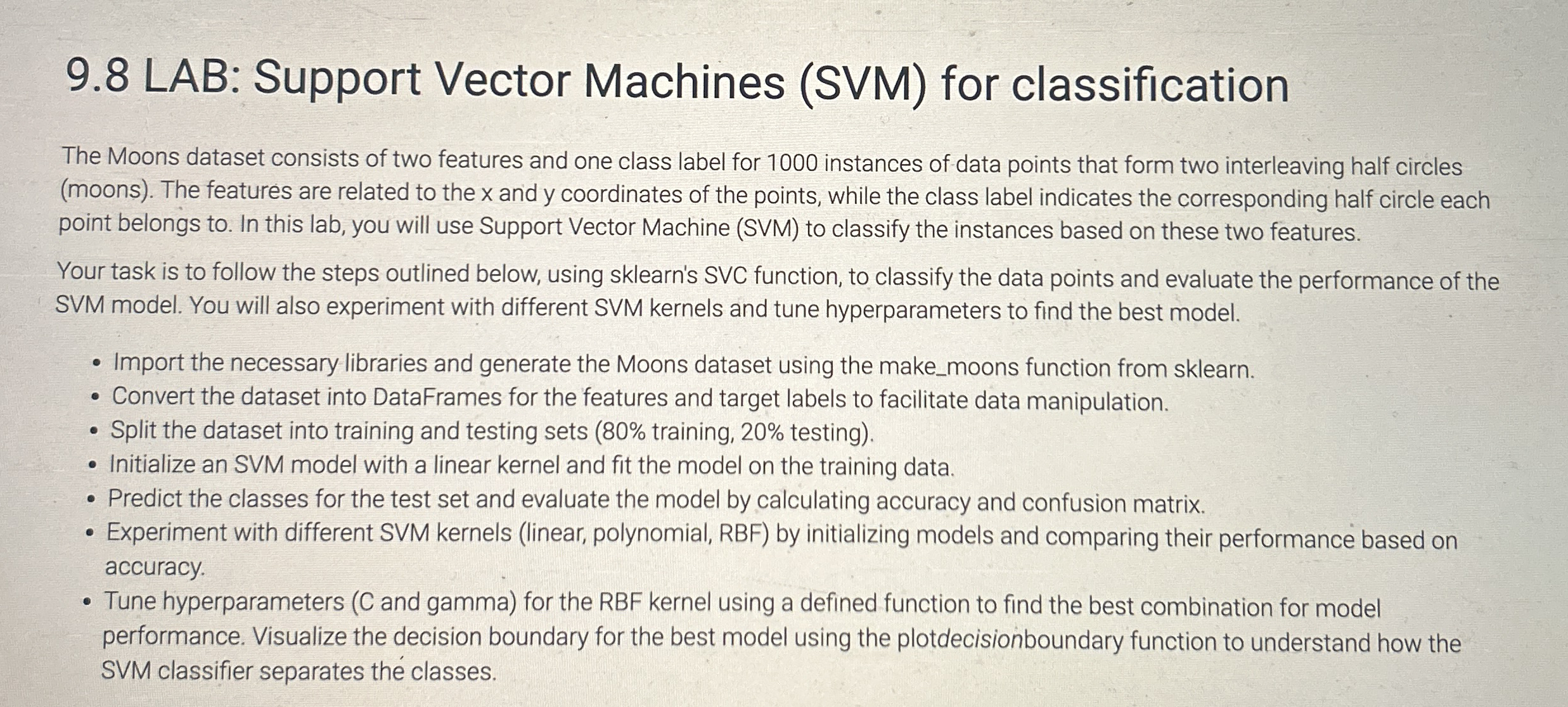
The Moons dataset consists of two features and one class label for instances of data points that form two interleaving half circles moons The features are related to the and coordinates of the points, while the class label indicates the corresponding half circle each point belongs to In this lab, you will use Support Vector Machine SVM to classify the instances based on these two features.
Your task is to follow the steps outlined below, using sklearn's SVC function, to classify the data points and evaluate the performance of the SVM model. You will also experiment with different SVM kernels and tune hyperparameters to find the best model.
Import the necessary libraries and generate the Moons dataset using the makemoons function from sklearn.
Convert the dataset into DataFrames for the features and target labels to facilitate data manipulation.
Split the dataset into training and testing sets training, testing
Initialize an SVM model with a linear kernel and fit the model on the training data.
Predict the classes for the test set and evaluate the model by calculating accuracy and confusion matrix.
Experiment with different SVM kernels linear polynomial, RBF by initializing models and comparing their performance based on accuracy.
Tune hyperparameters C and gamma for the RBF kernel using a defined function to find the best combination for model performance. Visualize the decision boundary for the best model using the plotdecisionboundary function to understand how the SVM classifier separates the classes.
Step by Step Solution
There are 3 Steps involved in it
1 Expert Approved Answer
Step: 1 Unlock

Question Has Been Solved by an Expert!
Get step-by-step solutions from verified subject matter experts
Step: 2 Unlock
Step: 3 Unlock
 Study Help