







Question: 9. For each cost function below, give the specified complexity estimate (tightest possible bounds): Give big-O for: Give big-Omega for: Give big-O for: Give big-Omega
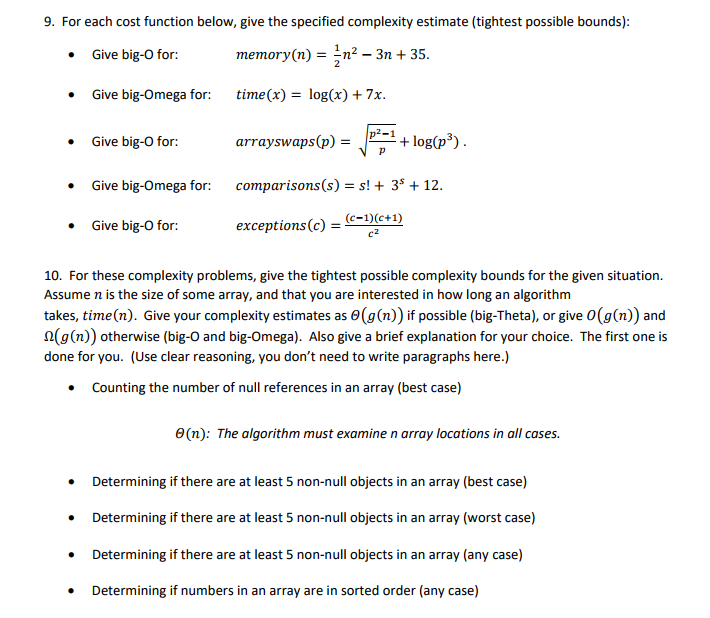
9. For each cost function below, give the specified complexity estimate (tightest possible bounds): Give big-O for: Give big-Omega for: Give big-O for: Give big-Omega for: Give big-O for: memory(n) = 2n2-3n + 35. time (x) = arrayswaps(p) comparisons(s) = s1+ 34 12. exceptions (c) = (c-1)(c+1) log(x) + 7x. p-1 +log(p3)- . c2 10. For these complexity problems, give the tightest possible complexity bounds for the given situation Assume n is the size of some array, and that you are interested in how long an algorithm takes, time (n). Give your complexity estimates as (g (n)) if possible (big-Theta), or give 0(g(n)) and 2(g(n)) otherwise (big-O and big-Omega). Also give a brief explanation for your choice. The first one is done for you. (Use clear reasoning, you don't need to write paragraphs here.) Counting the number of null references in an array (best case) 6(n): The algorithm must examine n array locations in all cases. Determining if there are at least 5 non-null objects in an array (best case) Determining if there are at least 5 non-null objects in an array (worst case) Determining if there are at least 5 non-null objects in an array (any case) Determining if numbers in an array are in sorted order (any case)
Step by Step Solution
There are 3 Steps involved in it
Lets analyze each part of the problem stepbystep Part 9 1 Memory Function textmemoryn frac12n2 3n 35 ... View full answer

Get step-by-step solutions from verified subject matter experts
 Study Help