







Question: ( 9 pts) Alkylated cyclohexanols are important intermediates in the fragrance and perfume industry. Recent work has focused on gas-phase catalyzed hydrogenation of o-cresol to
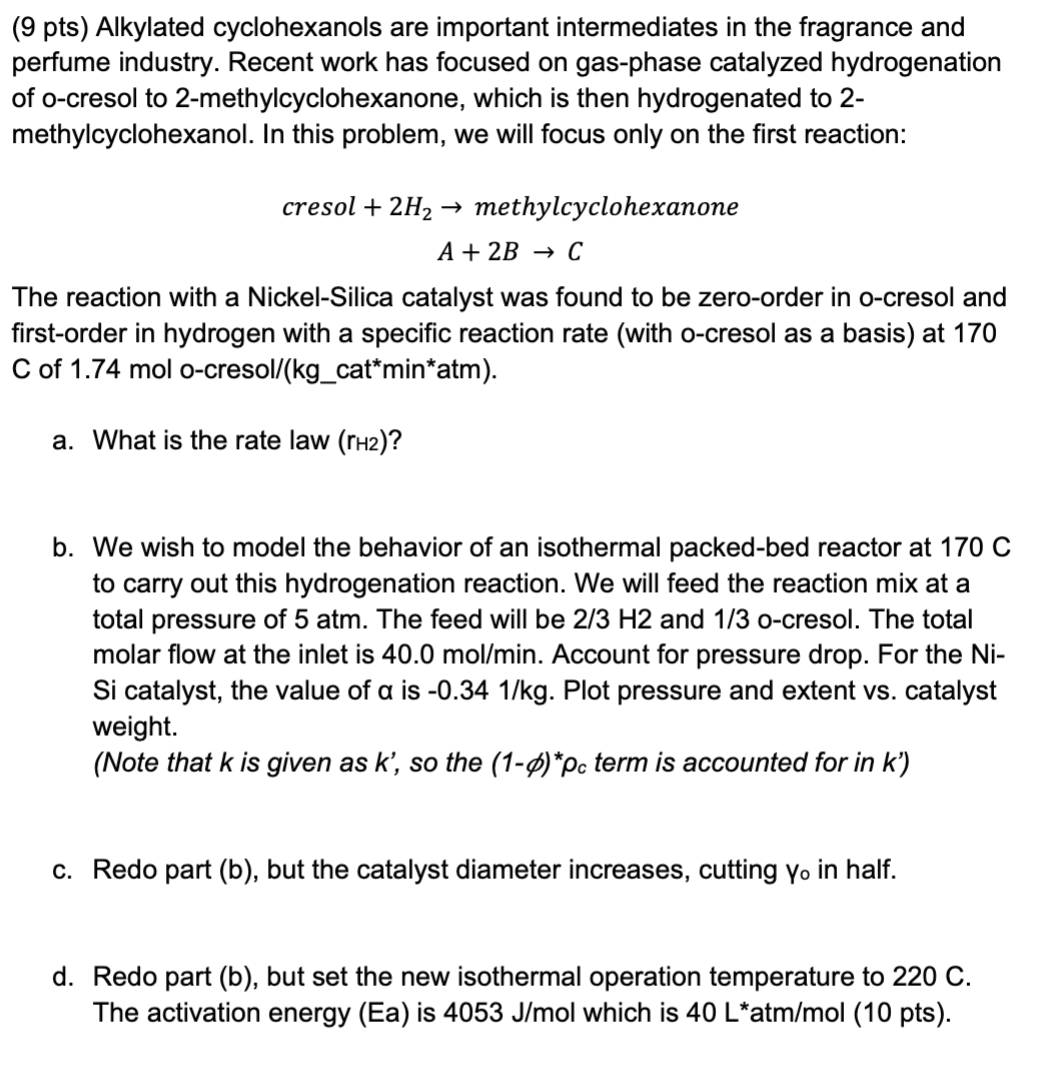
( 9 pts) Alkylated cyclohexanols are important intermediates in the fragrance and perfume industry. Recent work has focused on gas-phase catalyzed hydrogenation of o-cresol to 2-methylcyclohexanone, which is then hydrogenated to 2 methylcyclohexanol. In this problem, we will focus only on the first reaction: cresol+2H2methylcyclohexanoneA+2BC The reaction with a Nickel-Silica catalyst was found to be zero-order in o-cresol and first-order in hydrogen with a specific reaction rate (with o-cresol as a basis) at 170 C of 1.74 mol o-cresol/(kg_cat*min*atm). a. What is the rate law (rH2) ? b. We wish to model the behavior of an isothermal packed-bed reactor at 170C to carry out this hydrogenation reaction. We will feed the reaction mix at a total pressure of 5atm. The feed will be 2/3H2 and 1/3 o-cresol. The total molar flow at the inlet is 40.0mol/min. Account for pressure drop. For the Ni Si catalyst, the value of is 0.341/kg. Plot pressure and extent vs. catalyst weight. (Note that k is given as k, so the (1)c term is accounted for in k ) c. Redo part (b), but the catalyst diameter increases, cutting Yo in half. d. Redo part (b), but set the new isothermal operation temperature to 220C. The activation energy (Ea) is 4053J/mol which is 40Latm/mol (10 pts). ( 9 pts) Alkylated cyclohexanols are important intermediates in the fragrance and perfume industry. Recent work has focused on gas-phase catalyzed hydrogenation of o-cresol to 2-methylcyclohexanone, which is then hydrogenated to 2 methylcyclohexanol. In this problem, we will focus only on the first reaction: cresol+2H2methylcyclohexanoneA+2BC The reaction with a Nickel-Silica catalyst was found to be zero-order in o-cresol and first-order in hydrogen with a specific reaction rate (with o-cresol as a basis) at 170 C of 1.74 mol o-cresol/(kg_cat*min*atm). a. What is the rate law (rH2) ? b. We wish to model the behavior of an isothermal packed-bed reactor at 170C to carry out this hydrogenation reaction. We will feed the reaction mix at a total pressure of 5atm. The feed will be 2/3H2 and 1/3 o-cresol. The total molar flow at the inlet is 40.0mol/min. Account for pressure drop. For the Ni Si catalyst, the value of is 0.341/kg. Plot pressure and extent vs. catalyst weight. (Note that k is given as k, so the (1)c term is accounted for in k ) c. Redo part (b), but the catalyst diameter increases, cutting Yo in half. d. Redo part (b), but set the new isothermal operation temperature to 220C. The activation energy (Ea) is 4053J/mol which is 40Latm/mol (10 pts)
Step by Step Solution
There are 3 Steps involved in it

Get step-by-step solutions from verified subject matter experts
 Study Help