







Question: 9-6: Additional Funds Needed (AFN) Equation Method Problem 9-8 Financing Deficit Stevens Textile's 2015 financial statements are shown below: Balance Sheet as of December 31,
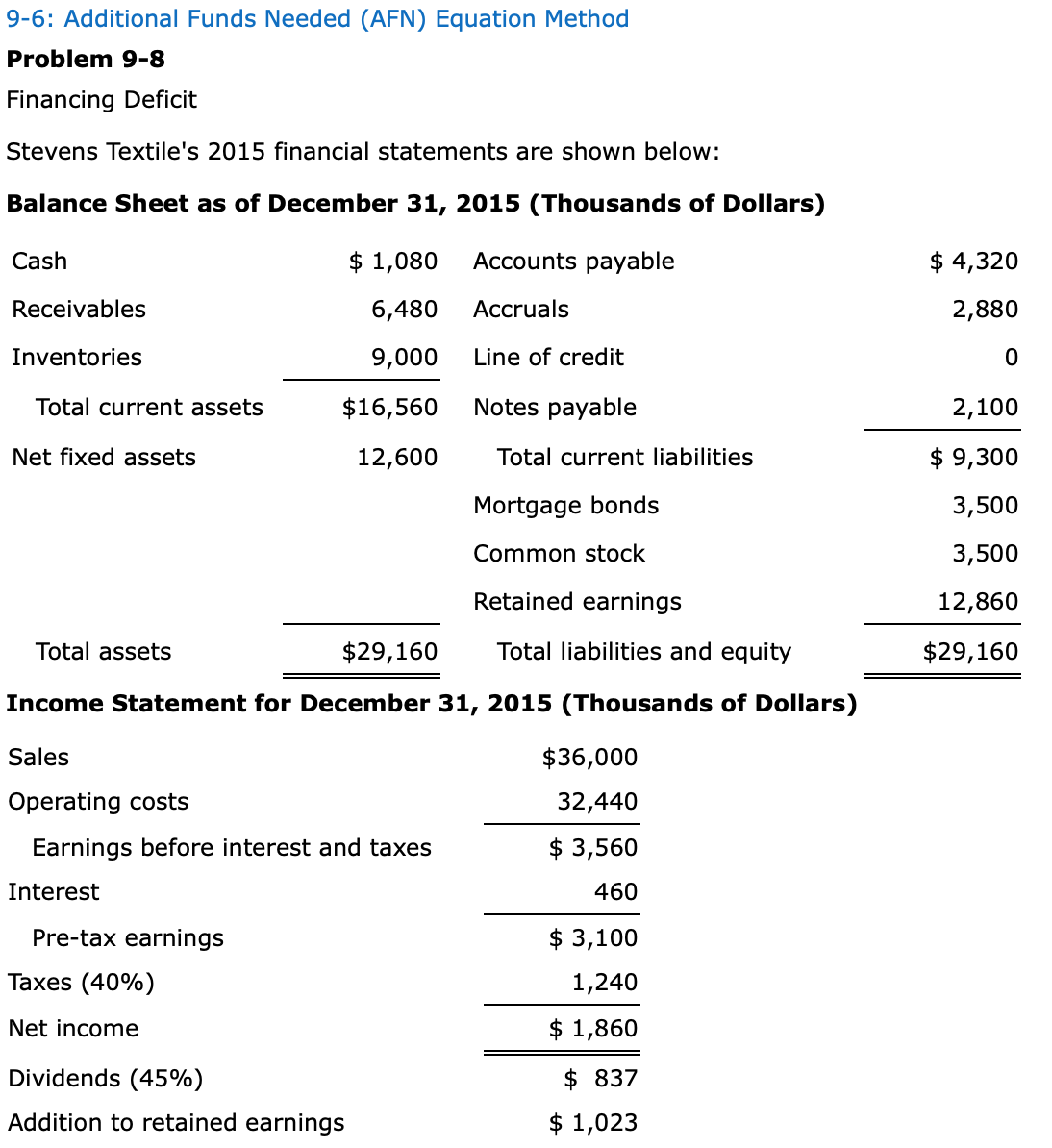
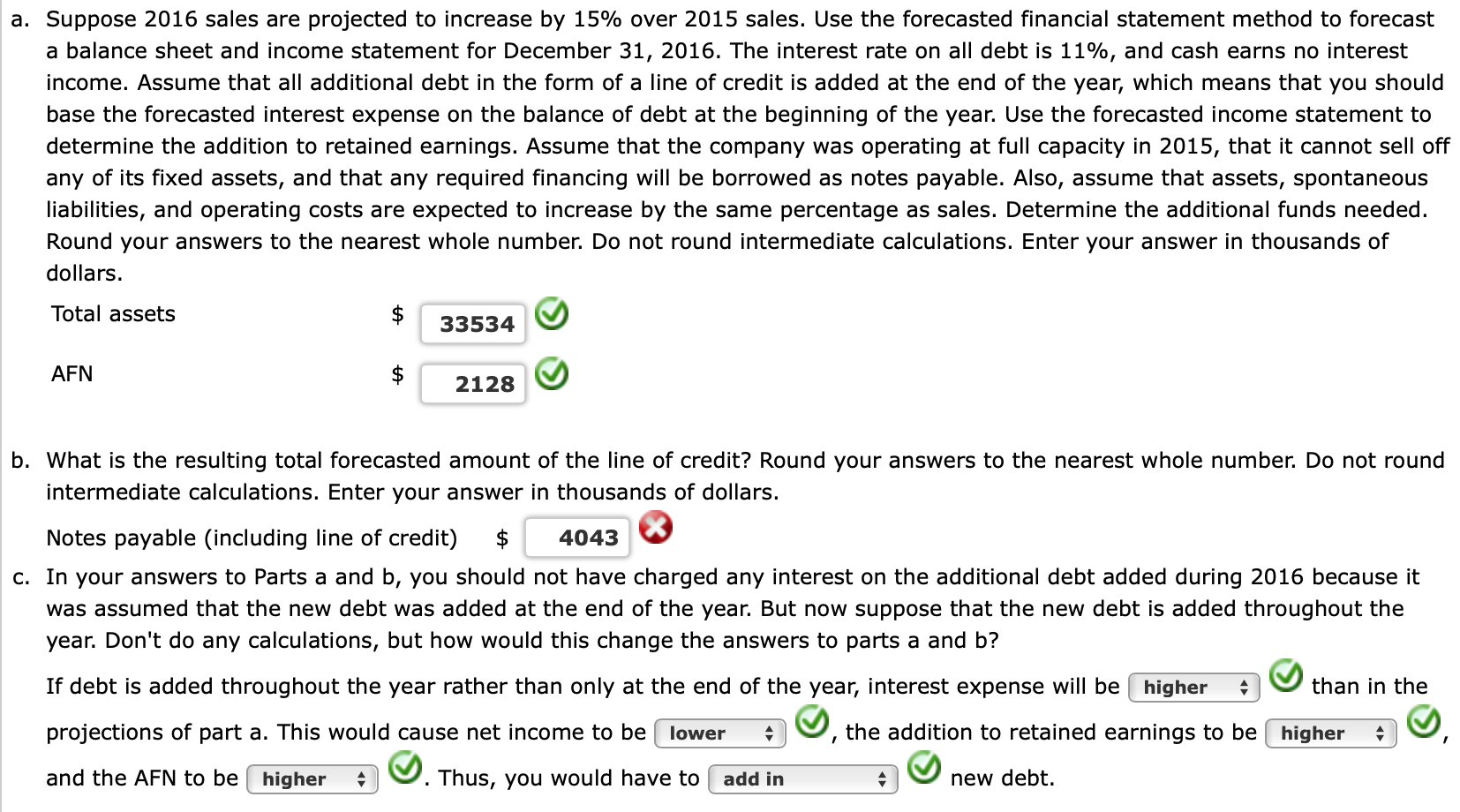
9-6: Additional Funds Needed (AFN) Equation Method Problem 9-8 Financing Deficit Stevens Textile's 2015 financial statements are shown below: Balance Sheet as of December 31, 2015 (Thousands of Dollars) Cash $ 1,080 Accounts payable $ 4,320 Receivables 6,480 Accruals 2,880 Inventories 9,000 Line of credit 0 Total current assets Notes payable 2,100 $16,560 12,600 Net fixed assets Total current liabilities $ 9,300 Mortgage bonds 3,500 Common stock 3,500 Retained earnings 12,860 Total assets $29,160 Total liabilities and equity $29,160 Income Statement for December 31, 2015 (Thousands of Dollars) Sales $36,000 32,440 Operating costs Earnings before interest and taxes $ 3,560 Interest 460 Pre-tax earnings Taxes (40%) $ 3,100 1,240 Net income $ 1,860 $ 837 Dividends (45%) Addition to retained earnings $ 1,023 a. Suppose 2016 sales are projected to increase by 15% over 2015 sales. Use the forecasted financial statement method to forecast a balance sheet and income statement for December 31, 2016. The interest rate on all debt is 11%, and cash earns no interest income. Assume that all additional debt in the form of a line of credit is added at the end of the year, which means that you should base the forecasted interest expense on the balance of debt at the beginning of the year. Use the forecasted income statement to determine the addition to retained earnings. Assume that the company was operating at full capacity in 2015, that it cannot sell off any of its fixed assets, and that any required financing will be borrowed as notes payable. Also, assume that assets, spontaneous liabilities, and operating costs are expected to increase by the same percentage as sales. Determine the additional funds needed. Round your answers to the nearest whole number. Do not round intermediate calculations. Enter your answer in thousands of dollars. Total assets 33534 AFN 2128 b. What is the resulting total forecasted amount of the line of credit? Round your answers to the nearest whole number. Do not round intermediate calculations. Enter your answer in thousands of dollars. Notes payable (including line of credit) $ 4043 c. In your answers to Parts a and b, you should not have charged any interest on the additional debt added during 2016 because it was assumed that the new debt was added at the end of the year. But now suppose that the new debt is added throughout the year. Don't do any calculations, but how would this change the answers to parts a and b? If debt is added throughout the year rather than only at the end of the year, interest expense will be higher than in the projections of part a. This would cause net income to be lower the addition to retained earnings to be higher and the AFN to be higher Thus, you would have to add in new debt
Step by Step Solution
There are 3 Steps involved in it

Get step-by-step solutions from verified subject matter experts
 Study Help