







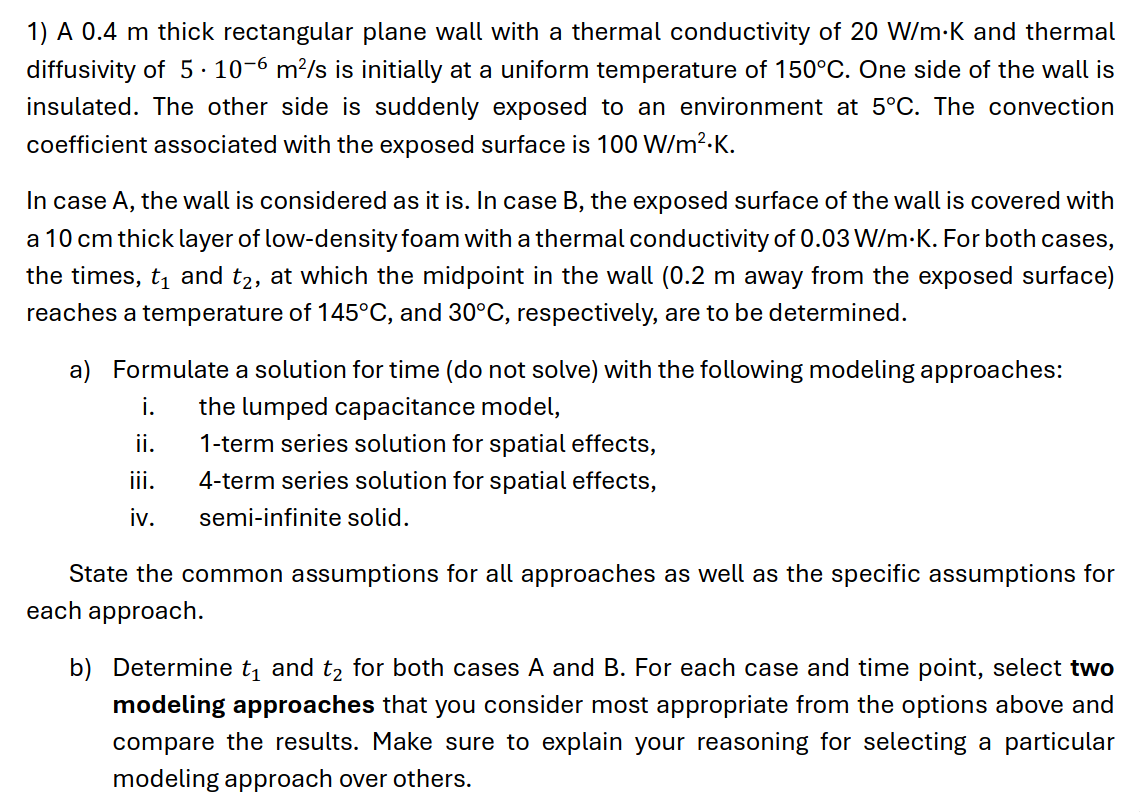
Question: A 0 . 4 m thick rectangular plane wall with a thermal conductivity of 2 0 W / / m * K and thermal diffusivity
A m thick rectangular plane wall with a thermal conductivity of WmK and thermal diffusivity of ms is initially at a uniform temperature of @C One side of the wall is
insulated. The other side is suddenly exposed to an environment at @C The convection
coefficient associated with the exposed surface is WmK
In case A the wall is considered as it is In case B the exposed surface of the wall is covered with
a cm thick layer of lowdensity foam with a thermal conductivity of WmK For both cases,
the times, t and t at which the midpoint in the wall m away from the exposed surface
reaches a temperature of @C and @C respectively, are to be determined.
a Formulate a solution for time do not solve with the following modeling approaches:
i the lumped capacitance model,
iiterm series solution for spatial effects,
iii. term series solution for spatial effects,
iv semiinfinite solid.
State the common assumptions for all approaches as well as the specific assumptions for
each approach.
b Determine t and t for both cases A and B For each case and time point, select two
modeling approaches that you consider most appropriate from the options above and
compare the results. Make sure to explain your reasoning for selecting a particular
modeling approach over others.
Step by Step Solution
There are 3 Steps involved in it
1 Expert Approved Answer
Step: 1 Unlock

Question Has Been Solved by an Expert!
Get step-by-step solutions from verified subject matter experts
Step: 2 Unlock
Step: 3 Unlock
 Study Help